QUESTION IMAGE
Question
part ii: symbol screen
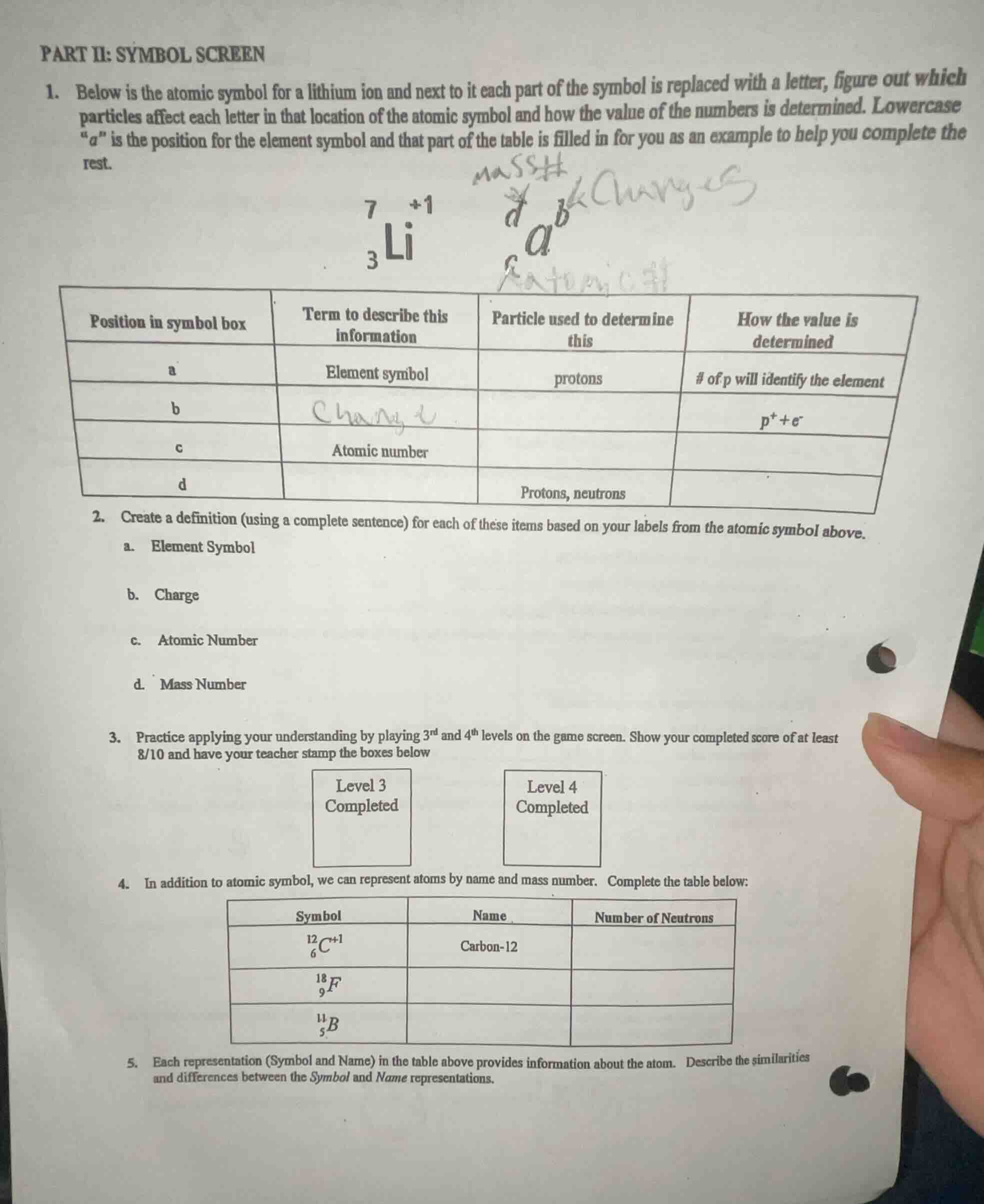
- below is the atomic symbol for a lithium ion and next to it each part of the symbol is replaced with a letter, figure out which particles affect each letter in that location of the atomic symbol and how the value of the numbers is determined. lowercase “a” is the position for the element symbol and that part of the table is filled in for you as an example to help you complete the rest.
(atomic symbol of li ion and table here)
- create a definition (using a complete sentence) for each of these items based on your labels from the atomic symbol above.
a. element symbol
b. charge
c. atomic number
d. mass number
- practice applying your understanding by playing 3rd and 4th levels on the game screen. show your completed score of at least 8/10 and have your teacher stamp the boxes below
(level 3 and level 4 boxes here)
- in addition to atomic symbol, we can represent atoms by name and mass number. complete the table below:
(table with symbol, name, number of neutrons)
- each representation (symbol and name) in the table above provides information about the atom. describe the similarities and differences between the symbol and name representations.
Step1: Complete Table 1 (Atomic Symbol Parts)
Position b:
Term: Charge
Particles: Protons ($p^+$) and electrons ($e^-$)
How value is determined: $\text{Charge} = p^+ - e^-$
Position c:
Term: Atomic number
Particles: Protons ($p^+$)
How value is determined: Equal to number of $p^+$
Position d:
Term: Mass number
Particles: Protons, neutrons
How value is determined: $\text{Mass number} = p^+ + n^0$
Step2: Write Definitions
a. Element Symbol:
A one or two-letter abbreviation that uniquely identifies a chemical element, based on the number of protons in its atoms.
b. Charge:
The net electrical charge of an ion, calculated by subtracting the number of electrons from the number of protons in the atom/ion.
c. Atomic Number:
The number of protons in the nucleus of an atom, which defines the identity of an element.
d. Mass Number:
The total number of protons and neutrons in the nucleus of a single atom, used to identify isotopes.
Step3: Complete Table 4 (Isotope Details)
Row 1: $\ce{^{12}_{6}C^{+1}}$
Number of neutrons: $12 - 6 = 6$
Row 2: $\ce{^{18}_{9}F}$
Name: Fluorine-18
Number of neutrons: $18 - 9 = 9$
Row 3: $\ce{^{11}_{5}B}$
Name: Boron-11
Number of neutrons: $11 - 5 = 6$
Step4: Compare Symbol and Name Representations
Similarities: Both identify the element and its mass number (to specify the isotope).
Differences: The atomic symbol includes the atomic number and ionic charge (if applicable), while the name representation only includes the element name and mass number, with no information about charge or atomic number.

Snap & solve any problem in the app
Get step-by-step solutions on Sovi AI
Photo-based solutions with guided steps
Explore more problems and detailed explanations
- Completed Atomic Symbol Table:
| Position in symbol box | Term to describe this information | Particle used to determine this | How the value is determined |
|---|---|---|---|
| b | Charge | protons, electrons | $\text{Charge} = p^+ - e^-$ |
| c | Atomic number | protons | Equal to number of $p^+$ |
| d | Mass number | Protons, neutrons | $\text{Mass number} = p^+ + n^0$ |
- Definitions:
a. Element Symbol: A unique one/two-letter code for an element, defined by its proton count.
b. Charge: The net electrical charge of an ion, found by subtracting electron count from proton count.
c. Atomic Number: The count of protons in an atom's nucleus, defining the element.
d. Mass Number: The total count of protons and neutrons in an atom's nucleus.
- (Note: This section requires in-game completion and teacher verification, no written answer provided here.)
- Completed Isotope Table:
| Symbol | Name | Number of Neutrons |
|---|---|---|
| $\ce{^{18}_{9}F}$ | Fluorine-18 | $9$ |
| $\ce{^{11}_{5}B}$ | Boron-11 | $6$ |
- Similarities & Differences:
- Similarities: Both the symbol and name representation identify the element and its mass number to specify the isotope.
- Differences: The atomic symbol includes the atomic number and ionic charge (if the atom is an ion), while the name representation only lists the element name and mass number, omitting atomic number and charge details.