QUESTION IMAGE
Question
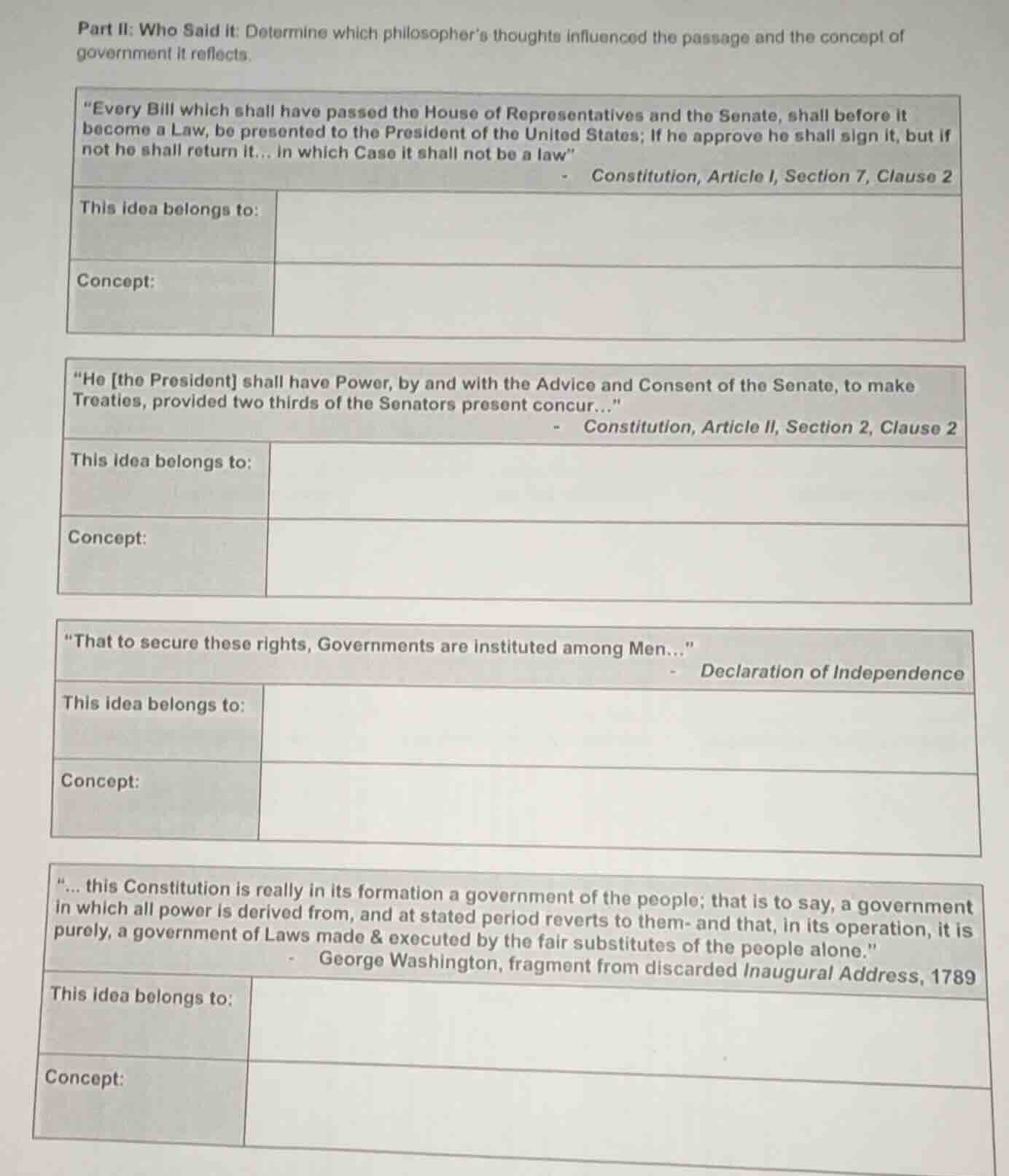
part ii: who said it: determine which philosopher’s thoughts influenced the passage and the concept of government it reflects.
“every bill which shall have passed the house of representatives and the senate, shall before it become a law, be presented to the president of the united states; if he approve he shall sign it, but if not he shall return it… in which case it shall not be a law”
- constitution, article i, section 7, clause 2
this idea belongs to:
concept:
“he the president shall have power, by and with the advice and consent of the senate, to make treaties, provided two thirds of the senators present concur…”
- constitution, article ii, section 2, clause 2
this idea belongs to:
concept:
“that to secure these rights, governments are instituted among men…”
- declaration of independence
this idea belongs to:
concept:
“… this constitution is really in its formation a government of the people; that is to say, a government in which all power is derived from, and at stated period reverts to them- and that, in its operation, it is purely, a government of laws made & executed by the fair substitutes of the people alone.”
- george washington, fragment from discarded inaugural address, 1789
this idea belongs to:
concept:
First Passage (Constitution, Article I, Section 7, Clause 2)
The passage describes the process of a bill becoming law, including the President's role in either signing or vetoing it. This reflects the idea of separation of powers and checks and balances, which was influenced by philosophers like Montesquieu. Montesquieu's work on the separation of powers (executive, legislative, judicial) and checks and balances among them is relevant here, as the President (executive) checking the legislative process (House and Senate) aligns with his ideas.
The passage outlines the President's power to make treaties with Senate advice and consent. This also relates to checks and balances (Senate checking the President's treaty - making power) and separation of powers. Montesquieu's ideas on separation of powers and checks and balances are applicable here, as different branches (executive - President, legislative - Senate) have roles that check each other.
The passage states that governments are instituted among men to secure rights. This is influenced by John Locke's ideas. Locke proposed that governments are formed by the consent of the governed to protect natural rights (life, liberty, property), and if a government fails to do so, the people have the right to alter or abolish it. The idea of government being established to secure rights aligns with Locke's social contract theory.

Snap & solve any problem in the app
Get step-by-step solutions on Sovi AI
Photo-based solutions with guided steps
Explore more problems and detailed explanations
This idea belongs to: Montesquieu
Concept: Checks and Balances (or Separation of Powers, as the President's role in the legislative process is a check on the legislature)