QUESTION IMAGE
Question
part c
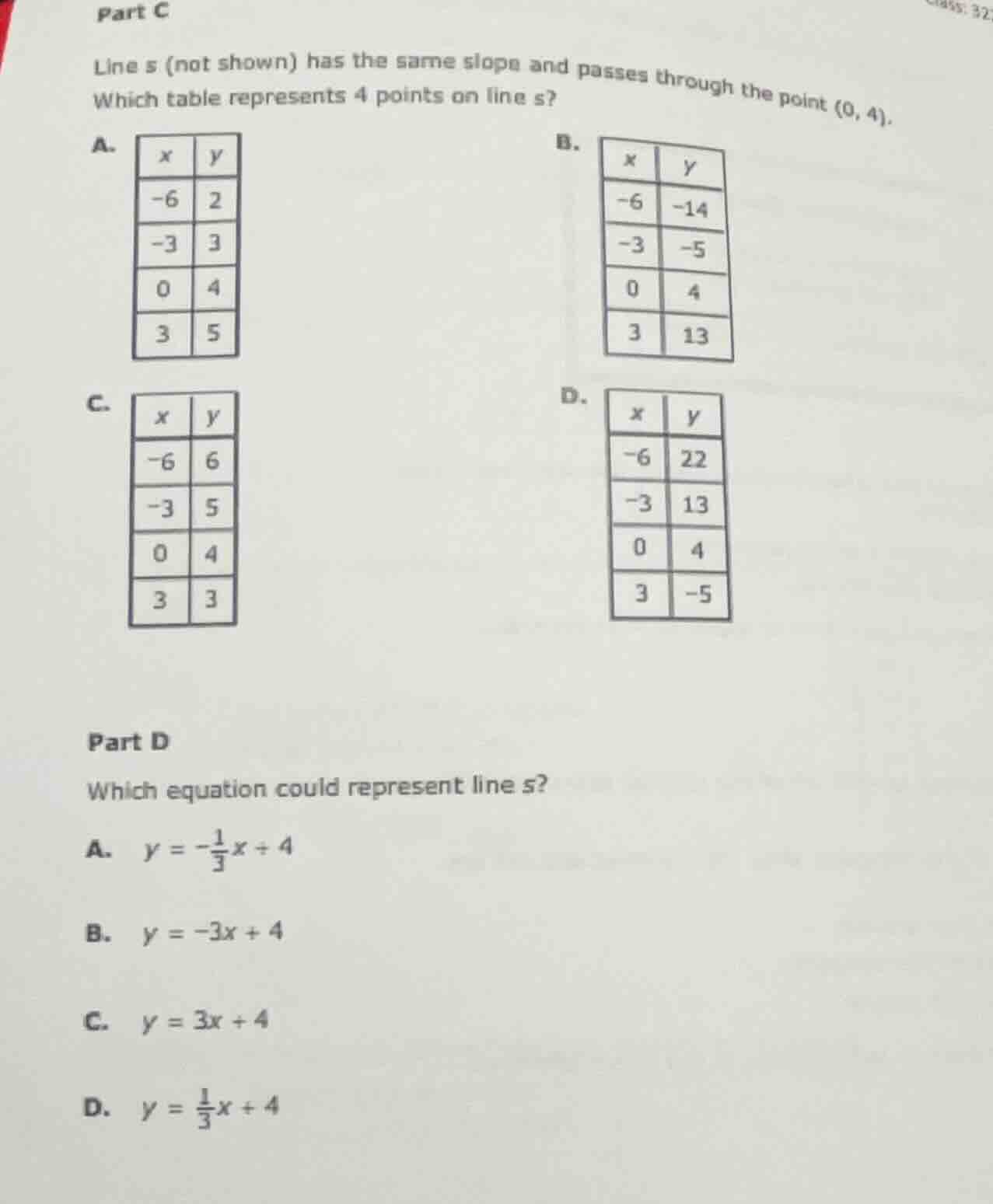
line s (not shown) has the same slope and passes through the point (0, 4).
which table represents 4 points on line s?
a.
| x | y |
| -6 | 2 |
| -3 | 3 |
| 0 | 4 |
| 3 | 5 |
b.
| x | y |
| -6 | -14 |
| -3 | -5 |
| 0 | 4 |
| 3 | 13 |
c.
| x | y |
| -6 | 6 |
| -3 | 5 |
| 0 | 4 |
| 3 | 3 |
d.
| x | y |
| -6 | 22 |
| -3 | 13 |
| 0 | 4 |
| 3 | -5 |
part d
which equation could represent line s?
a. $y = -\frac{1}{3}x + 4$
b. $y = -3x + 4$
c. $y = 3x + 4$
d. $y = \frac{1}{3}x + 4$
Part C
Step1: Recall slope formula
The slope \( m \) between two points \((x_1,y_1)\) and \((x_2,y_2)\) is \( m=\frac{y_2 - y_1}{x_2 - x_1} \). Line \( s \) passes through \((0,4)\), so the y - intercept \( b = 4 \). We can find the slope for each table using the point \((0,4)\) and another point.
Step2: Analyze Table A
Take points \((0,4)\) and \((3,5)\). Slope \( m=\frac{5 - 4}{3 - 0}=\frac{1}{3}\). Take \((-3,3)\) and \((0,4)\): \( m=\frac{4 - 3}{0-(-3)}=\frac{1}{3}\). Take \((-6,2)\) and \((-3,3)\): \( m=\frac{3 - 2}{-3-(-6)}=\frac{1}{3}\). All slopes are \(\frac{1}{3}\).
Step3: Analyze Table B
Take \((0,4)\) and \((3,13)\). Slope \( m=\frac{13 - 4}{3 - 0}=3\). Take \((-3,-5)\) and \((0,4)\): \( m=\frac{4-(-5)}{0 - (-3)} = 3\). Take \((-6,-14)\) and \((-3,-5)\): \( m=\frac{-5-(-14)}{-3-(-6)}=3\). But we will check Table A and others.
Step4: Analyze Table C
Take \((0,4)\) and \((3,3)\). Slope \( m=\frac{3 - 4}{3 - 0}=-\frac{1}{3}\). Take \((-3,5)\) and \((0,4)\): \( m=\frac{4 - 5}{0-(-3)}=-\frac{1}{3}\). Take \((-6,6)\) and \((-3,5)\): \( m=\frac{5 - 6}{-3-(-6)}=-\frac{1}{3}\).
Step5: Analyze Table D
Take \((0,4)\) and \((3,-5)\). Slope \( m=\frac{-5 - 4}{3 - 0}=-3\). Take \((-3,13)\) and \((0,4)\): \( m=\frac{4 - 13}{0-(-3)}=-3\). Take \((-6,22)\) and \((-3,13)\): \( m=\frac{13 - 22}{-3-(-6)}=-3\).
But we need to check the slope consistency. Wait, the problem says "Line \( s \) (not shown) has the same slope" (assuming from a previous line, but since we have \((0,4)\), let's re - check. Wait, maybe there was a previous line, but since we have the point \((0,4)\), let's see the slope between consecutive points. In Table A, the change in \( x \) is \( + 3 \) (from - 6 to - 3, - 3 to 0, 0 to 3) and change in \( y \) is \( + 1 \) (2 to 3, 3 to 4, 4 to 5), so slope is \(\frac{1}{3}\). In Table D, change in \( x \) is \( + 3 \), change in \( y \) is - 9 (13 to 4, 4 to - 5), slope - 3. Table B: change in \( x \) + 3, change in \( y \) + 9 (- 5 to 4, 4 to 13), slope 3. Table C: change in \( x \) + 3, change in \( y \) - 1 (5 to 4, 4 to 3), slope - \(\frac{1}{3}\). If we assume that the original line (not shown) has a slope of \(\frac{1}{3}\) (since Table A has slope \(\frac{1}{3}\) and passes through \((0,4)\)), then Table A is correct.
Step1: Recall slope - intercept form
The slope - intercept form of a line is \( y=mx + b \), where \( m \) is the slope and \( b \) is the y - intercept. We know the line \( s \) passes through \((0,4)\), so \( b = 4 \). From Part C, we found that the slope \( m=\frac{1}{3}\) (from Table A which is the correct table for line \( s \)).
Step2: Analyze each option
- Option A: \( y =-\frac{1}{3}x + 4 \), slope \( m=-\frac{1}{3}\), incorrect.
- Option B: \( y=-3x + 4 \), slope \( m = - 3 \), incorrect.
- Option C: \( y = 3x+4 \), slope \( m = 3 \), incorrect.
- Option D: \( y=\frac{1}{3}x + 4 \), slope \( m=\frac{1}{3}\) and \( b = 4 \), correct.

Snap & solve any problem in the app
Get step-by-step solutions on Sovi AI
Photo-based solutions with guided steps
Explore more problems and detailed explanations
A. \(
\)