QUESTION IMAGE
Question
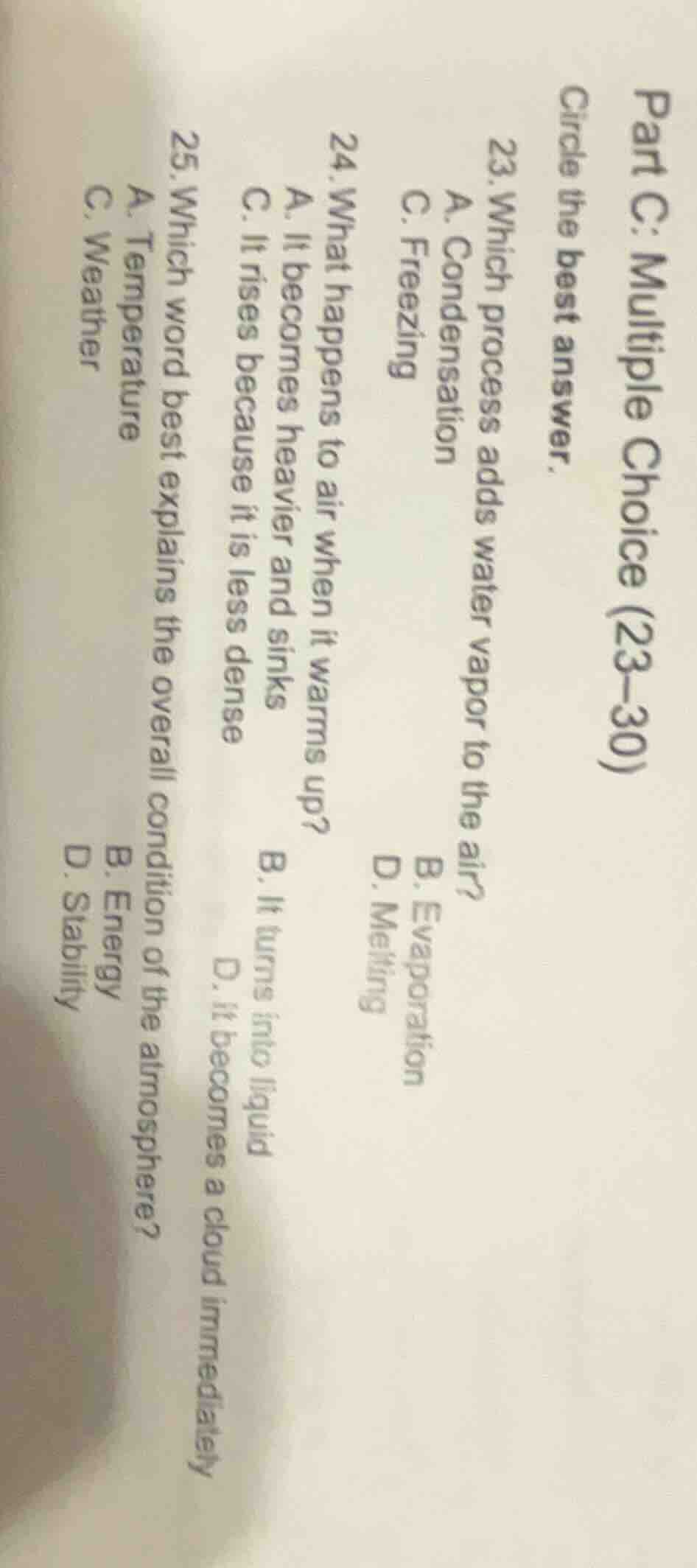
part c: multiple choice (23–30)
circle the best answer.
- which process adds water vapor to the air?
a. condensation
b. evaporation
c. freezing
d. melting
- what happens to air when it warms up?
a. it becomes heavier and sinks
b. it turns into liquid
c. it rises because it is less dense
d. it becomes a cloud immediately
- which word best explains the overall condition of the atmosphere?
a. temperature
b. energy
c. weather
d. stability
Response
Question 23
Brief Explanations
To solve this, we analyze each option:
- Option A (Condensation): This is the process where water vapor turns into liquid water (removes vapor from air).
- Option B (Evaporation): This is when liquid water turns into water vapor, adding vapor to the air.
- Option C (Freezing): Involves liquid turning to solid (not related to water vapor in air).
- Option D (Melting): Solid turning to liquid (also not related to water vapor).
So evaporation adds water vapor to the air.
Brief Explanations
Analyze the behavior of air with temperature:
- When air warms, its density decreases (since warmer air molecules move more and spread out). Less dense air rises (as denser air sinks).
- Option A: Warmer air is less dense, so it does not become heavier and sink.
- Option B: Air turning to liquid is condensation (requires cooling, not warming).
- Option C: Correct, as warm air is less dense than cooler air, so it rises.
- Option D: Cloud formation (condensation) needs cooling, not immediate warming.
Brief Explanations
Define each term:
- Option A (Temperature): Measures heat intensity (not overall atmospheric condition).
- Option B (Energy): A general term (not specific to atmospheric condition).
- Option C (Weather): Defined as the overall condition of the atmosphere (temperature, humidity, precipitation, etc.) at a time/place.
- Option D (Stability): Refers to air’s tendency to rise/sink (not the overall condition).

Snap & solve any problem in the app
Get step-by-step solutions on Sovi AI
Photo-based solutions with guided steps
Explore more problems and detailed explanations
B. Evaporation