QUESTION IMAGE
Question
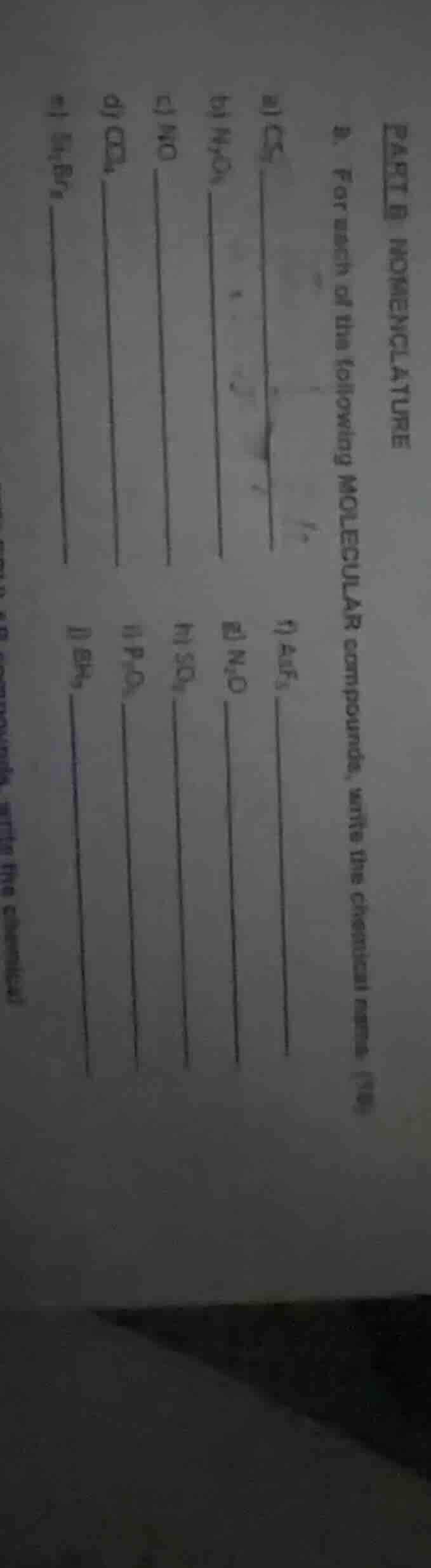
part b nomenclature 9. for each of the following molecular compounds, write the chemical name. a) cs₂ f) asf₅ b) n₂o₅ g) n₂o c) no h) sio₂ d) co₂ i) p₄o₆ e) i₂br₇ j) bh₃
To solve the nomenclature of these molecular compounds, we follow the rules for naming molecular (covalent) compounds: use prefixes (mono-, di-, tri-, tetra-, etc.) to indicate the number of each atom, except that "mono-" is not used for the first element.
a) \( \text{CS}_2 \)
- First element: Carbon (no prefix, since there's 1 C).
- Second element: Sulfur, with prefix "di-" (2 S atoms) and ending "-ide".
- Name: Carbon disulfide
b) \( \text{N}_2\text{O}_5 \)
- First element: Nitrogen, prefix "di-" (2 N atoms).
- Second element: Oxygen, prefix "penta-" (5 O atoms) and ending "-ide".
- Name: Dinitrogen pentoxide
c) \( \text{NO} \)
- First element: Nitrogen (no prefix, 1 N).
- Second element: Oxygen, prefix "mono-" (1 O atom) and ending "-ide".
- Name: Nitrogen monoxide
d) \( \text{CCl}_4 \)
- First element: Carbon (no prefix, 1 C).
- Second element: Chlorine, prefix "tetra-" (4 Cl atoms) and ending "-ide".
- Name: Carbon tetrachloride
e) \( \text{Br}_2\text{S} \)
- First element: Bromine, prefix "di-" (2 Br atoms).
- Second element: Sulfur (no prefix, 1 S) and ending "-ide".
- Name: Dibromine monosulfide (or Dibromine sulfide, since "mono-" for the second element is often optional)
f) \( \text{AsF}_5 \)
- First element: Arsenic (no prefix, 1 As).
- Second element: Fluorine, prefix "penta-" (5 F atoms) and ending "-ide".
- Name: Arsenic pentafluoride
g) \( \text{N}_2\text{O} \)
- First element: Nitrogen, prefix "di-" (2 N atoms).
- Second element: Oxygen, prefix "mono-" (1 O atom) and ending "-ide".
- Name: Dinitrogen monoxide
h) \( \text{SiO}_2 \)
- First element: Silicon (no prefix, 1 Si).
- Second element: Oxygen, prefix "di-" (2 O atoms) and ending "-ide".
- Name: Silicon dioxide
i) \( \text{P}_4\text{O}_6 \)
- First element: Phosphorus, prefix "tetra-" (4 P atoms).
- Second element: Oxygen, prefix "hexa-" (6 O atoms) and ending "-ide".
- Name: Tetraphosphorus hexoxide
j) \( \text{BH}_3 \)
- First element: Boron (no prefix, 1 B).
- Second element: Hydrogen, prefix "tri-" (3 H atoms) and ending "-ide".
- Name: Boron trihydride (or Borane, a common name)
Final Answers:
a) Carbon disulfide
b) Dinitrogen pentoxide
c) Nitrogen monoxide
d) Carbon tetrachloride
e) Dibromine sulfide (or Dibromine monosulfide)
f) Arsenic pentafluoride
g) Dinitrogen monoxide
h) Silicon dioxide
i) Tetraphosphorus hexoxide
j) Boron trihydride (or Borane)

Snap & solve any problem in the app
Get step-by-step solutions on Sovi AI
Photo-based solutions with guided steps
Explore more problems and detailed explanations
To solve the nomenclature of these molecular compounds, we follow the rules for naming molecular (covalent) compounds: use prefixes (mono-, di-, tri-, tetra-, etc.) to indicate the number of each atom, except that "mono-" is not used for the first element.
a) \( \text{CS}_2 \)
- First element: Carbon (no prefix, since there's 1 C).
- Second element: Sulfur, with prefix "di-" (2 S atoms) and ending "-ide".
- Name: Carbon disulfide
b) \( \text{N}_2\text{O}_5 \)
- First element: Nitrogen, prefix "di-" (2 N atoms).
- Second element: Oxygen, prefix "penta-" (5 O atoms) and ending "-ide".
- Name: Dinitrogen pentoxide
c) \( \text{NO} \)
- First element: Nitrogen (no prefix, 1 N).
- Second element: Oxygen, prefix "mono-" (1 O atom) and ending "-ide".
- Name: Nitrogen monoxide
d) \( \text{CCl}_4 \)
- First element: Carbon (no prefix, 1 C).
- Second element: Chlorine, prefix "tetra-" (4 Cl atoms) and ending "-ide".
- Name: Carbon tetrachloride
e) \( \text{Br}_2\text{S} \)
- First element: Bromine, prefix "di-" (2 Br atoms).
- Second element: Sulfur (no prefix, 1 S) and ending "-ide".
- Name: Dibromine monosulfide (or Dibromine sulfide, since "mono-" for the second element is often optional)
f) \( \text{AsF}_5 \)
- First element: Arsenic (no prefix, 1 As).
- Second element: Fluorine, prefix "penta-" (5 F atoms) and ending "-ide".
- Name: Arsenic pentafluoride
g) \( \text{N}_2\text{O} \)
- First element: Nitrogen, prefix "di-" (2 N atoms).
- Second element: Oxygen, prefix "mono-" (1 O atom) and ending "-ide".
- Name: Dinitrogen monoxide
h) \( \text{SiO}_2 \)
- First element: Silicon (no prefix, 1 Si).
- Second element: Oxygen, prefix "di-" (2 O atoms) and ending "-ide".
- Name: Silicon dioxide
i) \( \text{P}_4\text{O}_6 \)
- First element: Phosphorus, prefix "tetra-" (4 P atoms).
- Second element: Oxygen, prefix "hexa-" (6 O atoms) and ending "-ide".
- Name: Tetraphosphorus hexoxide
j) \( \text{BH}_3 \)
- First element: Boron (no prefix, 1 B).
- Second element: Hydrogen, prefix "tri-" (3 H atoms) and ending "-ide".
- Name: Boron trihydride (or Borane, a common name)
Final Answers:
a) Carbon disulfide
b) Dinitrogen pentoxide
c) Nitrogen monoxide
d) Carbon tetrachloride
e) Dibromine sulfide (or Dibromine monosulfide)
f) Arsenic pentafluoride
g) Dinitrogen monoxide
h) Silicon dioxide
i) Tetraphosphorus hexoxide
j) Boron trihydride (or Borane)