QUESTION IMAGE
Question
part b: understanding slope & intercepts
- in the equation ( y = mx + b ), what does:
- ( m ) represent?
- ( b ) represent?
- how do you identify a proportional relationship using:
a graph:
a table of values:
an equation:
part c: graph analysis
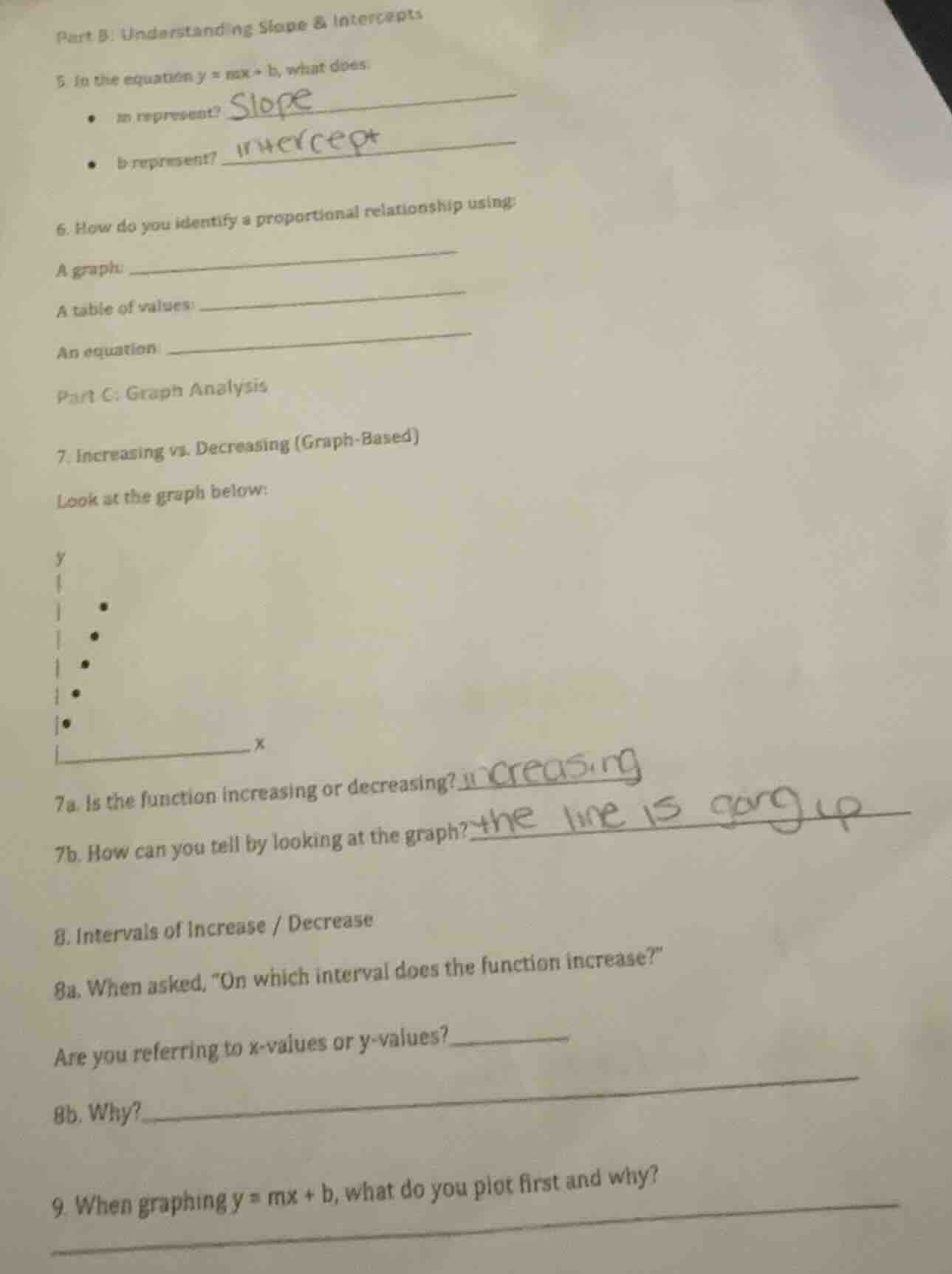
- increasing vs. decreasing (graph - based)
look at the graph below:
(graph with y - axis, x - axis, and some points)
7a. is the function increasing or decreasing?
7b. how can you tell by looking at the graph?
- intervals of increase / decrease
8a. when asked, \on which interval does the function increase?\
are you referring to ( x ) - values or ( y ) - values?
8b. why?
- when graphing ( y = mx + b ), what do you plot first and why?
- For question 6:
- Graph: A proportional relationship forms a straight line passing through the origin (0,0).
- Table: The ratio of y to x is constant for all pairs.
- Equation: It follows the form $y = kx$ (no constant term, $b=0$).
- For question 8:
- 8a: Interval questions for function increase/decrease reference x-values.
- 8b: Functions are defined by how output (y) changes with input (x); intervals describe input ranges.
- For question 9:
Plot the y-intercept ($b$) first. It gives a fixed starting point $(0, b)$ on the y-axis, making it easy to apply the slope ($m$) to find other points.

Snap & solve any problem in the app
Get step-by-step solutions on Sovi AI
Photo-based solutions with guided steps
Explore more problems and detailed explanations
6.
A graph: A straight line through (0,0)
A table of values: Constant $\frac{y}{x}$ ratio
An equation: Has form $y = kx$ ($b=0$)
8a. x-values
8b. Intervals describe input (x) ranges where y changes
- Plot the y-intercept ($b$) first; it is a defined starting point $(0, b)$ to build the line using the slope.