QUESTION IMAGE
Question
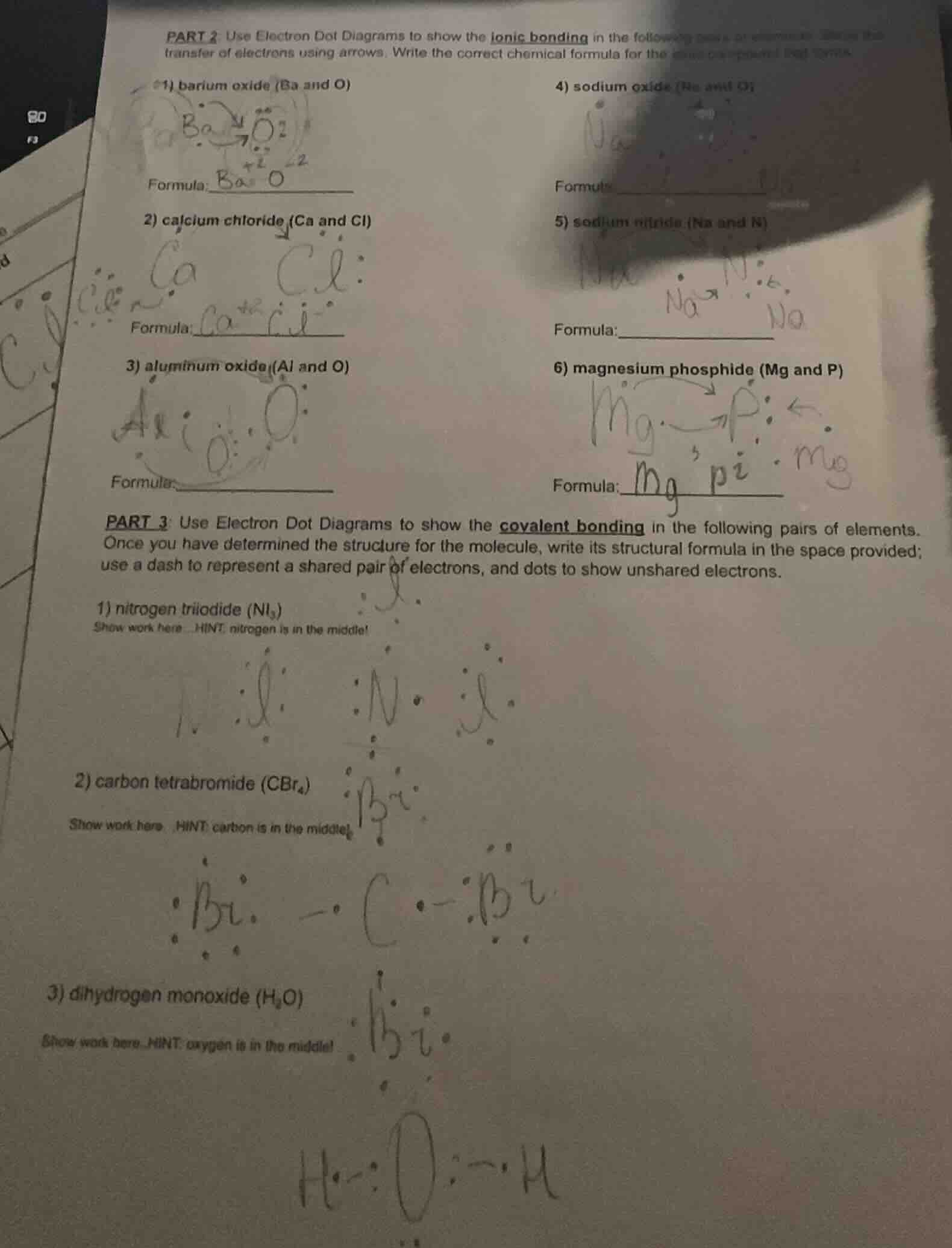
part 2 use electron dot diagrams to show the ionic bonding in the following pairs of elements. show the transfer of electrons using arrows. write the correct chemical formula for the ionic compound.\
- barium oxide (ba and o)\
formula: \
- calcium chloride (ca and cl)\
formula: \
- aluminum oxide (al and o)\
formula: \
- sodium oxide (na and o)\
formula: \
- sodium nitride (na and n)\
formula: \
- magnesium phosphide (mg and p)\
formula: \
part 3: use electron dot diagrams to show the covalent bonding in the following pairs of elements. once you have determined the structure for the molecule, write its structural formula in the space provided; use a dash to represent a shared pair of electrons, and dots to show unshared electrons.\
- nitrogen triiodide (ni₃)\
show work here... hint: nitrogen is in the middle!\
- carbon tetrabromide (cbr₄)\
show work here... hint: carbon is in the middle!\
- dihydrogen monoxide (h₂o)\
show work here... hint: oxygen is in the middle!
Step1: Find ionic charges (Barium Oxide)
Barium (Ba) has +2 charge, Oxygen (O) has -2 charge.
Step2: Balance charges for formula
$\text{Ba}^{2+} + \text{O}^{2-}
ightarrow \text{BaO}$
Step3: Find ionic charges (Calcium Chloride)
Calcium (Ca) has +2 charge, Chlorine (Cl) has -1 charge.
Step4: Balance charges for formula
$\text{Ca}^{2+} + 2\text{Cl}^-
ightarrow \text{CaCl}_2$
Step5: Find ionic charges (Aluminum Oxide)
Aluminum (Al) has +3 charge, Oxygen (O) has -2 charge.
Step6: Balance charges for formula
$2\text{Al}^{3+} + 3\text{O}^{2-}
ightarrow \text{Al}_2\text{O}_3$
Step7: Find ionic charges (Sodium Oxide)
Sodium (Na) has +1 charge, Oxygen (O) has -2 charge.
Step8: Balance charges for formula
$2\text{Na}^+ + \text{O}^{2-}
ightarrow \text{Na}_2\text{O}$
Step9: Find ionic charges (Sodium Nitride)
Sodium (Na) has +1 charge, Nitrogen (N) has -3 charge.
Step10: Balance charges for formula
$3\text{Na}^+ + \text{N}^{3-}
ightarrow \text{Na}_3\text{N}$
Step11: Find ionic charges (Magnesium Phosphide)
Magnesium (Mg) has +2 charge, Phosphorus (P) has -3 charge.
Step12: Balance charges for formula
$3\text{Mg}^{2+} + 2\text{P}^{3-}
ightarrow \text{Mg}_3\text{P}_2$
Step13: Draw covalent structure (NI₃)
Nitrogen (5 valence e⁻) shares 1 e⁻ with each Iodine (7 valence e⁻). Structural formula: $\text{I}-\ddot{\text{N}}(\ddot{\text{I}})-\ddot{\text{I}}$ (with 6 unshared e⁻ on each I, 2 unshared e⁻ on N)
Step14: Draw covalent structure (CBr₄)
Carbon (4 valence e⁻) shares 1 e⁻ with each Bromine (7 valence e⁻). Structural formula: $\text{Br}-\underset{\ddot{\text{Br}}}{\overset{\ddot{\text{Br}}}{\text{C}}}-\ddot{\text{Br}}$ (with 6 unshared e⁻ on each Br)
Step15: Draw covalent structure (H₂O)
Oxygen (6 valence e⁻) shares 1 e⁻ with each Hydrogen (1 valence e⁻). Structural formula: $\text{H}-\ddot{\text{O}}-\text{H}$ (with 4 unshared e⁻ on O)

Snap & solve any problem in the app
Get step-by-step solutions on Sovi AI
Photo-based solutions with guided steps
Explore more problems and detailed explanations
PART 2 (Ionic Bonding Formulas):
- Barium oxide: $\text{BaO}$
- Calcium chloride: $\text{CaCl}_2$
- Aluminum oxide: $\text{Al}_2\text{O}_3$
- Sodium oxide: $\text{Na}_2\text{O}$
- Sodium nitride: $\text{Na}_3\text{N}$
- Magnesium phosphide: $\text{Mg}_3\text{P}_2$
PART 3 (Covalent Structural Formulas):
- Nitrogen triiodide: $\text{I}-\ddot{\text{N}}-\text{I}$ (with 6 dots on each outer I, 2 dots on N)
- Carbon tetrabromide: $\text{Br}-\underset{\text{Br}}{\overset{\text{Br}}{\text{C}}}-\text{Br}$ (with 6 dots on each Br)
- Dihydrogen monoxide: $\text{H}-\ddot{\text{O}}-\text{H}$ (with 4 dots on O)