QUESTION IMAGE
Question
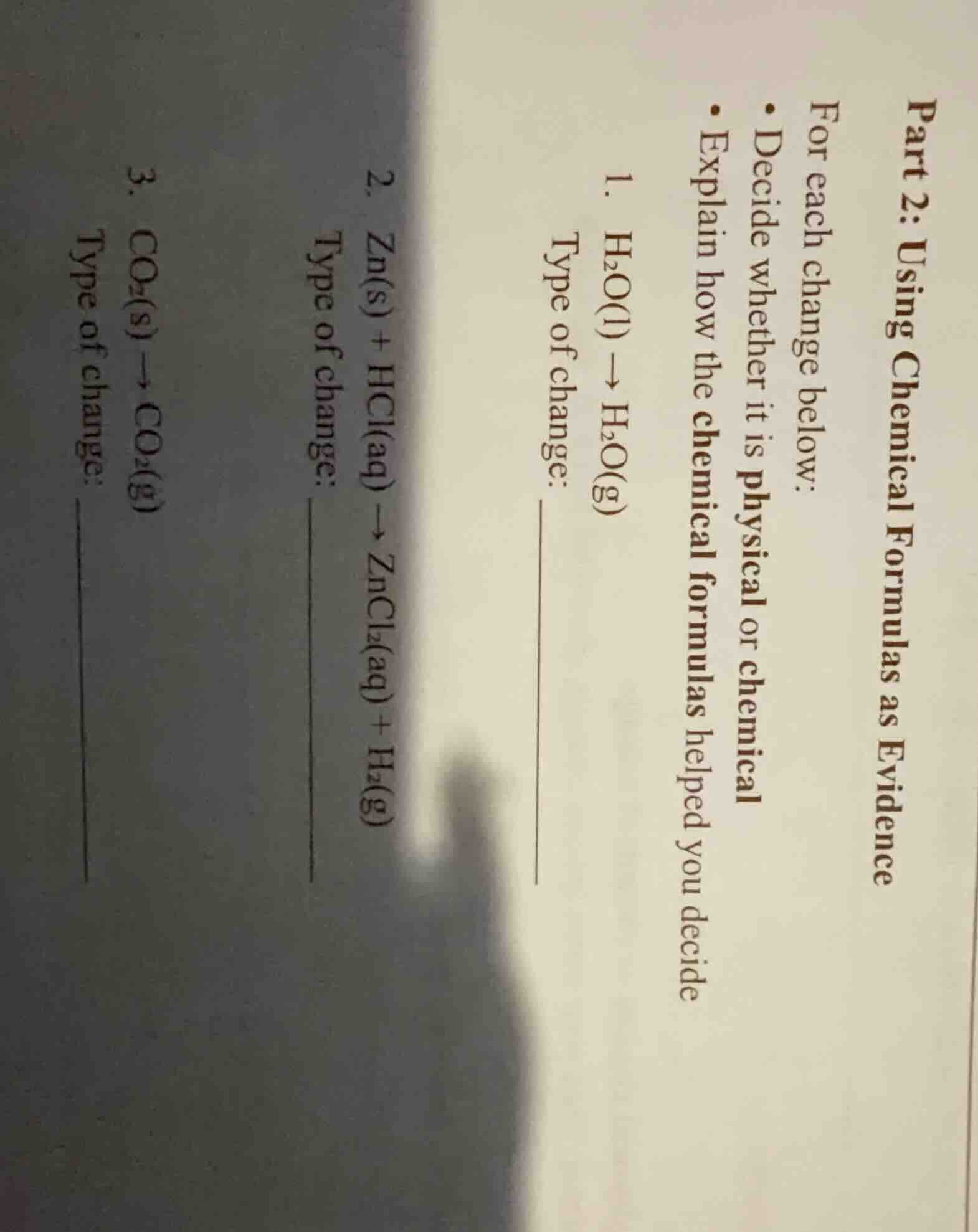
part 2: using chemical formulas as evidence
for each change below:
- decide whether it is physical or chemical
- explain how the chemical formulas helped you decide
- h₂o(l) → h₂o(g)
type of change: ______
- zn(s) + hcl(aq) → zncl₂(aq) + h₂(g)
type of change: ______
- co₂(s) → co₂(g)
type of change: ______
1. Analysis for $\boldsymbol{\ce{H2O(l) -> H2O(g)}}$
Step 1: Identify substance before/after
The reactant is $\ce{H2O(l)}$ (liquid water) and the product is $\ce{H2O(g)}$ (gaseous water).
Step 2: Check for new substances
The chemical formula is the same ($\ce{H2O}$), only the state (phase) changes. Physical changes involve state/phase changes without new substances.
Step 3: Determine change type
Since no new chemical substance is formed (same formula), it is a physical change (specifically, vaporization).
Step 1: Identify substances
Reactants: $\ce{Zn(s)}$ (zinc) and $\ce{HCl(aq)}$ (hydrochloric acid). Products: $\ce{ZnCl2(aq)}$ (zinc chloride) and $\ce{H2(g)}$ (hydrogen gas).
Step 2: Check for new substances
The products ($\ce{ZnCl2}$ and $\ce{H2}$) are different from the reactants ($\ce{Zn}$ and $\ce{HCl}$), so new chemical substances are formed.
Step 3: Determine change type
A change with new substances formed is a chemical change (this is a single - replacement reaction: $\ce{Zn}$ replaces $\ce{H}$ in $\ce{HCl}$).
Step 1: Identify substance before/after
Reactant: $\ce{CO2(s)}$ (solid carbon dioxide, dry ice). Product: $\ce{CO2(g)}$ (gaseous carbon dioxide).
Step 2: Check for new substances
The chemical formula is $\ce{CO2}$ for both, only the state (phase) changes from solid to gas.
Step 3: Determine change type
Since no new chemical substance is created (same formula, just phase change: sublimation), it is a physical change.

Snap & solve any problem in the app
Get step-by-step solutions on Sovi AI
Photo-based solutions with guided steps
Explore more problems and detailed explanations
Physical change (because the chemical formula remains $\ce{H2O}$, only the phase changes from liquid to gas, no new substance is formed).