QUESTION IMAGE
Question
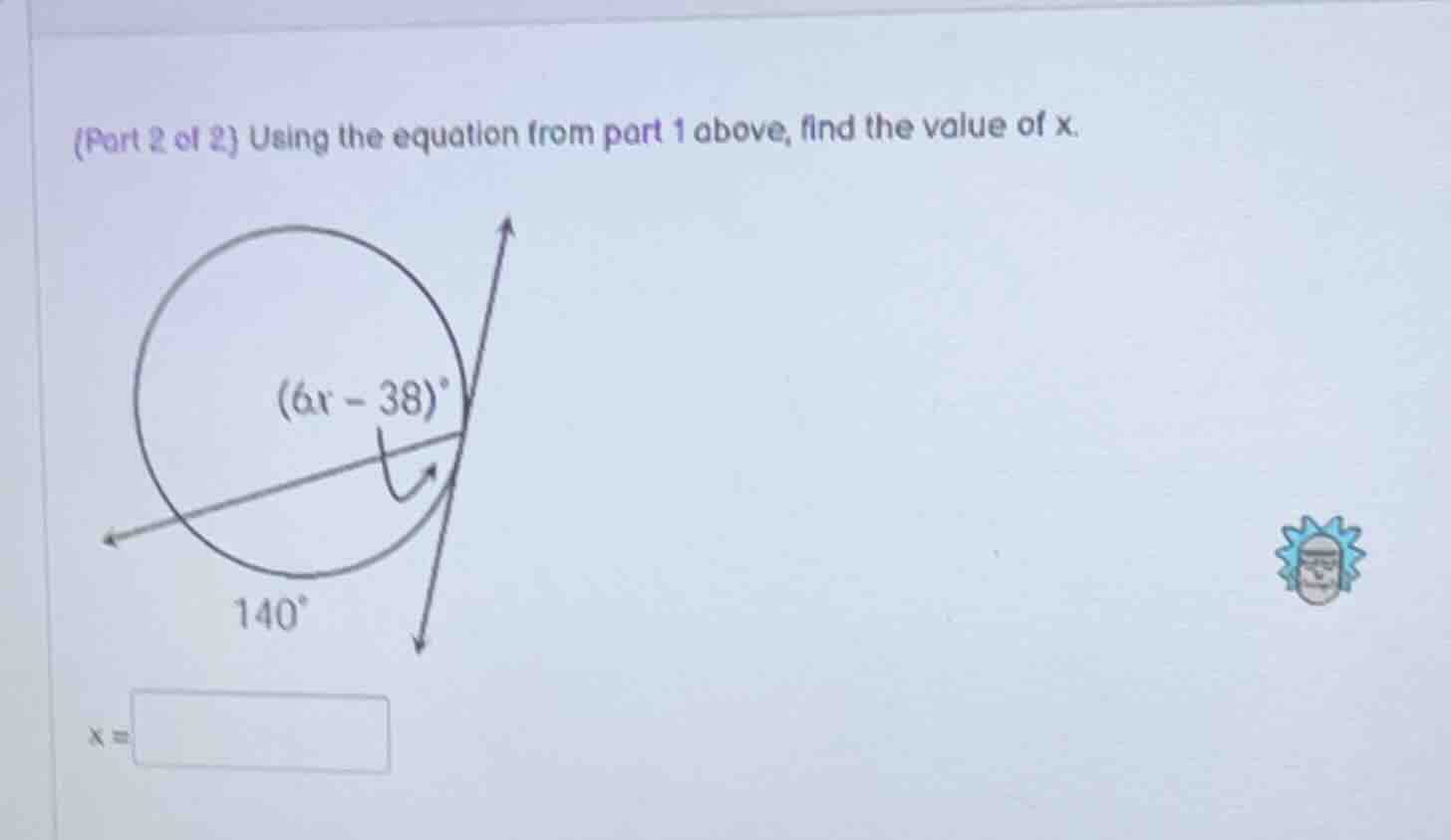
(part 2 of 2) using the equation from part 1 above, find the value of x. (6x - 38)° 140° x =
Step1: Recall the property of angles formed by a tangent and a chord (or two chords intersecting outside/inside, but here it's a tangent and a secant? Wait, actually, the angle between a tangent and a chord is equal to the inscribed angle on the opposite side. Wait, no, in this case, the angle (6x - 38)° and the 140° arc: the measure of an angle formed by a tangent and a secant (or two secants) outside the circle is half the difference of the intercepted arcs. Wait, no, actually, if we have a tangent and a chord, the angle is half the measure of the intercepted arc. But here, maybe the angle (6x - 38)° and the 140° arc: wait, the total around a point is 360°, but no, the angle between the tangent and the chord (or the two lines: one secant, one tangent) – wait, actually, the angle formed by a tangent and a secant is half the difference of the intercepted arcs. But in this case, maybe the angle (6x - 38)° is equal to half of 140°? No, wait, maybe the angle (6x - 38)° and the 140° arc: wait, the angle between a tangent and a chord is equal to the inscribed angle on the opposite side, which is half the measure of the intercepted arc. Wait, no, let's think again. The angle formed by a tangent and a chord is equal to half the measure of the intercepted arc. So if the intercepted arc is 140°, then the angle would be half of that? No, wait, no: the angle between tangent and chord is equal to the inscribed angle on the opposite side, which is half the measure of the intercepted arc. Wait, but in the diagram, maybe the angle (6x - 38)° is equal to 140°? No, that doesn't make sense. Wait, maybe the angle (6x - 38)° and the 140° arc: the sum of the angle and the arc? No, wait, the angle formed by a tangent and a secant outside the circle is (1/2)(major arc - minor arc). But here, maybe the angle (6x - 38)° is equal to half of (360° - 140°)? Wait, no, let's check the diagram again. Wait, the diagram shows a circle, a tangent line, and a secant line (or a chord and a tangent). The angle between the tangent and the chord is (6x - 38)°, and the arc opposite to it is 140°. Wait, actually, the measure of an angle formed by a tangent and a chord is equal to half the measure of the intercepted arc. So if the intercepted arc is 140°, then the angle would be half of 140°? No, that would be 70°, but 6x - 38 = 70? Let's check: 6x = 108, x = 18. But wait, maybe the angle is equal to the arc? No, that's not right. Wait, maybe the angle (6x - 38)° and the 140° arc: the sum of the angle and the arc is 180°? No, that would be if they are supplementary. Wait, let's think again. The angle between a tangent and a chord is equal to half the measure of the intercepted arc. So if the intercepted arc is 140°, then the angle is (1/2)*140° = 70°? But then 6x - 38 = 70? Let's solve that: 6x = 70 + 38 = 108, so x = 18. Wait, but maybe the angle (6x - 38)° is equal to 140°? No, that would be 6x = 178, x ≈ 29.67, which doesn't seem right. Wait, maybe the angle is equal to half of (360° - 140°)? 360 - 140 = 220, half of that is 110. Then 6x - 38 = 110? 6x = 1[SSE onError error]

Snap & solve any problem in the app
Get step-by-step solutions on Sovi AI
Photo-based solutions with guided steps
Explore more problems and detailed explanations