QUESTION IMAGE
Question
part b
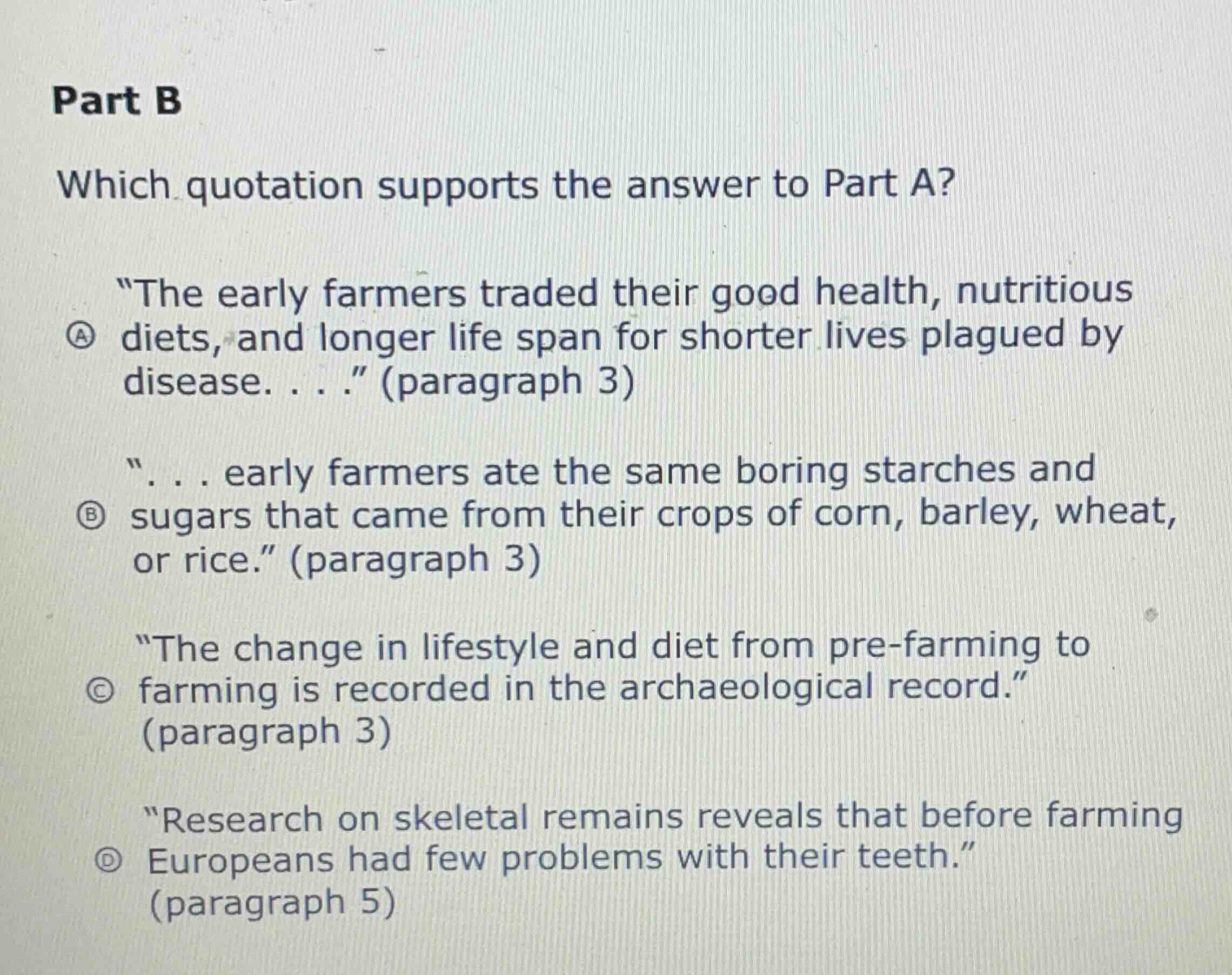
which quotation supports the answer to part a?
a \the early farmers traded their good health, nutritious diets, and longer life span for shorter lives plagued by disease. . . .\ (paragraph 3)
b \. . . early farmers ate the same boring starches and sugars that came from their crops of corn, barley, wheat, or rice.\ (paragraph 3)
c \the change in lifestyle and diet from pre - farming to farming is recorded in the archaeological record.\ (paragraph 3)
d
esearch on skeletal remains reveals that before farming europeans had few problems with their teeth.\ (paragraph 5)
To solve this, we assume Part A was about the negative impacts of early farming on health (since option A talks about trading good health for shorter, disease - plagued lives). Let's analyze each option:
- Option A: Talks about early farmers losing good health, nutritious diets, and longer lifespan for shorter lives with disease. This directly supports a claim about negative health impacts of farming.
- Option B: Only talks about the monotony of early farmers' diets, not a broader health impact.
- Option C: Just states that lifestyle and diet changes are recorded in archaeological records, no specific support for a health - related answer in Part A.
- Option D: Focuses on dental problems of pre - farming Europeans, not the impact of farming.
To determine the correct quotation, we analyze each option. Option A discusses early farmers trading good health, nutritious diets, and longer life for shorter, disease - plagued lives, which likely supports a Part A answer about negative health impacts of early farming. Other options focus on diet monotony (B), archaeological record of change (C), or pre - farming dental health (D), not directly supporting a health - impact - of - farming answer.

Snap & solve any problem in the app
Get step-by-step solutions on Sovi AI
Photo-based solutions with guided steps
Explore more problems and detailed explanations
A. "The early farmers traded their good health, nutritious diets, and longer life span for shorter lives plagued by disease. . . ." (paragraph 3)