QUESTION IMAGE
Question
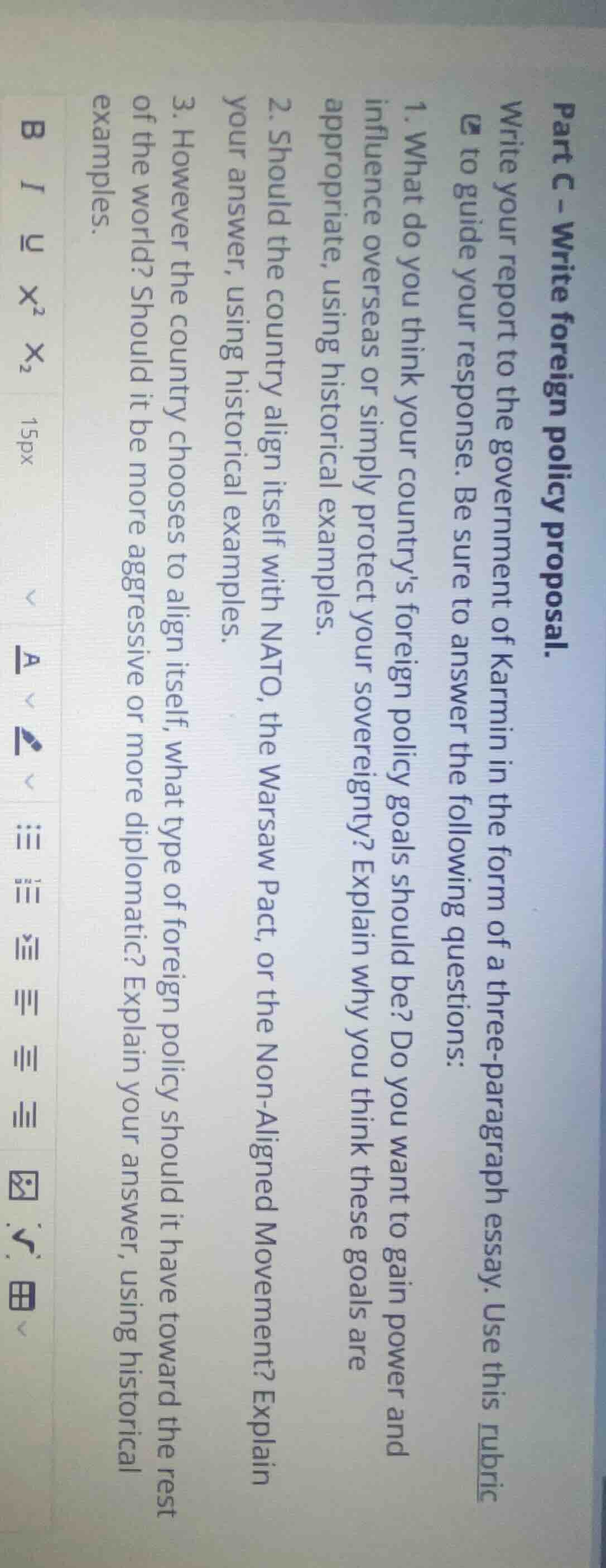
part c - write foreign policy proposal.
write your report to the government of karmin in the form of a three - paragraph essay. use this rubric to guide your response. be sure to answer the following questions:
- what do you think your countrys foreign policy goals should be? do you want to gain power and influence overseas or simply protect your sovereignty? explain why you think these goals are appropriate, using historical examples.
- should the country align itself with nato, the warsaw pact, or the non - aligned movement? explain your answer, using historical examples.
- however the country chooses to align itself, what type of foreign policy should it have toward the rest of the world? should it be more aggressive or more diplomatic? explain your answer, using historical examples.
Brief Explanations
- For the first question: Karmin's foreign policy should prioritize protecting sovereignty first, with targeted influence building as a secondary goal. Historical example: Switzerland's neutrality during World War II preserved its sovereignty, allowing it to later build global economic influence through banking and diplomacy. This order is appropriate because sovereignty is the foundational prerequisite for any state action—without it, attempts to gain influence become dependent on external powers, as seen in Vichy France, which lost sovereignty and could only act as a proxy for Nazi Germany, gaining no independent global influence.
- For the second question: Karmin should align with the Non-Aligned Movement (NAM). Historical example: Yugoslavia's membership in NAM during the Cold War allowed it to receive aid and trade from both NATO and Warsaw Pact states without being dragged into their direct conflicts, unlike Poland (Warsaw Pact) which was forced to participate in the 1968 invasion of Czechoslovakia, damaging its international reputation, or Greece (NATO) which faced internal political interference from Western allies. NAM alignment lets Karmin retain sovereignty while engaging with all global blocs.
- For the third question: If aligning independently, Karmin should pursue a primarily diplomatic foreign policy. Historical example: Post-Cold War Finland used "Finlandization 2.0" (diplomatic engagement with both EU and Russia) to avoid conflict, maintain trade ties, and resolve border disputes peacefully. A more aggressive policy, like pre-WWI Germany's naval arms race and territorial expansion, led to isolation and its eventual defeat. Diplomacy allows Karmin to build alliances, resolve disputes, and advance its interests without the high costs of aggression.

Snap & solve any problem in the app
Get step-by-step solutions on Sovi AI
Photo-based solutions with guided steps
Explore more problems and detailed explanations
- Karmin's foreign policy goals should prioritize protecting sovereignty first, with targeted influence building as a secondary goal. This order is appropriate because sovereignty is the foundational prerequisite for independent state action; without it, influence efforts become dependent on external powers.
- Karmin should align itself with the Non-Aligned Movement. This alignment allows the country to retain full sovereignty, engage with both Western and Eastern blocs for trade and aid, and avoid being drawn into proxy conflicts, as seen in Yugoslavia's Cold War experience.
- If choosing independent alignment, Karmin should pursue a primarily diplomatic foreign policy. Diplomacy allows for peaceful dispute resolution, alliance-building, and interest advancement without the isolation and high costs associated with aggressive policies, as demonstrated by post-Cold War Finland's successful diplomatic engagement with neighboring powers.