QUESTION IMAGE
Question
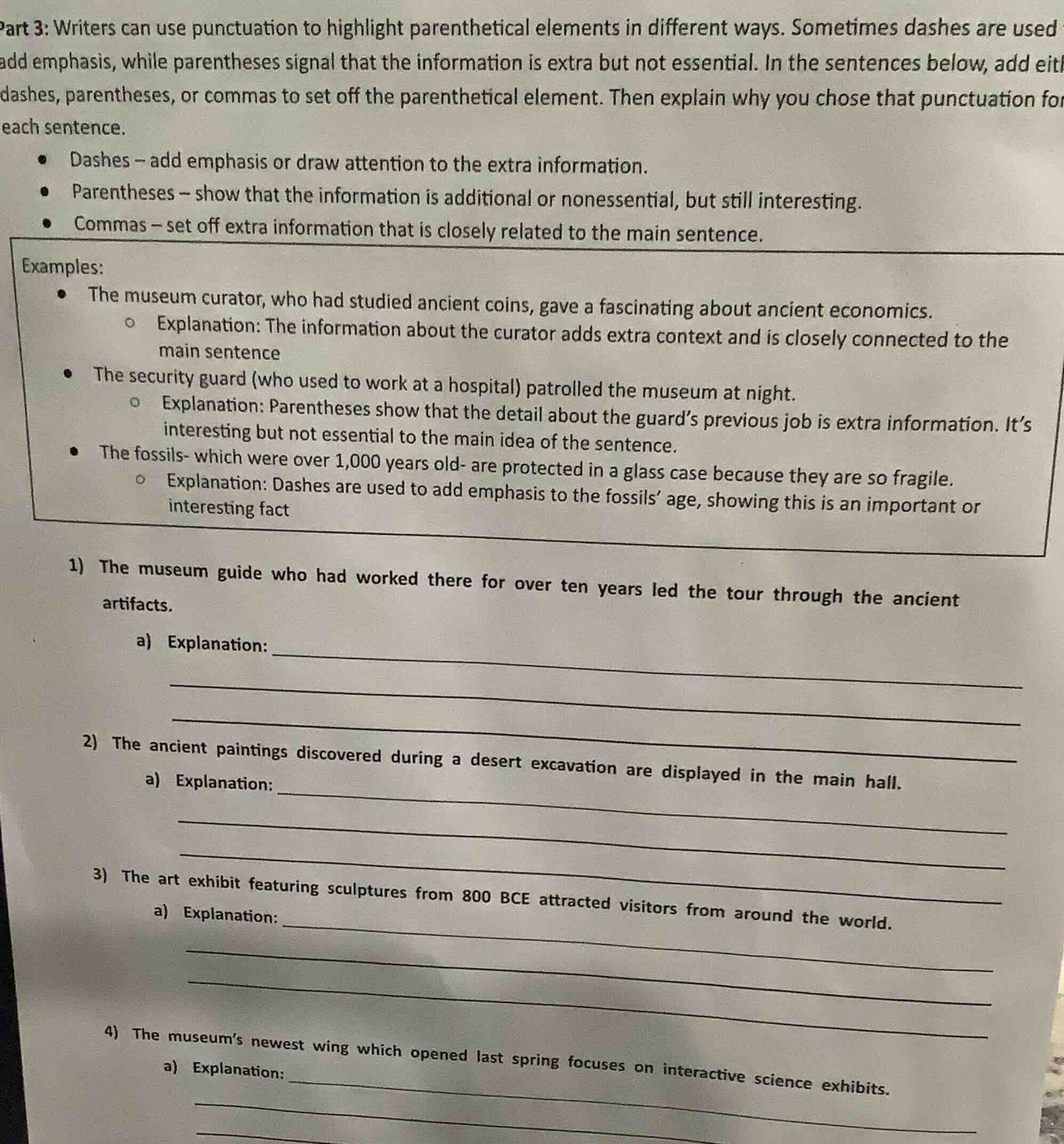
part 3: writers can use punctuation to highlight parenthetical elements in different ways. sometimes dashes are used add emphasis, while parentheses signal that the information is extra but not essential. in the sentences below, add eit dashes, parentheses, or commas to set off the parenthetical element. then explain why you chose that punctuation for each sentence. - dashes – add emphasis or draw attention to the extra information. - parentheses – show that the information is additional or nonessential, but still interesting. - commas – set off extra information that is closely related to the main sentence. examples: - the museum curator, who had studied ancient coins, gave a fascinating about ancient economics. - explanation: the information about the curator adds extra context and is closely connected to the main sentence - the security guard (who used to work at a hospital) patrolled the museum at night. - explanation: parentheses show that the detail about the guard’s previous job is extra information. it’s interesting but not essential to the main idea of the sentence. - the fossils- which were over 1,000 years old- are protected in a glass case because they are so fragile. - explanation: dashes are used to add emphasis to the fossils’ age, showing this is an important or interesting fact 1) the museum guide who had worked there for over ten years led the tour through the ancient artifacts. a) explanation: _________________________ _______________________ 2) the ancient paintings discovered during a desert excavation are displayed in the main hall. a) explanation: _______________________ _______________________ 3) the art exhibit featuring sculptures from 800 bce attracted visitors from around the world. a) explanation: _______________________ _______________________ 4) the museum’s newest wing which opened last spring focuses on interactive science exhibits. a) explanation: _______________________ _________________________

Snap & solve any problem in the app
Get step-by-step solutions on Sovi AI
Photo-based solutions with guided steps
Explore more problems and detailed explanations
- The museum guide, who had worked there for over ten years, led the tour through the ancient artifacts. a) Explanation: Commas set off extra information that is closely related to the main sentence.
- The ancient paintings (discovered during a desert excavation) are displayed in the main hall. a) Explanation: Parentheses show that the information is additional or nonessential, but still interesting.
- The art exhibit—featuring sculptures from 800 BCE—attracted visitors from around the world. a) Explanation: Dashes add emphasis or draw attention to the extra information.
- The museum's newest wing, which opened last spring, focuses on interactive science exhibits. a) Explanation: Commas set off extra information that is closely related to the main sentence.