QUESTION IMAGE
Question
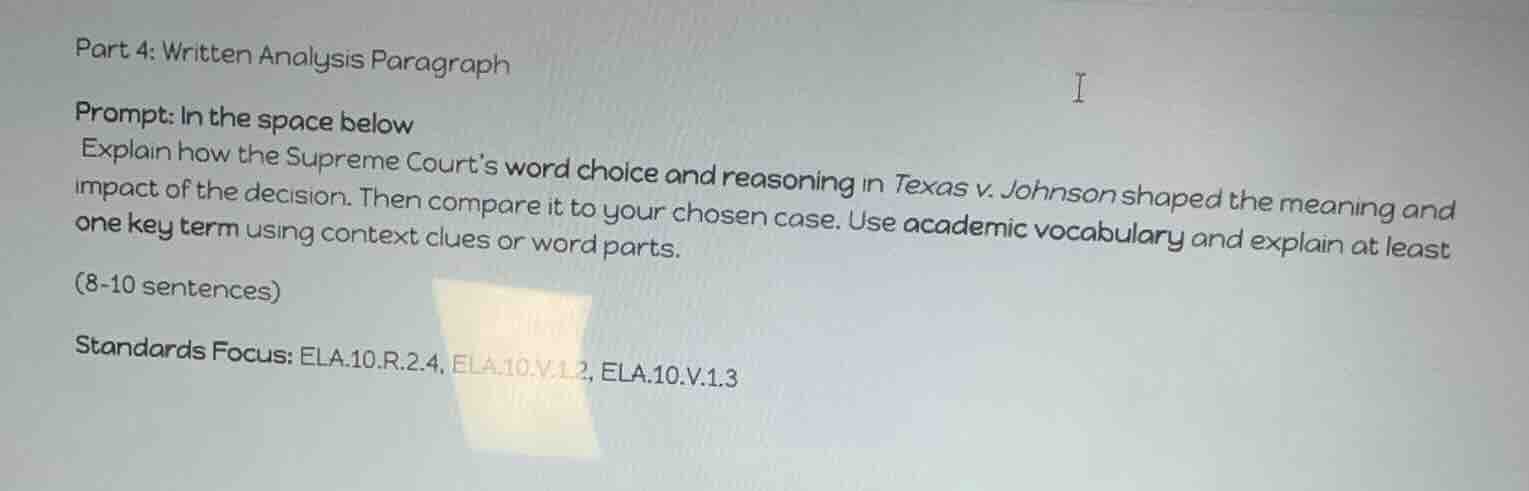
part 4: written analysis paragraph
prompt: in the space below
explain how the supreme court’s word choice and reasoning in texas v. johnson shaped the meaning and
impact of the decision. then compare it to your chosen case. use academic vocabulary and explain at least
one key term using context clues or word parts.
(8 - 10 sentences)
standards focus: ela.10.r.2.4, ela.10.v.1.2, ela.10.v.1.3
To answer this, we analyze Texas v. Johnson first. The Supreme Court used terms like "symbolic speech" (from the First Amendment context, "symbolic" relates to representing ideas, "speech" here broadened to non - verbal expression) in its reasoning. This word choice emphasized that flag - burning, as a form of symbolic speech, is protected, shaping the decision’s meaning to prioritize First Amendment rights over state - level flag - protection laws. Now, compare it to Tinker v. Des Moines (a chosen case). In Tinker, the Court used terms like "substantial disruption" ( "substantial" meaning significant, "disruption" referring to interference with school operations). The reasoning here shaped the decision to allow student speech (like wearing armbands) unless it causes substantial disruption. A key term from Texas v. Johnson is "symbolic speech". Using word parts, "symbolic" comes from "symbol", which is something representing an idea, and "speech" here is extended to non - verbal communication. In context, it’s used to describe actions (like flag - burning) that convey a message, justifying the Court’s decision to protect such actions under the First Amendment.

Snap & solve any problem in the app
Get step-by-step solutions on Sovi AI
Photo-based solutions with guided steps
Explore more problems and detailed explanations
In Texas v. Johnson, the Supreme Court’s word choice like “symbolic speech” (where “symbolic” derives from “symbol” (a representation of ideas) and “speech” is broadened to non - verbal expression) and reasoning about First Amendment protection for flag - burning shaped the decision’s meaning to prioritize expressive rights over state flag - protection statutes, impacting future cases on symbolic speech. When compared to Tinker v. Des Moines, in Tinker, the Court’s use of “substantial disruption” ( “substantial” meaning significant, “disruption” referring to interference with school order) shaped its decision to allow student speech unless it causes such disruption. The key term “symbolic speech” from Texas v. Johnson uses “symbolic” (relating to symbols as idea - carriers) and “speech” (extended to non - verbal communication) to describe actions like flag - burning that convey a message, justifying the Court’s ruling to protect them under the First Amendment.