QUESTION IMAGE
Question
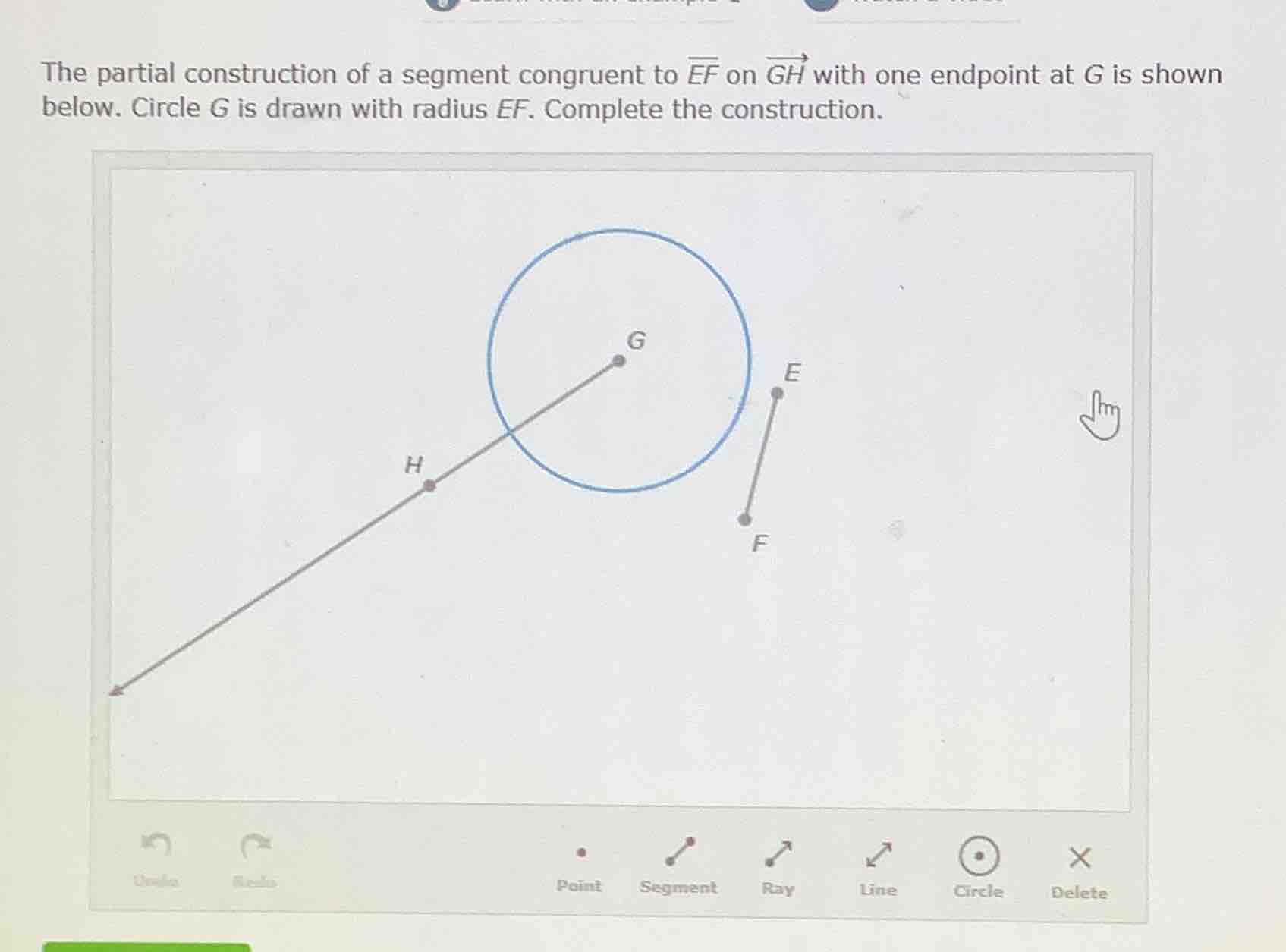
the partial construction of a segment congruent to \\(\overline{ef}\\) on \\(\overrightarrow{gh}\\) with one endpoint at g is shown below. circle g is drawn with radius ef. complete the construction.
Step1: Identify Intersection Point
The circle centered at \( G \) with radius \( EF \) intersects \( \overrightarrow{GH} \) at a point (let's call it \( I \)). This intersection point is on the ray \( \overrightarrow{GH} \) (since the circle is drawn such that it should intersect the ray from \( G \) through \( H \) or the other direction? Wait, looking at the diagram, the circle is drawn, and the ray \( \overrightarrow{GH} \) passes through the circle. So the intersection point (other than maybe the side towards \( H \)? Wait, no, the ray starts at \( G \) and goes through \( H \), so the circle centered at \( G \) with radius \( EF \) will intersect \( \overrightarrow{GH} \) at a point \( I \) such that \( GI = EF \) (since radius is \( EF \)). So we need to mark that intersection point.
Step2: Construct the Segment
Once we have the intersection point \( I \) (on \( \overrightarrow{GH} \), with \( G \) as one endpoint), the segment \( \overline{GI} \) will be congruent to \( \overline{EF} \) because \( GI \) is a radius of the circle (and the circle was drawn with radius \( EF \), so \( GI = EF \)). So we mark the point where the circle intersects \( \overrightarrow{GH} \) (let's say the point is \( I \)) and then the segment \( \overline{GI} \) is the congruent segment.

Snap & solve any problem in the app
Get step-by-step solutions on Sovi AI
Photo-based solutions with guided steps
Explore more problems and detailed explanations
To complete the construction:
- Locate the point where the circle centered at \( G \) (with radius \( EF \)) intersects \( \overrightarrow{GH} \) (let this point be \( I \)).
- Draw the segment \( \overline{GI} \). This segment \( \overline{GI} \) is congruent to \( \overline{EF} \) (since \( GI = EF \) as \( GI \) is a radius of the circle with radius \( EF \)) and has one endpoint at \( G \) on \( \overrightarrow{GH} \).