QUESTION IMAGE
Question
passage 1
passage 2
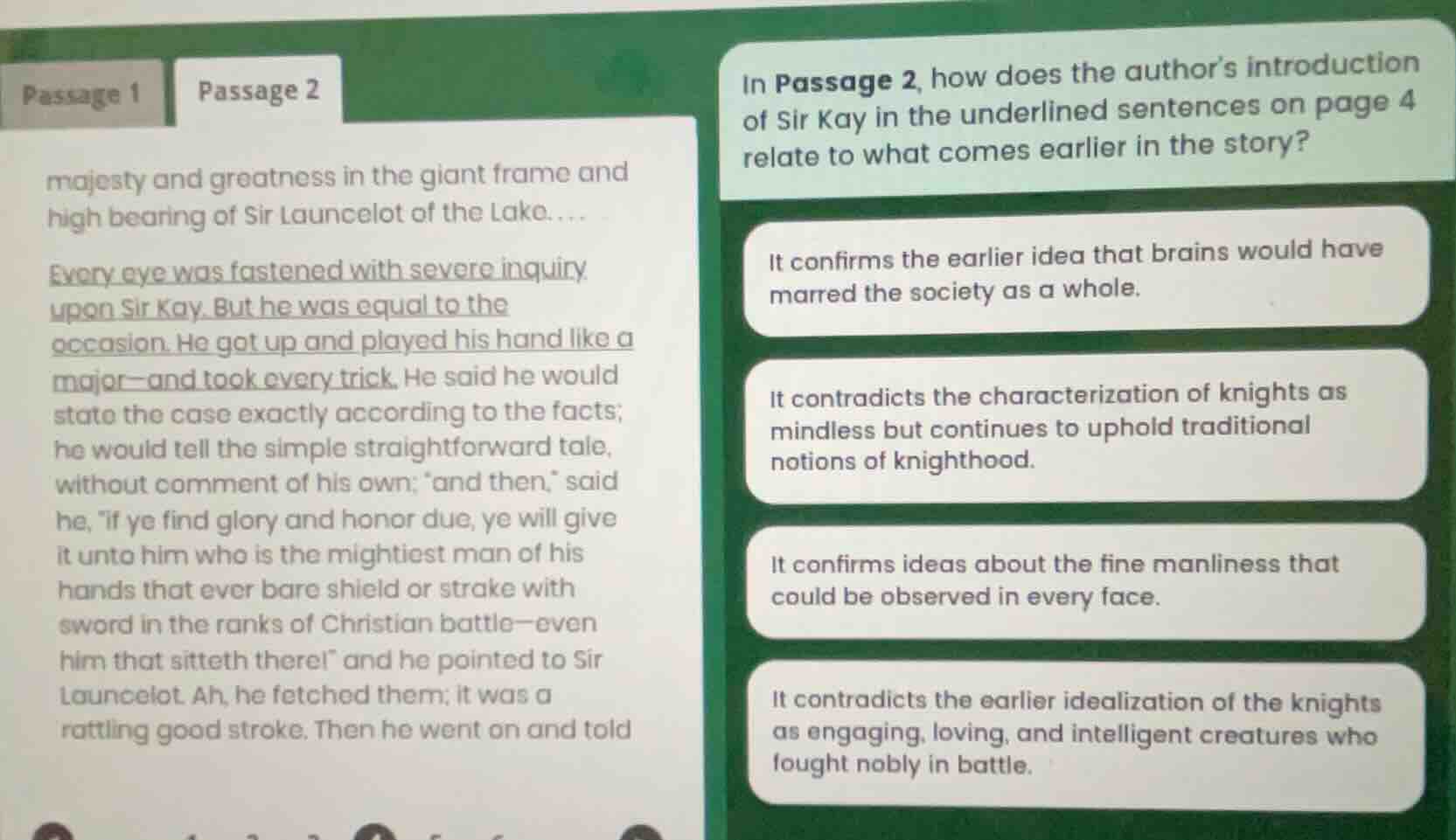
majesty and greatness in the giant frame and high bearing of sir launcelot of the lake....
every eye was fastened with severe inquiry upon sir kay. but he was equal to the occasion. he got up and played his hand like a major—and took every trick. he said he would state the case exactly according to the facts; he would tell the simple straightforward tale, without comment of his own; “and then,” said he, “if ye find glory and honor due, ye will give it unto him who is the mightiest man of his hands that ever bare shield or strake with sword in the ranks of christian battle—even him that sitteth there!” and he pointed to sir launcelot. ah, he fetched them; it was a rattling good stroke. then he went on and told
in passage 2, how does the author’s introduction of sir kay in the underlined sentences on page 4 relate to what comes earlier in the story?
it confirms the earlier idea that brains would have marred the society as a whole.
it contradicts the characterization of knights as mindless but continues to uphold traditional notions of knighthood.
it confirms ideas about the fine manliness that could be observed in every face.
it contradicts the earlier idealization of the knights as engaging, loving, and intelligent creatures who fought nobly in battle.
The opening of Passage 2 establishes Sir Launcelot as a paragon of knightly majesty and greatness. The underlined section shows Sir Kay, another knight, demonstrating sharp, composed, strategic thinking (handling the occasion "like a major," stating facts precisely to direct glory to the worthy). This pushes back against any implicit idea that knights are mindless, while still upholding the core knightly value of honoring true prowess. The other options are incorrect: there is no earlier claim about brains harming society, the text does not reference "fine manliness in every face," and it does not contradict an idealization of knights as intelligent/noble.

Snap & solve any problem in the app
Get step-by-step solutions on Sovi AI
Photo-based solutions with guided steps
Explore more problems and detailed explanations
It contradicts the characterization of knights as mindless but continues to uphold traditional notions of knighthood.