QUESTION IMAGE
Question
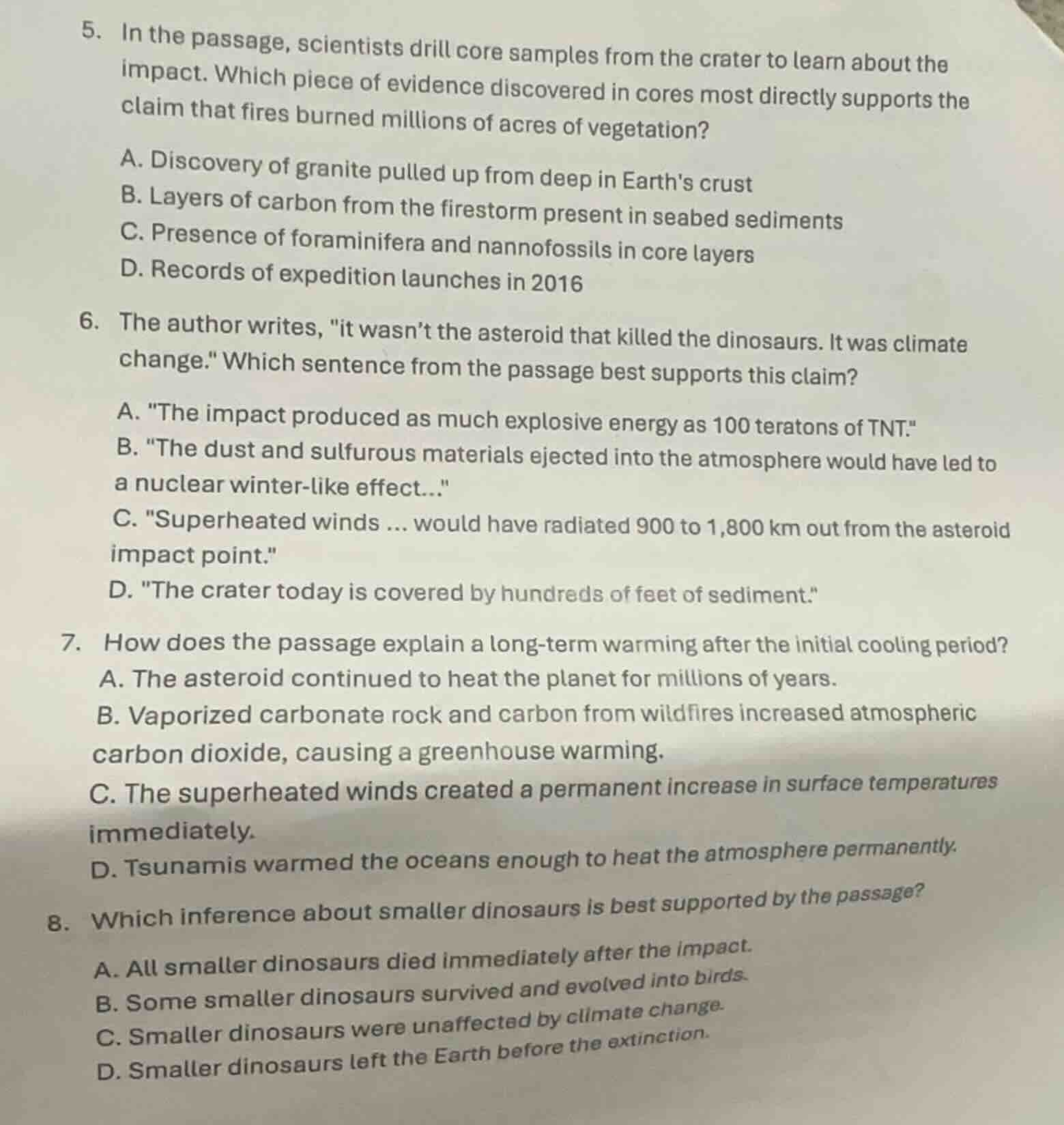
- in the passage, scientists drill core samples from the crater to learn about the impact. which piece of evidence discovered in cores most directly supports the claim that fires burned millions of acres of vegetation?
a. discovery of granite pulled up from deep in earths crust
b. layers of carbon from the firestorm present in seabed sediments
c. presence of foraminifera and nannofossils in core layers
d. records of expedition launches in 2016
- the author writes, \it wasnt the asteroid that killed the dinosaurs. it was climate change.\ which sentence from the passage best supports this claim?
a. \the impact produced as much explosive energy as 100 teratons of tnt.\
b. \the dust and sulfurous materials ejected into the atmosphere would have led to a nuclear winter - like effect...\
c. \superheated winds... would have radiated 900 to 1,800 km out from the asteroid impact point.\
d. \the crater today is covered by hundreds of feet of sediment.\
- how does the passage explain a long - term warming after the initial cooling period?
a. the asteroid continued to heat the planet for millions of years.
b. vaporized carbonate rock and carbon from wildfires increased atmospheric carbon dioxide, causing a greenhouse warming.
c. the superheated winds created a permanent increase in surface temperatures immediately.
d. tsunamis warmed the oceans enough to heat the atmosphere permanently.
- which inference about smaller dinosaurs is best supported by the passage?
a. all smaller dinosaurs died immediately after the impact.
b. some smaller dinosaurs survived and evolved into birds.
c. smaller dinosaurs were unaffected by climate change.
d. smaller dinosaurs left the earth before the extinction.
Question 5
To support the claim that fires burned millions of acres of vegetation, we need evidence related to fire - related residues. Option A (granite from Earth's crust) is about geological material, not fire. Option C (foraminifera and nannofossils) are marine organisms, not related to fire. Option D (expedition launches in 2016) is about human activity, not fire evidence. Option B (layers of carbon from the firestorm in seabed sediments) is directly related to fire as carbon from firestorms would be a residue of burning vegetation.
The claim is that climate change (not the asteroid directly) killed the dinosaurs. Option A is about the energy of the impact, not climate change. Option C is about superheated winds, which is a direct impact effect. Option D is about the current state of the crater. Option B (dust and sulfurous materials in the atmosphere leading to a nuclear - winter - like effect) explains how the asteroid impact caused climate change (cooling) that would kill dinosaurs.
We need to find how the passage explains long - term warming after initial cooling. Option A is incorrect as an asteroid can't heat the planet for millions of years. Option C (superheated winds creating permanent surface temperature increase immediately) is about immediate effects, not long - term warming. Option D (tsunamis warming oceans permanently) is not a valid long - term warming mechanism. Option B (vaporized carbonate rock and carbon from wildfires increasing atmospheric carbon dioxide, causing greenhouse warming) is a valid mechanism for long - term warming as carbon dioxide is a greenhouse gas.

Snap & solve any problem in the app
Get step-by-step solutions on Sovi AI
Photo-based solutions with guided steps
Explore more problems and detailed explanations
B. Layers of carbon from the firestorm present in seabed sediments