QUESTION IMAGE
Question
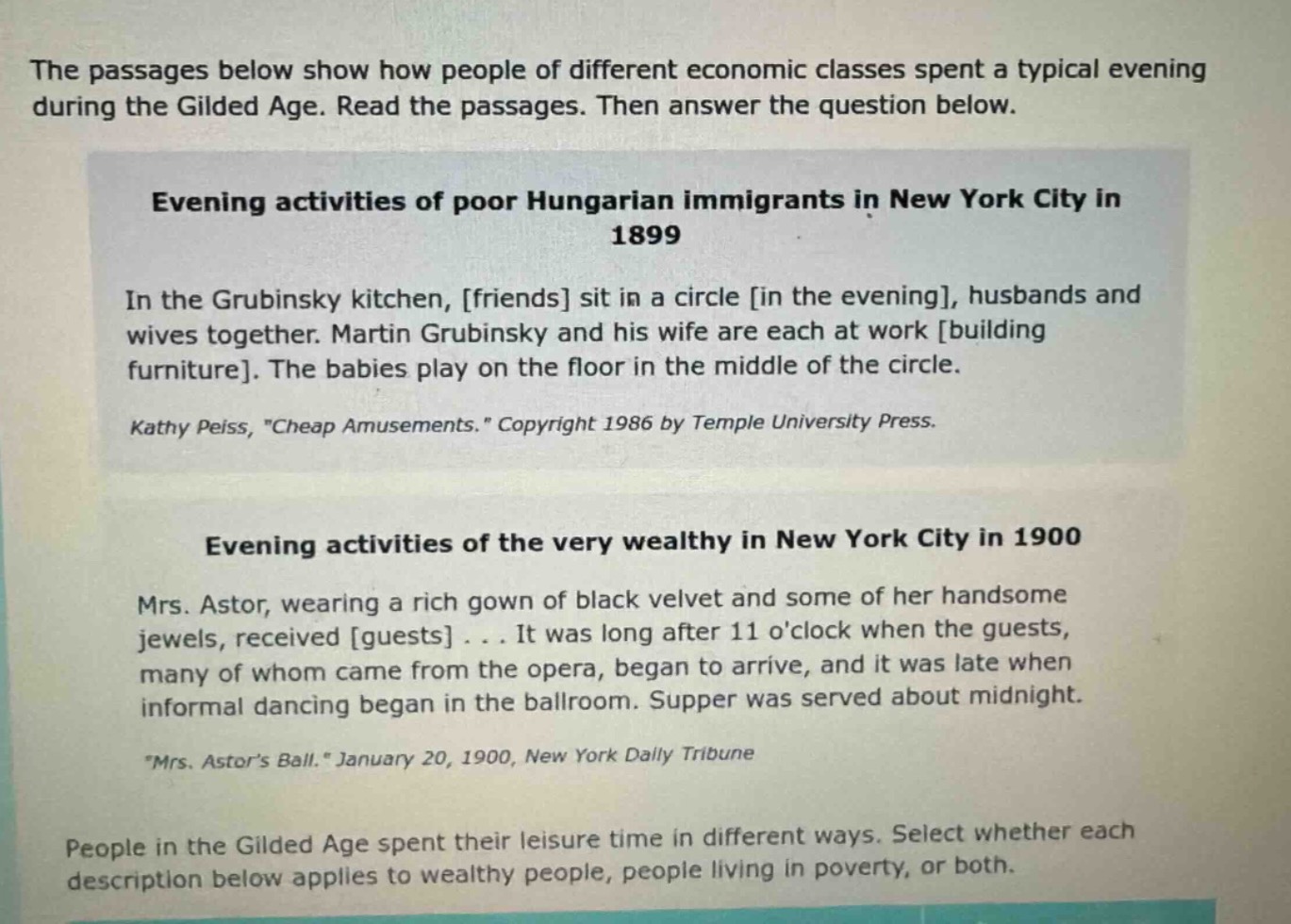
the passages below show how people of different economic classes spent a typical evening during the gilded age. read the passages. then answer the question below. evening activities of poor hungarian immigrants in new york city in 1899 in the grubinsky kitchen, friends sit in a circle in the evening, husbands and wives together. martin grubinsky and his wife are each at work building furniture. the babies play on the floor in the middle of the circle. kathy peiss, \cheap amusements.\ copyright 1986 by temple university press. evening activities of the very wealthy in new york city in 1900 mrs. astor, wearing a rich gown of black velvet and some of her handsome jewels, received guests... it was long after 11 oclock when the guests, many of whom came from the opera, began to arrive, and it was late when informal dancing began in the ballroom. supper was served about midnight. \mrs. astors ball.\ january 20, 1900, new york daily tribune people in the gilded age spent their leisure time in different ways. select whether each description below applies to wealthy people, people living in poverty, or both.
Since the specific descriptions to classify (whether they apply to wealthy people, people in poverty, or both) are not provided, we can't complete the task yet. However, here's how we would approach it if the descriptions were given:
For each description:
- Analyze the details of the description (e.g., type of activity, setting, time, resources involved).
- Compare with the two passages:
- For the poor Hungarian immigrants: The activity is in a kitchen, involves working (building furniture) even in the evening, and is a simple, home - based gathering with friends and family (babies playing on the floor).
- For the very wealthy: The activity is a formal reception (Mrs. Astor receiving guests), involves going to the opera, dancing in a ballroom, and having supper at midnight, with expensive attire (rich gown of black velvet, jewels) and a grand setting (ballroom).
- Based on the comparison, determine if the description matches the wealthy, the poor, or both.
If you could provide the specific descriptions, we can help you classify them.

Snap & solve any problem in the app
Get step-by-step solutions on Sovi AI
Photo-based solutions with guided steps
Explore more problems and detailed explanations
Since the specific descriptions to classify (whether they apply to wealthy people, people in poverty, or both) are not provided, we can't complete the task yet. However, here's how we would approach it if the descriptions were given:
For each description:
- Analyze the details of the description (e.g., type of activity, setting, time, resources involved).
- Compare with the two passages:
- For the poor Hungarian immigrants: The activity is in a kitchen, involves working (building furniture) even in the evening, and is a simple, home - based gathering with friends and family (babies playing on the floor).
- For the very wealthy: The activity is a formal reception (Mrs. Astor receiving guests), involves going to the opera, dancing in a ballroom, and having supper at midnight, with expensive attire (rich gown of black velvet, jewels) and a grand setting (ballroom).
- Based on the comparison, determine if the description matches the wealthy, the poor, or both.
If you could provide the specific descriptions, we can help you classify them.