QUESTION IMAGE
Question
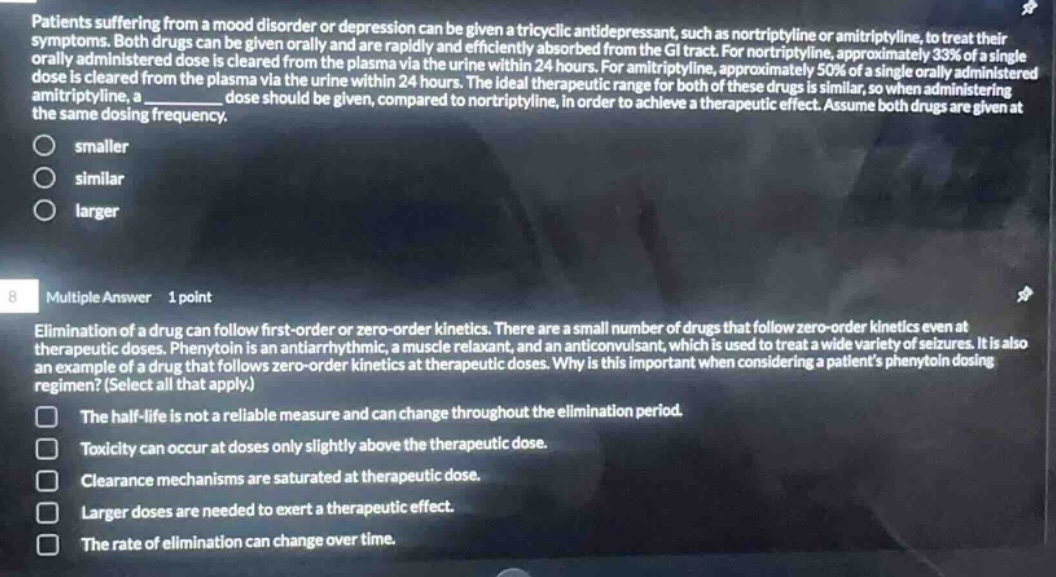
patients suffering from a mood disorder or depression can be given a tricyclic antidepressant, such as nortriptyline or amitriptyline, to treat their symptoms. both drugs can be given orally and are rapidly and efficiently absorbed from the gi tract. for nortriptyline, approximately 33% of a single orally administered dose is cleared from the plasma via the urine within 24 hours. for amitriptyline, approximately 50% of a single orally administered dose is cleared from the plasma via the urine within 24 hours. the ideal therapeutic range for both of these drugs is similar, so when administering amitriptyline, a ______ dose should be given, compared to nortriptyline, in order to achieve a therapeutic effect. assume both drugs are given at the same dosing frequency.
○ smaller
○ similar
○ larger
8 multiple answer 1 point
elimination of a drug can follow first-order or zero-order kinetics. there are a small number of drugs that follow zero-order kinetics even at therapeutic doses. phenytoin is an antiarrhythmic, a muscle relaxant, and an anticonvulsant, which is used to treat a wide variety of seizures. it is also an example of a drug that follows zero-order kinetics at therapeutic doses. why is this important when considering a patients phenytoin dosing regimen? (select all that apply.)
□ the half-life is not a reliable measure and can change throughout the elimination period.
□ toxicity can occur at doses only slightly above the therapeutic dose.
□ clearance mechanisms are saturated at therapeutic dose.
□ larger doses are needed to exert a therapeutic effect.
□ the rate of elimination can change over time.
---
First Question (Top)
Step1: Compare drug clearance rates
Nortriptyline: 33% cleared in 24h; Amitriptyline: 50% cleared in 24h.
Step2: Relate clearance to dose need
Faster clearance means more drug is lost in the same time, so a larger dose is required to maintain the same therapeutic level when dosing frequency is identical.
Zero-order kinetics means drug elimination rate is constant (independent of plasma concentration), which occurs when clearance mechanisms are saturated at therapeutic doses. Key consequences include:
- Half-life is not constant (depends on drug amount, so it changes during elimination).
- Clearance pathways are saturated at therapeutic doses (the defining feature of zero-order here).
- Toxicity can occur with small dose increases, since elimination can't speed up to match higher concentrations.
- Elimination rate is fixed, so it does not change over time (eliminating that option), and larger doses are not inherently needed for therapeutic effect (eliminating that option).

Snap & solve any problem in the app
Get step-by-step solutions on Sovi AI
Photo-based solutions with guided steps
Explore more problems and detailed explanations
larger
---