QUESTION IMAGE
Question
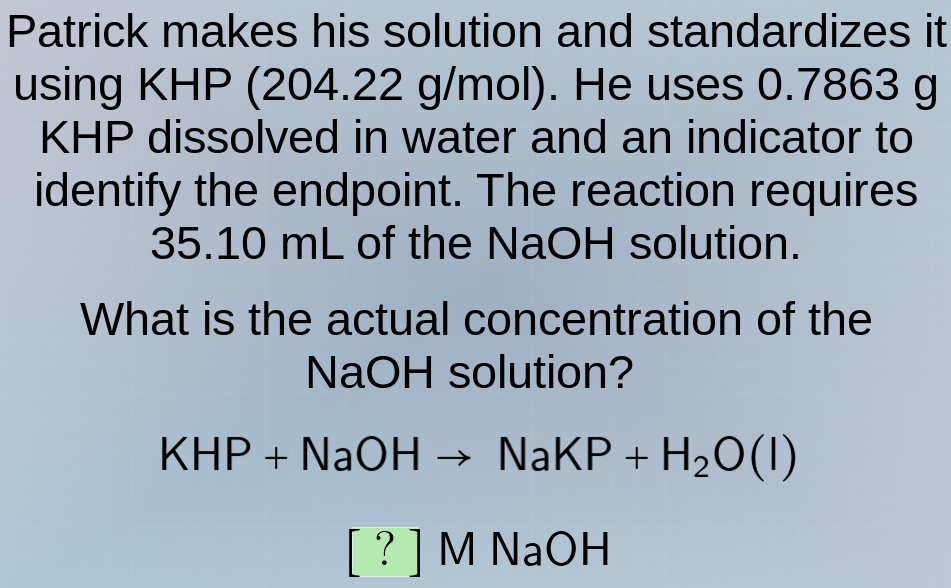
patrick makes his solution and standardizes it using khp (204.22 g/mol). he uses 0.7863 g khp dissolved in water and an indicator to identify the endpoint. the reaction requires 35.10 ml of the naoh solution. what is the actual concentration of the naoh solution? khp + naoh → nakp + h₂o(l) ? m naoh
Step1: Calculate moles of KHP
Moles of KHP = mass / molar mass. Mass of KHP is 0.7863 g, molar mass is 204.22 g/mol. So, moles of KHP = $\frac{0.7863\ g}{204.22\ g/mol}$.
Step2: Determine mole ratio
From the reaction KHP + NaOH → NaKP + H₂O, the mole ratio of KHP to NaOH is 1:1. So moles of NaOH = moles of KHP.
Step3: Calculate concentration of NaOH
Concentration (M) = moles / volume (in L). Volume of NaOH is 35.10 mL = 0.03510 L. So M = (moles of KHP) / 0.03510 L.
First, calculate moles of KHP: $\frac{0.7863}{204.22} \approx 0.00385\ mol$.
Then, concentration of NaOH: $\frac{0.00385\ mol}{0.03510\ L} \approx 0.110\ M$.

Snap & solve any problem in the app
Get step-by-step solutions on Sovi AI
Photo-based solutions with guided steps
Explore more problems and detailed explanations
0.110 (or more precisely, let's do the calculation accurately:
Moles of KHP = 0.7863 / 204.22 = 0.0038502 mol (approx)
Volume of NaOH = 35.10 mL = 0.03510 L
Molarity of NaOH = 0.0038502 / 0.03510 ≈ 0.1097 M ≈ 0.110 M (or 0.1097 M, depending on significant figures. The given values: 0.7863 (4 sig figs), 204.22 (5 sig figs), 35.10 (4 sig figs). So the answer should have 4 sig figs? Wait, 0.7863 / 204.22 = 0.0038502, then divided by 0.03510 (4 sig figs) gives 0.0038502 / 0.03510 = 0.10969 M ≈ 0.1097 M. So more accurately, 0.1097 M, which can be rounded to 0.110 M or 0.1097 M. Let's check the calculation again:
0.7863 ÷ 204.22 = 0.00385017...
0.00385017 ÷ 0.03510 = 0.00385017 / 0.03510 = 0.10969... ≈ 0.1097 M.
So the actual concentration is approximately 0.1097 M, which can be written as 0.110 M (three significant figures) or 0.1097 M (four significant figures).)