QUESTION IMAGE
Question
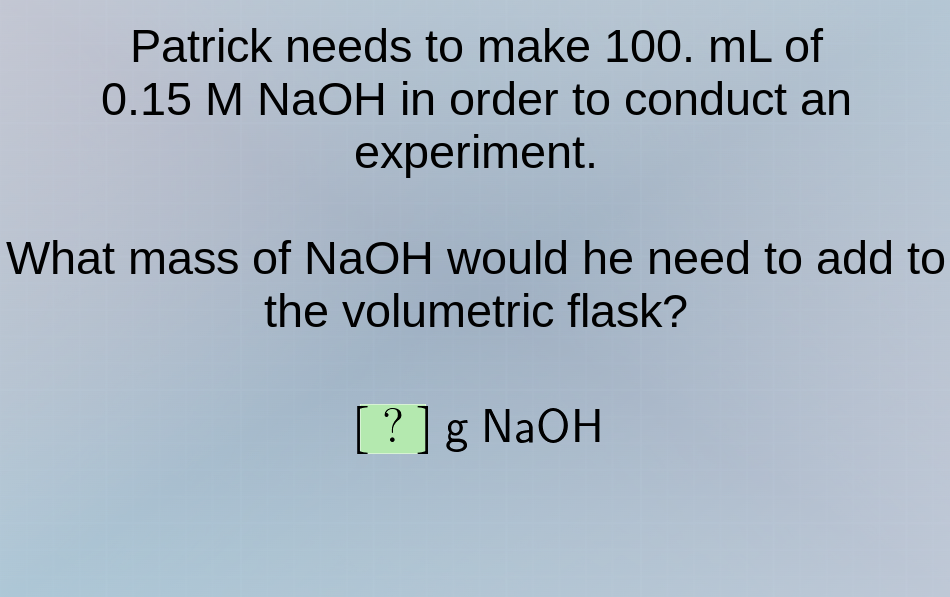
patrick needs to make 100. ml of 0.15 m naoh in order to conduct an experiment. what mass of naoh would he need to add to the volumetric flask? ? g naoh
Step1: Recall the formula for molarity
Molarity ($M$) is defined as moles of solute ($n$) divided by volume of solution in liters ($V$), so $M=\frac{n}{V}$. We can rearrange this to find moles: $n = M\times V$.
The volume is 100. mL, which we convert to liters: $V = 100. \, \text{mL} = \frac{100.}{1000} \, \text{L} = 0.100 \, \text{L}$.
The molarity $M = 0.15 \, \text{M}$.
So, moles of NaOH: $n = 0.15 \, \text{mol/L} \times 0.100 \, \text{L} = 0.015 \, \text{mol}$.
Step2: Calculate molar mass of NaOH
The molar mass of Na (sodium) is approximately 22.99 g/mol, O (oxygen) is 16.00 g/mol, and H (hydrogen) is 1.008 g/mol.
For NaOH, molar mass $M_m = 22.99 + 16.00 + 1.008 = 39.998 \, \text{g/mol} \approx 40.00 \, \text{g/mol}$.
Step3: Find mass using moles and molar mass
Mass ($m$) is moles times molar mass: $m = n \times M_m$.
We have $n = 0.015 \, \text{mol}$ and $M_m = 40.00 \, \text{g/mol}$.
So, $m = 0.015 \, \text{mol} \times 40.00 \, \text{g/mol} = 0.60 \, \text{g}$.

Snap & solve any problem in the app
Get step-by-step solutions on Sovi AI
Photo-based solutions with guided steps
Explore more problems and detailed explanations
0.60