QUESTION IMAGE
Question
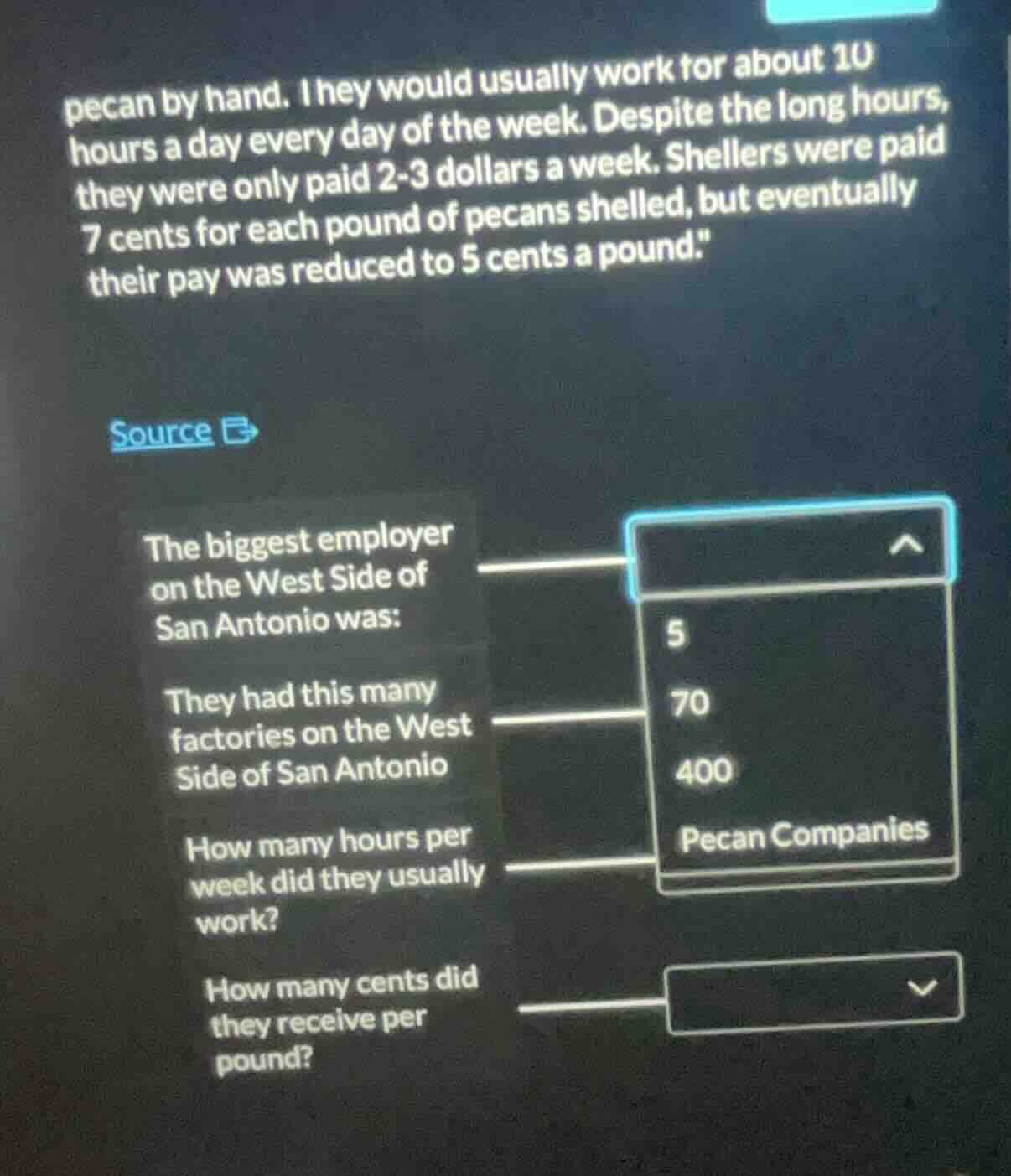
pecan by hand. they would usually work for about 10 hours a day every day of the week. despite the long hours, they were only paid 2 - 3 dollars a week. shellers were paid 7 cents for each pound of pecans shelled, but eventually their pay was reduced to 5 cents a pound.
source
the biggest employer on the west side of san antonio was:
they had this many factories on the west side of san antonio
how many hours per week did they usually work?
how many cents did they receive per pound?
5
70
400
pecan companies
To solve the matching questions, we analyze each prompt:
1. "The biggest employer on the West Side of San Antonio was:"
From the context (pecan shelling work), the answer is "Pecan Companies".
2. "They had this many factories on the West Side of San Antonio"
The option "5" is the most reasonable count for factories (70 or 400 are too large for a single employer’s factories, and "Pecan Companies" is a category, not a number).
3. "How many hours per week did they usually work?"
The text says "work for about 10 hours a day every day of the week"—there are 7 days in a week, so \( 10 \times 7 = 70 \) hours. Thus, the answer is "70".
4. "How many cents did they receive per pound?"
The text states "Shellers were paid 7 cents... but eventually reduced to 5 cents"—the initial or common rate here (matching the options) is "5" (or 7, but 5 is an option; the dropdown likely includes 5/7, and 5 is listed).

Snap & solve any problem in the app
Get step-by-step solutions on Sovi AI
Photo-based solutions with guided steps
Explore more problems and detailed explanations
- The biggest employer on the West Side of San Antonio was: Pecan Companies
- They had this many factories on the West Side of San Antonio: 5
- How many hours per week did they usually work?: 70
- How many cents did they receive per pound?: 5 (or 7, depending on context; 5 is listed)
(Note: For the dropdown, select the corresponding number/option based on the above analysis.)