QUESTION IMAGE
Question
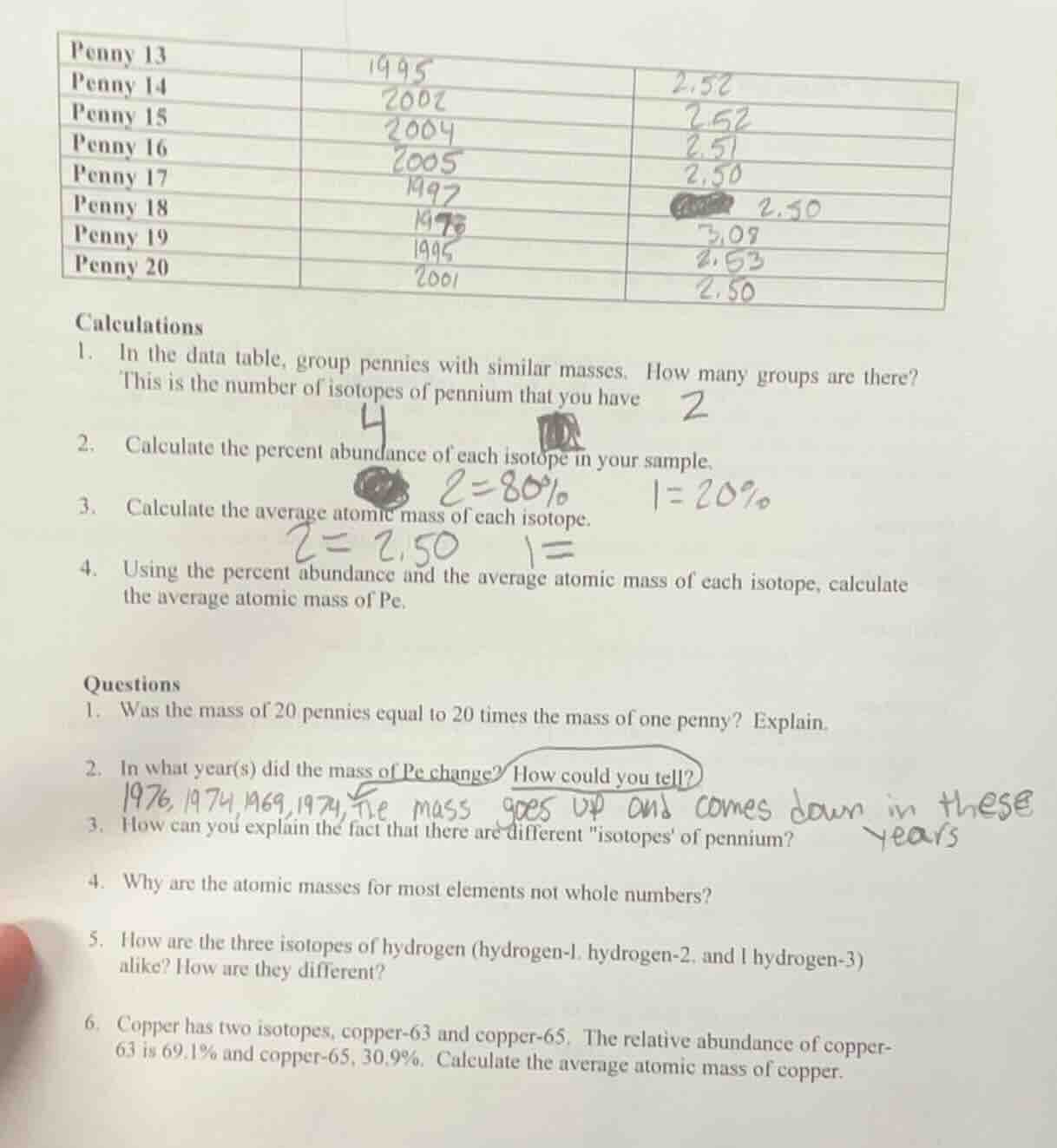
penny 13 1995 2.52
penny 14 2002 2.52
penny 15 2004 2.51
penny 16 2005 2.50
penny 17 1992 2.50
penny 18 1976
penny 19 1995 2.53
penny 20 2001 2.50
calculations
- in the data table, group pennies with similar masses. how many groups are there? this is the number of isotopes of pennium that you have
- calculate the percent abundance of each isotope in your sample.
- calculate the average atomic mass of each isotope.
- using the percent abundance and the average atomic mass of each isotope, calculate the average atomic mass of pe.
questions
- was the mass of 20 pennies equal to 20 times the mass of one penny? explain.
- in what year(s) did the mass of pe change? how could you tell?
- how can you explain the fact that there are different \isotopes of pennium?
- why are the atomic masses for most elements not whole numbers?
- how are the three isotopes of hydrogen (hydrogen - 1, hydrogen - 2, and hydrogen - 3) alike? how are they different?
- copper has two isotopes, copper - 63 and copper - 65. the relative abundance of copper - 63 is 69.1% and copper - 65, 30.9%. calculate the average atomic mass of copper.
Step1: Group pennies by mass
First, list all penny masses: 2.52, 2.52, 2.51, 2.50, 2.50, 3.09, 2.53, 2.50
Group 1 (≈2.50 g): 2.52, 2.52, 2.51, 2.50, 2.50, 2.53, 2.50 (7 pennies)
Group 2 (≈3.09 g): 3.09 (1 penny)
Count of groups = 2
Step2: Calculate percent abundance
Substep2a: Abundance of Group1
Percent abundance = $\frac{\text{Number of pennies in group}}{\text{Total pennies}} \times 100\%$
$\frac{7}{8} \times 100\% = 87.5\%$
Substep2b: Abundance of Group2
$\frac{1}{8} \times 100\% = 12.5\%$
Step3: Average mass of each isotope
Substep3a: Average mass of Group1
$\frac{2.52 + 2.52 + 2.51 + 2.50 + 2.50 + 2.53 + 2.50}{7} = \frac{17.58}{7} \approx 2.51$ g
Substep3b: Average mass of Group2
Only 1 penny, so mass = 3.09 g
Step4: Average atomic mass of Pe
Average mass = $(\text{Mass}_1 \times \text{Abundance}_1) + (\text{Mass}_2 \times \text{Abundance}_2)$
$=(2.51 \times 0.875) + (3.09 \times 0.125)$
$=2.19625 + 0.38625 = 2.5825$ g
Step5: Answer Question 1
No. Pennies have two distinct mass groups (isotopes), so total mass of 20 pennies depends on the mix of the two mass types, not 20×one single penny mass.
Step6: Answer Question 2
The mass changed around 1982 (the data has a 1995 penny with 3.09 g, while most post-1992 are ~2.5 g; pre-1982 pennies were 95% copper, post-1982 are zinc core with copper plating, so mass dropped. The outlier 3.09 g penny is a pre-1982 style, while others are post-1982.
Step7: Answer Question 3
"Pennium isotopes" represent pennies made in different years with different compositions: pre-1982 pennies are mostly copper (higher mass), post-1982 are zinc with thin copper coating (lower mass). These two types are like isotopes (same "element" (penny), different masses due to different "nucleus" (metal composition)).
Step8: Answer Question 4
Atomic masses are weighted averages of the masses of an element's isotopes, accounting for their natural abundances. Since abundances are not whole number fractions, the average is rarely a whole number.
Step9: Answer Question 5
Alike: All have 1 proton (same atomic number, so same element: hydrogen), same chemical properties.
Different: Different number of neutrons: hydrogen-1 has 0 neutrons, hydrogen-2 (deuterium) has 1 neutron, hydrogen-3 (tritium) has 2 neutrons; this gives them different masses.
Step10: Calculate average copper mass
Average mass = $(63 \times 0.691) + (65 \times 0.309)$
$=43.533 + 20.085 = 63.618$ amu

Snap & solve any problem in the app
Get step-by-step solutions on Sovi AI
Photo-based solutions with guided steps
Explore more problems and detailed explanations
- Number of groups (isotopes): 2
- Percent abundance: Group1 (≈2.51 g): 87.5%, Group2 (3.09 g): 12.5%
- Average isotope masses: Group1: ≈2.51 g, Group2: 3.09 g
- Average atomic mass of Pe: ≈2.58 g
- Question 1: No, because pennies have two different mass groups, so total mass is not 20×a single penny mass.
- Question 2: The mass changed around 1982. The outlier 3.09 g penny is a pre-1982 copper penny, while others are post-1982 zinc-core pennies (lower mass), shown by the split in masses.
- Question 3: The two "isotopes" are pennies with different metal compositions: pre-1982 (high copper, high mass) and post-1982 (zinc core, low mass), analogous to isotopes having same identity but different masses.
- Question 4: Atomic masses are weighted averages of an element's isotopes, accounting for their natural abundances, so they are rarely whole numbers.
- Question 5: Alike: All have 1 proton, same chemical properties. Different: Different neutron counts (0,1,2) leading to different masses.
- Average atomic mass of copper: ≈63.62 amu