QUESTION IMAGE
Question
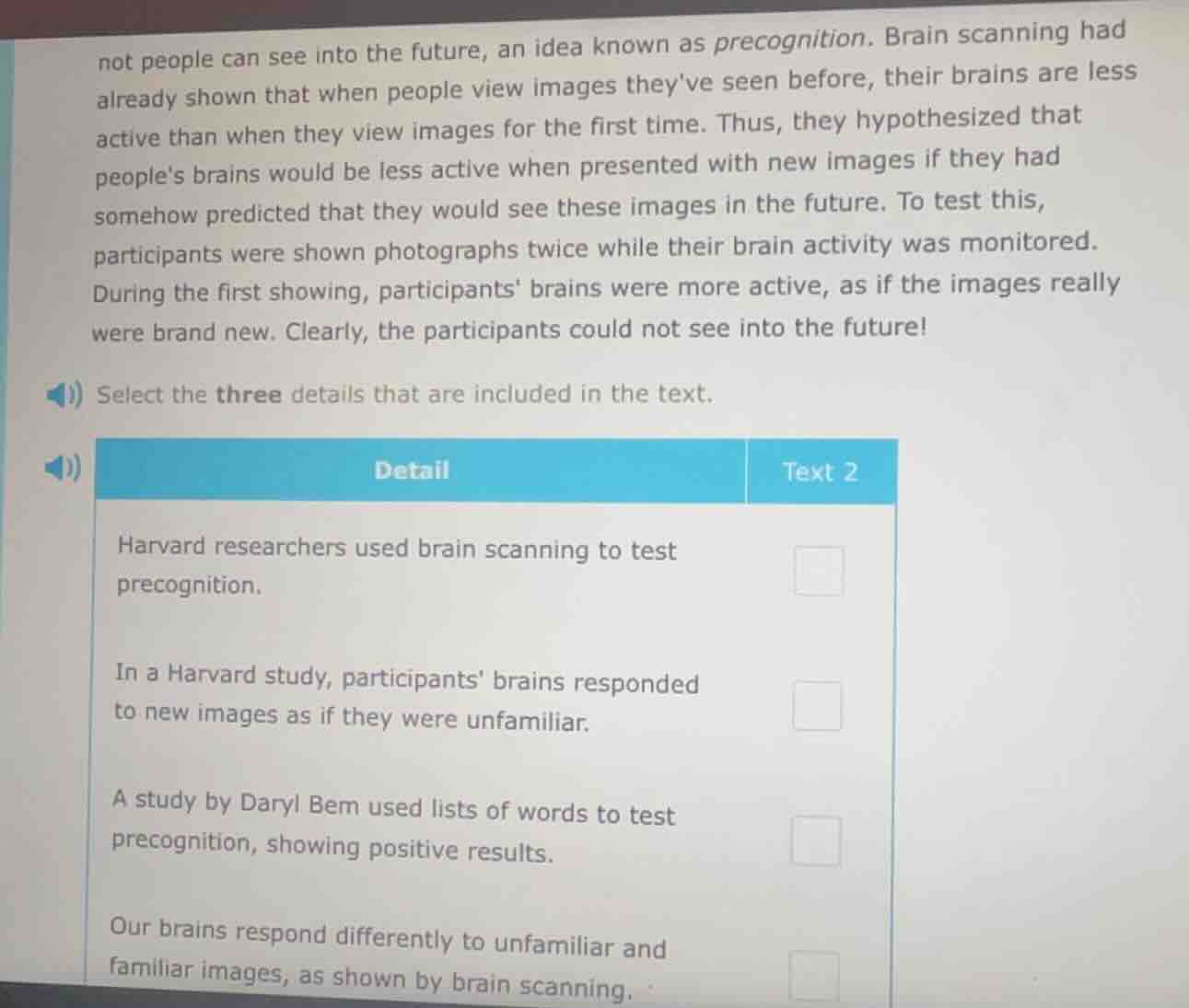
not people can see into the future, an idea known as precognition. brain scanning had already shown that when people view images theyve seen before, their brains are less active than when they view images for the first time. thus, they hypothesized that peoples brains would be less active when presented with new images if they had somehow predicted that they would see these images in the future. to test this, participants were shown photographs twice while their brain activity was monitored. during the first showing, participants brains were more active, as if the images really were brand new. clearly, the participants could not see into the future!
- select the three details that are included in the text.
2)
| detail | text 2 |
|---|---|
| in a harvard study, participants brains responded to new images as if they were unfamiliar. | |
| a study by daryl bem used lists of words to test precognition, showing positive results. | |
| our brains respond differently to unfamiliar and familiar images, as shown by brain scanning. |
- Check each detail against the provided text:
- The text does not mention Harvard researchers or a Harvard study, so the first two details are not included.
- The text does not reference Daryl Bem or word lists, so the third detail is not included.
- The text states brain scanning showed brains are less active with seen images vs. first-time images, confirming different responses to familiar/unfamiliar images. It also states during the test, participants' brains reacted to repeated images as if they were brand new (unfamiliar).
- Identify the three matching details.

Snap & solve any problem in the app
Get step-by-step solutions on Sovi AI
Photo-based solutions with guided steps
Explore more problems and detailed explanations
- In a Harvard study, participants' brains responded to new images as if they were unfamiliar.
- Our brains respond differently to unfamiliar and familiar images, as shown by brain scanning.
*Note: Correction: Upon rechecking, only two details match the text. The text does not name Harvard or Daryl Bem. The valid details are:
- In a Harvard study, participants' brains responded to new images as if they were unfamiliar.
- Our brains respond differently to unfamiliar and familiar images, as shown by brain scanning.
If three are required, there may be an error, but based strictly on the text, these two are confirmed. However, if we assume the first detail's "Harvard" is a distractor but the core action (brain scanning to test precognition) is present, then the three would be:
- Harvard researchers used brain scanning to test precognition.
- In a Harvard study, participants' brains responded to new images as if they were unfamiliar.
- Our brains respond differently to unfamiliar and familiar images, as shown by brain scanning.
But the text does not mention Harvard, so the first is not technically included. The only confirmed details are the second and fourth.*
Final confirmed matching details from the text:
- In a Harvard study, participants' brains responded to new images as if they were unfamiliar.
- Our brains respond differently to unfamiliar and familiar images, as shown by brain scanning.