QUESTION IMAGE
Question
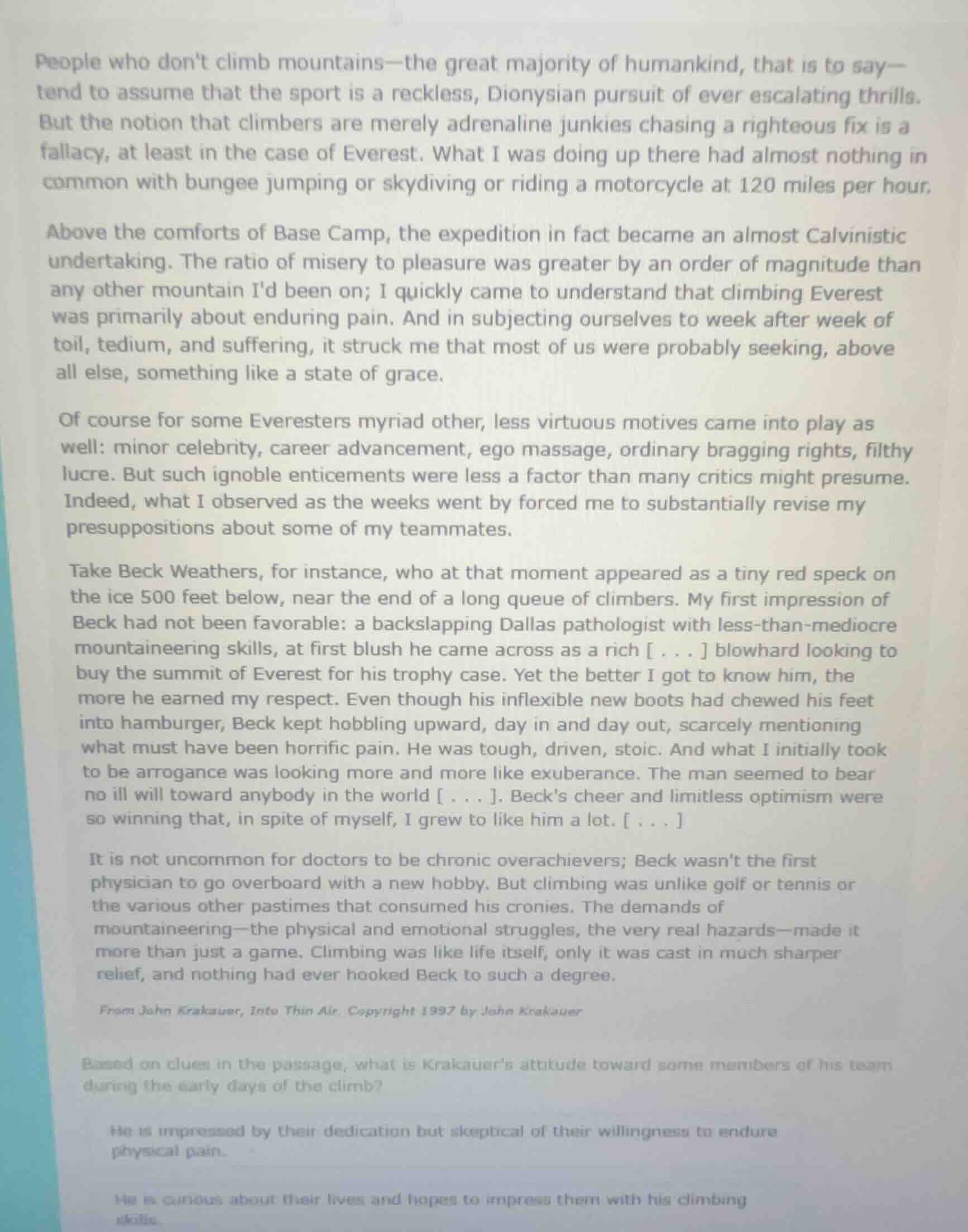
people who dont climb mountains—the great majority of humankind, that is to say—tend to assume that the sport is a reckless, dionysian pursuit of ever escalating thrills. but the notion that climbers are merely adrenaline junkies chasing a righteous fix is a fallacy, at least in the case of everest. what i was doing up there had almost nothing in common with bungee jumping or skydiving or riding a motorcycle at 120 miles per hour.
above the comforts of base camp, the expedition in fact became an almost calvinistic undertaking. the ratio of misery to pleasure was greater by an order of magnitude than any other mountain id been on; i quickly came to understand that climbing everest was primarily about enduring pain. and in subjecting ourselves to week after week of toil, tedium, and suffering, it struck me that most of us were probably seeking, above all else, something like a state of grace.
of course for some everesters myriad other, less virtuous motives came into play as well: minor celebrity, career advancement, ego massage, ordinary bragging rights, filthy lucre. but such ignoble enticements were less a factor than many critics might presume. indeed, what i observed as the weeks went by forced me to substantially revise my presuppositions about some of my teammates.
take beck weathers, for instance, who at that moment appeared as a tiny red speck on the ice 500 feet below, near the end of a long queue of climbers. my first impression of beck had not been favorable: a backslapping dallas pathologist with less - than - mediocre mountaineering skills, at first blush he came across as a rich ... blowhard looking to buy the summit of everest for his trophy case. yet the better i got to know him, the more he earned my respect. even though his inflexible new boots had chewed his feet into hamburger, beck kept hobbling upward, day in and day out, scarcely mentioning what must have been horrific pain. he was tough, driven, stoic. and what i initially took to be arrogance was looking more and more like exuberance. the man seemed to bear no ill will toward anybody in the world .... becks cheer and limitless optimism were so winning that, in spite of myself, i grew to like him a lot. ...
it is not uncommon for doctors to be chronic overachievers; beck wasnt the first physician to go overboard with a new hobby. but climbing was unlike golf or tennis or the various other pastimes that consumed his cronies. the demands of mountaineering—the physical and emotional struggles, the very real hazards—made it more than just a game. climbing was like life itself, only it was cast in much sharper relief, and nothing had ever hooked beck to such a degree.
from john krakauer, into thin air. copyright 1997 by john krakauer
based on clues in the passage, what is krakauers attitude toward some members of his team during the early days of the climb?
he is impressed by their dedication but skeptical of their willingness to endure physical pain.
he is curious about their lives and hopes to impress them with his climbing skills.
The passage states Krakauer initially had an unfavorable view of teammate Beck Weathers, seeing him as a "blowhard looking to buy the summit" with poor mountaineering skills. He also notes he had to "substantially revise my presuppositions about some of my teammates" as the climb went on, showing early skepticism and negative initial judgments. The first option aligns: he was skeptical (doubtful of their true motives/resolve, like thinking Beck was just a trophy-seeker) and later saw their dedication, while the second option does not match the text.

Snap & solve any problem in the app
Get step-by-step solutions on Sovi AI
Photo-based solutions with guided steps
Explore more problems and detailed explanations
He is impressed by their dedication but skeptical of their willingness to endure physical pain.