QUESTION IMAGE
Question
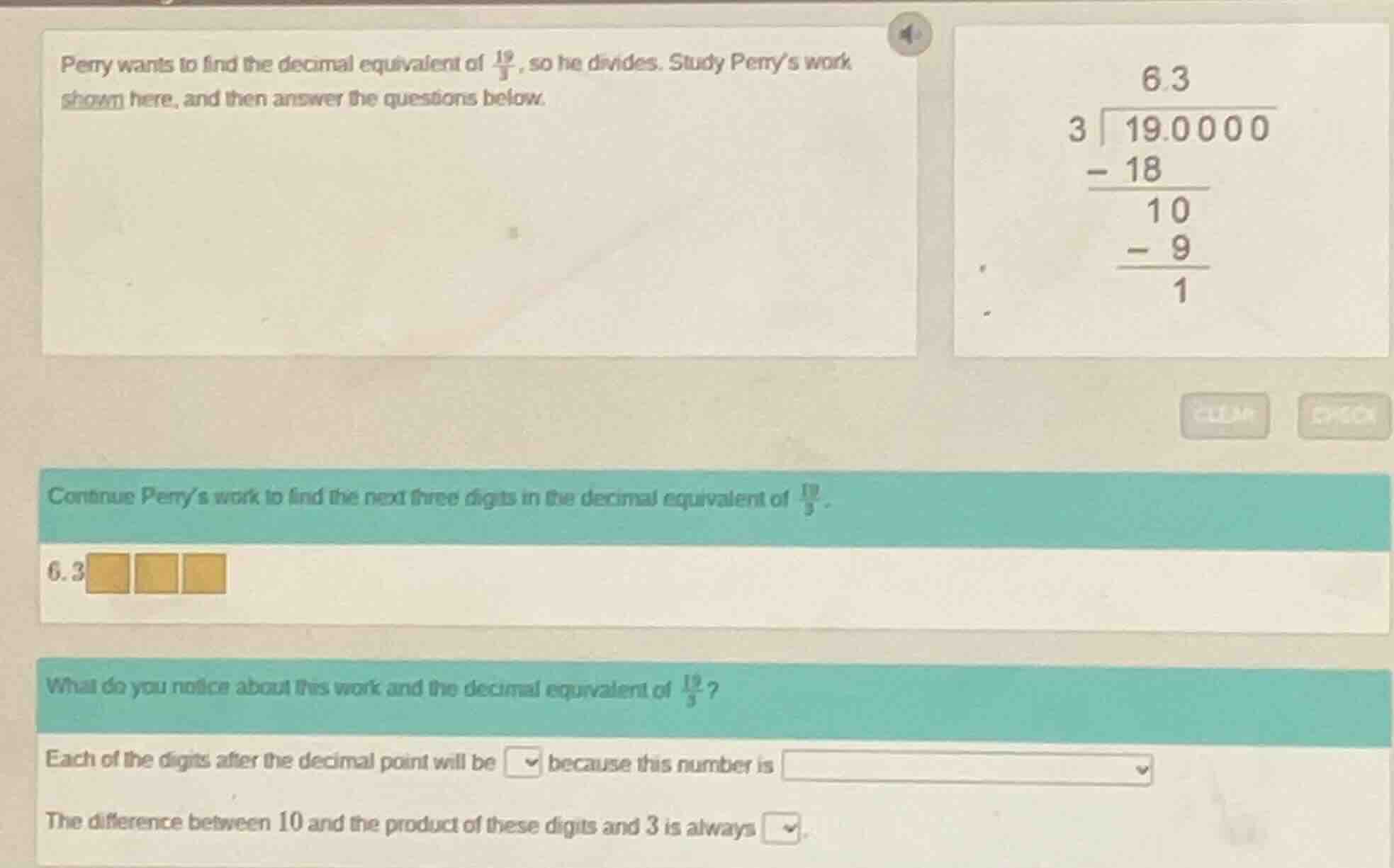
perry wants to find the decimal equivalent of \\(\frac{19}{3}\\), so he divides. study perry’s work shown here, and then answer the questions below.
continue perry’s work to find the next three digits in the decimal equivalent of \\(\frac{19}{3}\\).
\\(6.3\square\square\square\\)
what do you notice about this work and the decimal equivalent of \\(\frac{19}{3}\\)?
each of the digits after the decimal point will be \\(\boldsymbol{\checkmark}\\) because this number is \\(\boldsymbol{\
ule{10em}{0.15em}}\\)
the difference between 10 and the product of these digits and 3 is always \\(\boldsymbol{\checkmark}\\).
Step1: Bring down next 0
Current remainder: $1$, append 0 to get $10$
Step2: Divide 10 by 3
$10 \div 3 = 3$, remainder $10 - (3 \times 3) = 1$
Step3: Repeat for second digit
Append 0 to remainder 1 to get $10$, $10 \div 3 = 3$, remainder $1$
Step4: Repeat for third digit
Append 0 to remainder 1 to get $10$, $10 \div 3 = 3$, remainder $1$
Each digit after the decimal repeats because the division remainder cycles infinitely. The consistent remainder of 1 creates a repeating decimal pattern.

Snap & solve any problem in the app
Get step-by-step solutions on Sovi AI
Photo-based solutions with guided steps
Explore more problems and detailed explanations
Next three digits: 3, 3, 3