QUESTION IMAGE
Question
personal management
scouts name:
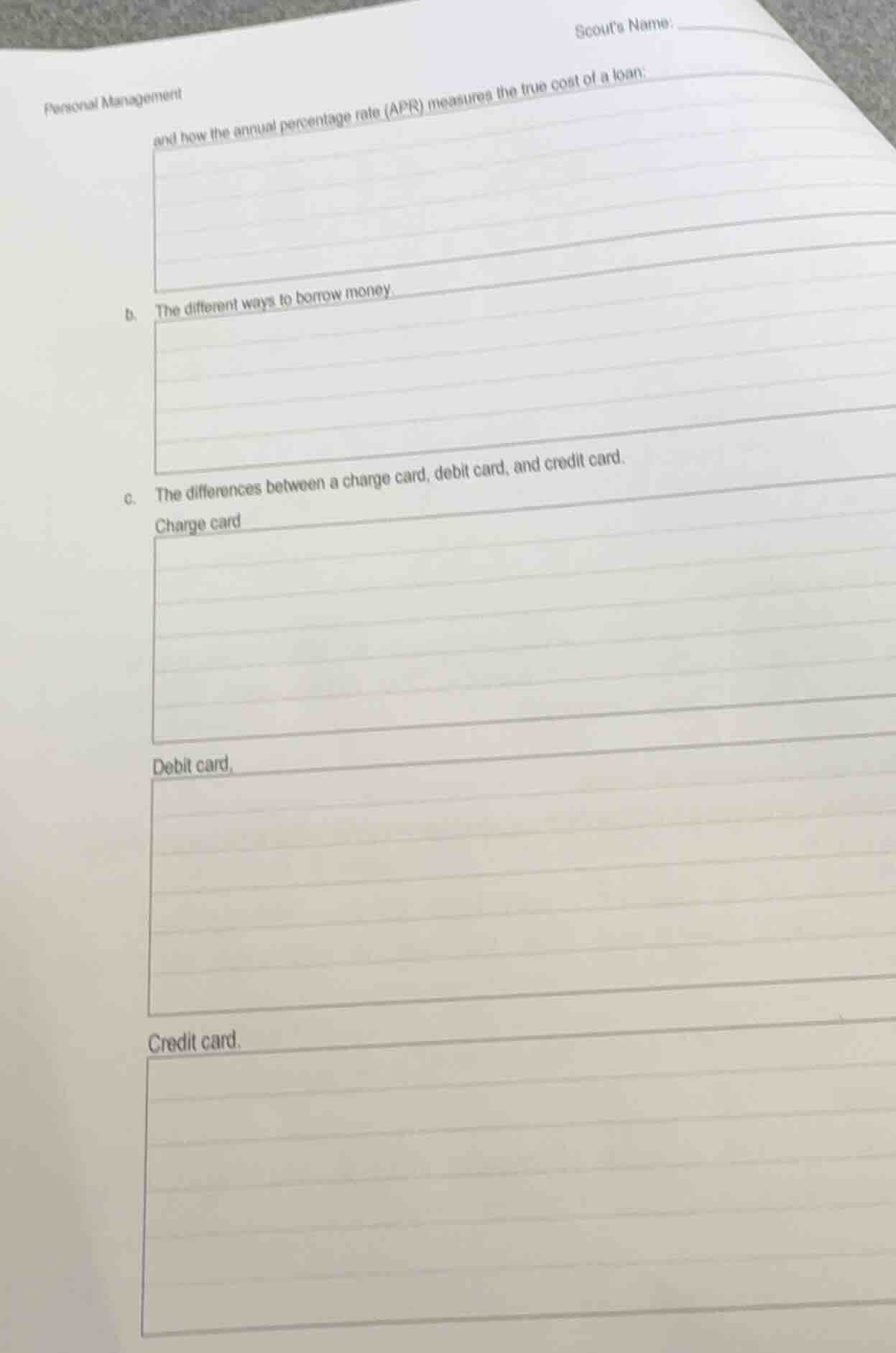
and how the annual percentage rate (apr) measures the true cost of a loan;
b. the different ways to borrow money
c. the differences between a charge card, debit card, and credit card.
charge card
debit card,
credit card.
Part a: APR and Loan Cost
APR (Annual Percentage Rate) includes interest and fees for a loan, expressed as an annual rate. It helps borrowers compare loan costs by showing the true annual cost of borrowing, accounting for compounding and additional charges. For example, a loan with a 5% interest rate and 1% fees has a higher APR than 5%, reflecting the total cost.
Common methods to borrow money include: 1) Personal Loans: Fixed-term loans from banks/credit unions, with set payments. 2) Credit Cards: Revolving credit, allowing borrowing up to a limit, with interest if not paid in full. 3) Mortgages: Loans for real estate, secured by the property. 4) Auto Loans: Secured loans for vehicle purchases. 5) Payday Loans: Short-term, high-interest loans (risky). 6) Home Equity Loans/Lines of Credit (HELOC): Borrow against home equity, with lower interest (secured by home). 7) Student Loans: For education, with favorable terms (federal loans have income-driven repayment).
A charge card requires the full balance to be paid each month (no revolving credit). It often has no preset spending limit (but has a "soft" limit based on creditworthiness) and may have annual fees. Examples: American Express Platinum.

Snap & solve any problem in the app
Get step-by-step solutions on Sovi AI
Photo-based solutions with guided steps
Explore more problems and detailed explanations
APR measures the true cost of a loan by combining the interest rate with any fees or additional costs associated with borrowing, expressed as an annual percentage. It allows borrowers to compare the total annual cost of different loans (including compounding effects and fees) to determine which loan is more expensive overall.