QUESTION IMAGE
Question
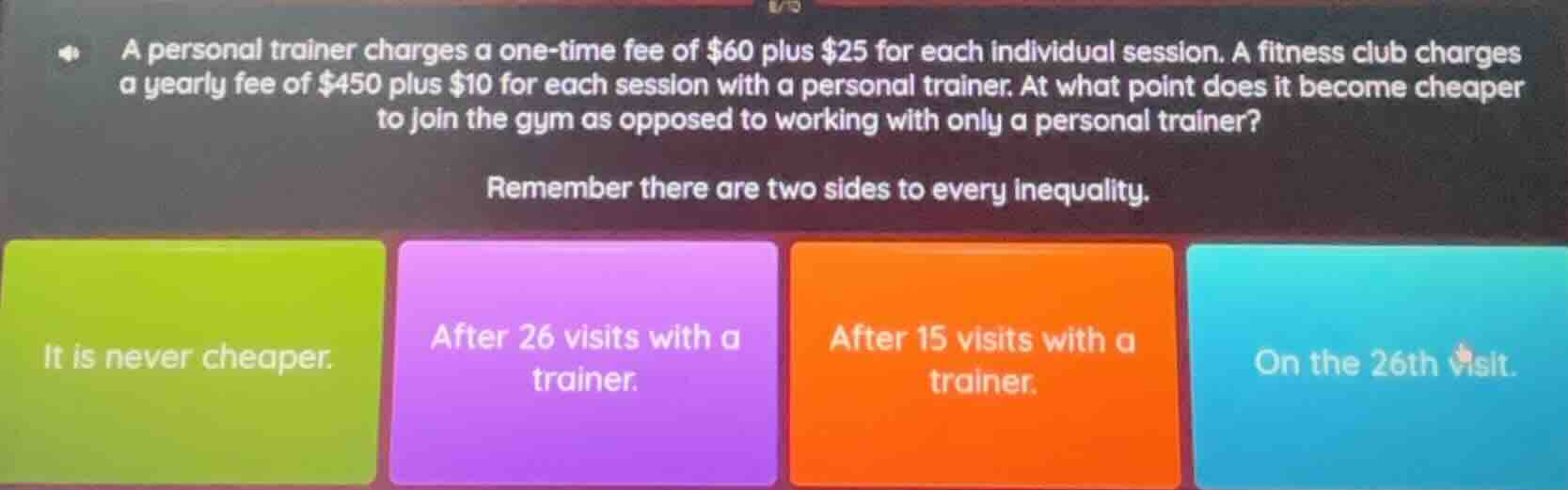
a personal trainer charges a one - time fee of $60 plus $25 for each individual session. a fitness club charges a yearly fee of $450 plus $10 for each session with a personal trainer. at what point does it become cheaper to join the gym as opposed to working with only a personal trainer? remember there are two sides to every inequality. it is never cheaper. after 26 visits with a trainer. after 15 visits with a trainer. on the 26th visit.
Step1: Define cost functions
Let \( x \) be the number of sessions. The cost for the personal trainer (\( C_{pt} \)) is \( C_{pt}=60 + 25x \). The cost for the fitness club (\( C_{fc} \)) is \( C_{fc}=450 + 10x \). We want to find when \( C_{fc} Subtract \( 10x \) from both sides: \( 450<60 + 15x \). Then subtract 60 from both sides: \( 390<15x \). Divide both sides by 15: \( x > 26 \). Wait, no, wait. Wait, let's re - do the inequality. Wait, \( C_{fc} \( 450-60<25x - 10x \) \( 390<15x \) \( x > \frac{390}{15}=26 \). So when \( x>26 \), the gym is cheaper. But the options: "After 26 visits with a trainer" – wait, if \( x = 27 \), then it's after 26 visits. Wait, maybe the inequality was set up wrong. Wait, maybe we should set \( C_{fc}\leq C_{pt} \)? No, the question is "when does it become cheaper", so strictly less. Wait, let's check the cost at \( x = 26 \): Personal trainer: \( 60+25\times26=60 + 650 = 710 \) Gym: \( 450+10\times26=450 + 260 = 710 \) At \( x = 27 \): Personal trainer: \( 60+25\times27=60 + 675 = 735 \) Gym: \( 450+10\times27=450 + 270 = 720 \) So at \( x = 27 \), the gym is cheaper, which is after 26 visits (since 27 is after 26). So the correct option is "After 26 visits with a trainer".Step2: Solve the inequality

Snap & solve any problem in the app
Get step-by-step solutions on Sovi AI
Photo-based solutions with guided steps
Explore more problems and detailed explanations
B. After 26 visits with a trainer.