QUESTION IMAGE
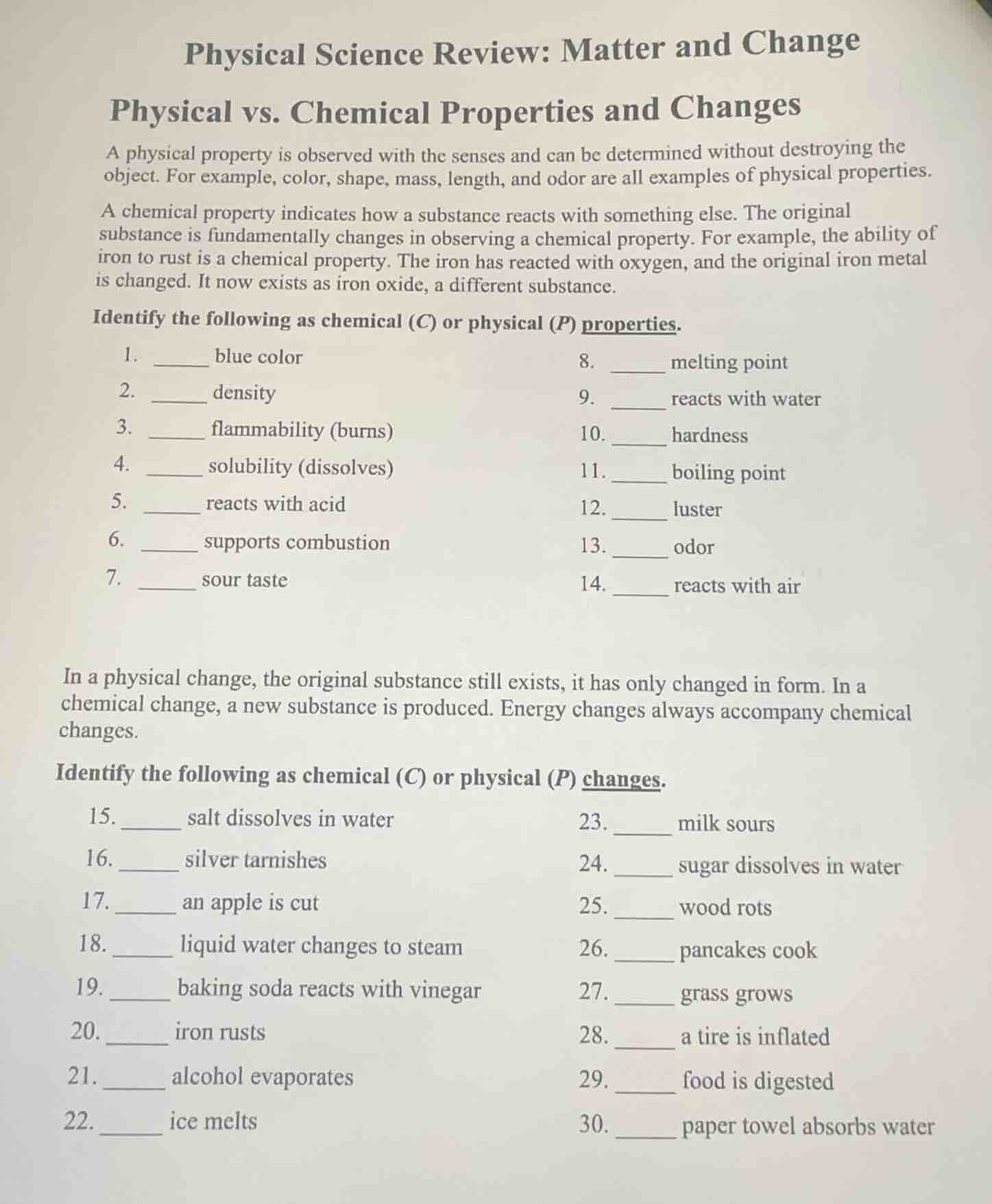
Question
physical science review: matter and change
physical vs. chemical properties and changes
a physical property is observed with the senses and can be determined without destroying the
object. for example, color, shape, mass, length, and odor are all examples of physical properties.
a chemical property indicates how a substance reacts with something else. the original
substance is fundamentally changes in observing a chemical property. for example, the ability of
iron to rust is a chemical property. the iron has reacted with oxygen, and the original iron metal
is changed. it now exists as iron oxide, a different substance.
identify the following as chemical (c) or physical (p) properties.
- ____ blue color 8. ____ melting point
- ____ density 9. ____ reacts with water
- ____ flammability (burns) 10. ____ hardness
- ____ solubility (dissolves) 11. ____ boiling point
- ____ reacts with acid 12. ____ luster
- ____ supports combustion 13. ____ odor
- ____ sour taste 14. ____ reacts with air
in a physical change, the original substance still exists, it has only changed in form. in a
chemical change, a new substance is produced. energy changes always accompany chemical
changes.
identify the following as chemical (c) or physical (p) changes.
- ____ salt dissolves in water 23. ____ milk sours
- ____ silver tarnishes 24. ____ sugar dissolves in water
- ____ an apple is cut 25. ____ wood rots
- ____ liquid water changes to steam 26. ____ pancakes cook
- ____ baking soda reacts with vinegar 27. ____ grass grows
- ____ iron rusts 28. ____ a tire is inflated
- ____ alcohol evaporates 29. ____ food is digested
- ____ ice melts 30. ____ paper towel absorbs water
Physical properties are observable without altering the substance's identity; chemical properties involve reactivity that changes the substance. Physical changes alter form but not substance identity; chemical changes create new substances.

Snap & solve any problem in the app
Get step-by-step solutions on Sovi AI
Photo-based solutions with guided steps
Explore more problems and detailed explanations
Properties (C = Chemical, P = Physical)
- P blue color
- P density
- C flammability (burns)
- P solubility (dissolves)
- C reacts with acid
- C supports combustion
- P sour taste
- P melting point
- C reacts with water
- P hardness
- P boiling point
- P luster
- P odor
- C reacts with air
Changes (C = Chemical, P = Physical)
- P salt dissolves in water
- C silver tarnishes
- P an apple is cut
- P liquid water changes to steam
- C baking soda reacts with vinegar
- C iron rusts
- P alcohol evaporates
- P ice melts
- C milk sours
- P sugar dissolves in water
- C wood rots
- C pancakes cook
- C grass grows
- P a tire is inflated
- C food is digested
- P paper towel absorbs water