QUESTION IMAGE
Question
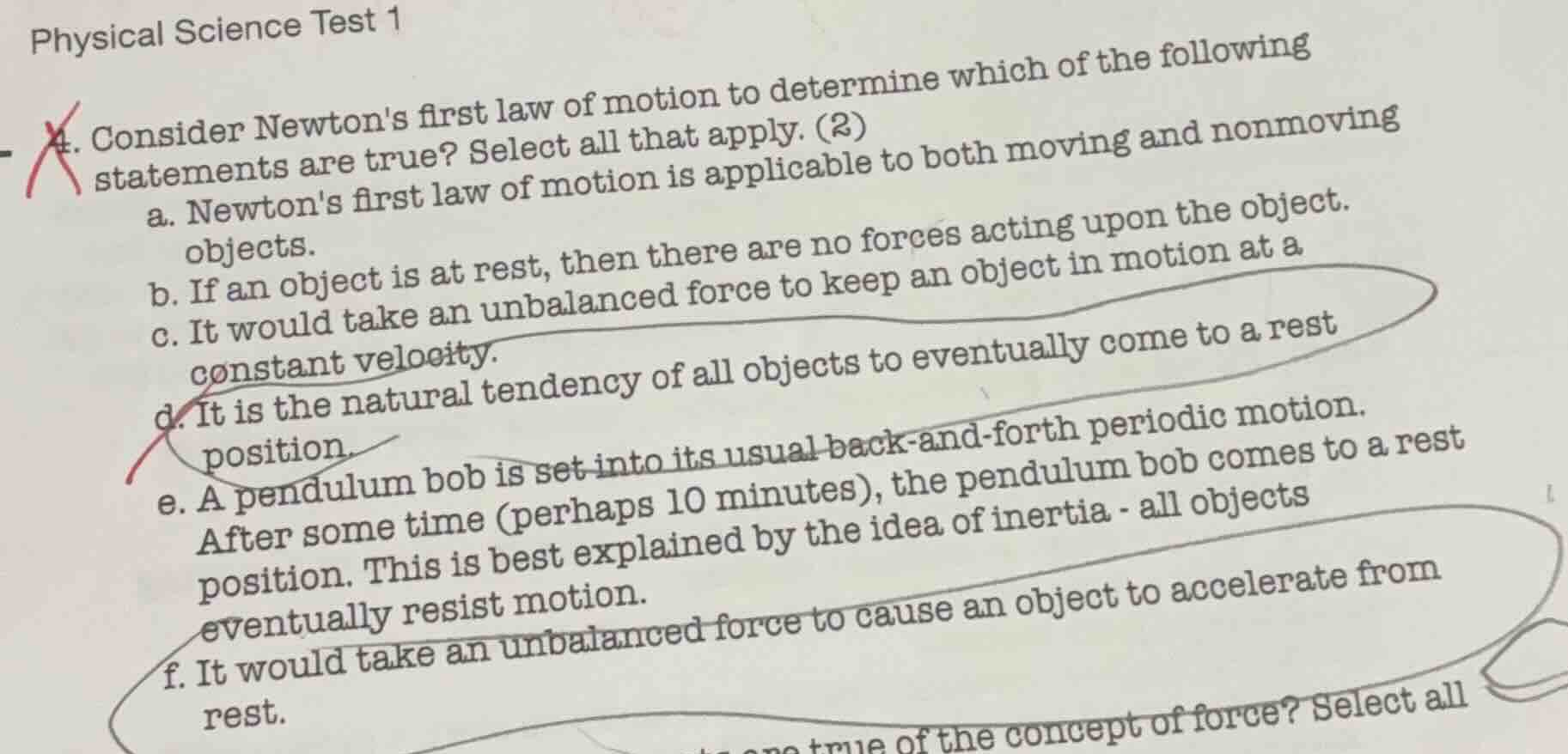
physical science test 1
- consider newtons first law of motion to determine which of the following statements are true? select all that apply. (2)
a. newtons first law of motion is applicable to both moving and nonmoving objects.
b. if an object is at rest, then there are no forces acting upon the object.
c. it would take an unbalanced force to keep an object in motion at a constant velocity.
d. it is the natural tendency of all objects to eventually come to a rest position.
e. a pendulum bob is set into its usual back - and - forth periodic motion. after some time (perhaps 10 minutes), the pendulum bob comes to a rest position. this is best explained by the idea of inertia - all objects eventually resist motion.
f. it would take an unbalanced force to cause an object to accelerate from rest.
of the concept of force? select all
- Option a: Newton's first law (law of inertia) applies to all objects, whether moving (with constant velocity) or non - moving (at rest). So this statement is true.
- Option b: An object at rest can have balanced forces acting on it (e.g., gravity and normal force on a book on a table). So the claim that no forces act on a resting object is false.
- Option c: According to Newton's first law, an object in motion at constant velocity will continue in that state without the need for an unbalanced force. An unbalanced force is needed to change the velocity (accelerate or decelerate), not to maintain constant velocity. So this statement is false.
- Option d: Objects do not have a natural tendency to come to rest. In the absence of unbalanced forces, moving objects stay in motion and resting objects stay at rest. So this statement is false.
- Option e: A pendulum bob comes to rest due to air resistance and friction (unbalanced forces), not because objects "resist motion" in the way described. Inertia is the resistance to change in motion, not a resistance to motion itself. So this statement is false.
- Option f: To accelerate an object from rest (change its velocity from 0), an unbalanced force must be applied (Newton's second law is related here, but Newton's first law also implies that a force is needed to overcome inertia and start motion). So this statement is true.

Snap & solve any problem in the app
Get step-by-step solutions on Sovi AI
Photo-based solutions with guided steps
Explore more problems and detailed explanations
a. Newton's first law of motion is applicable to both moving and nonmoving objects.
f. It would take an unbalanced force to cause an object to accelerate from rest.