QUESTION IMAGE
Question
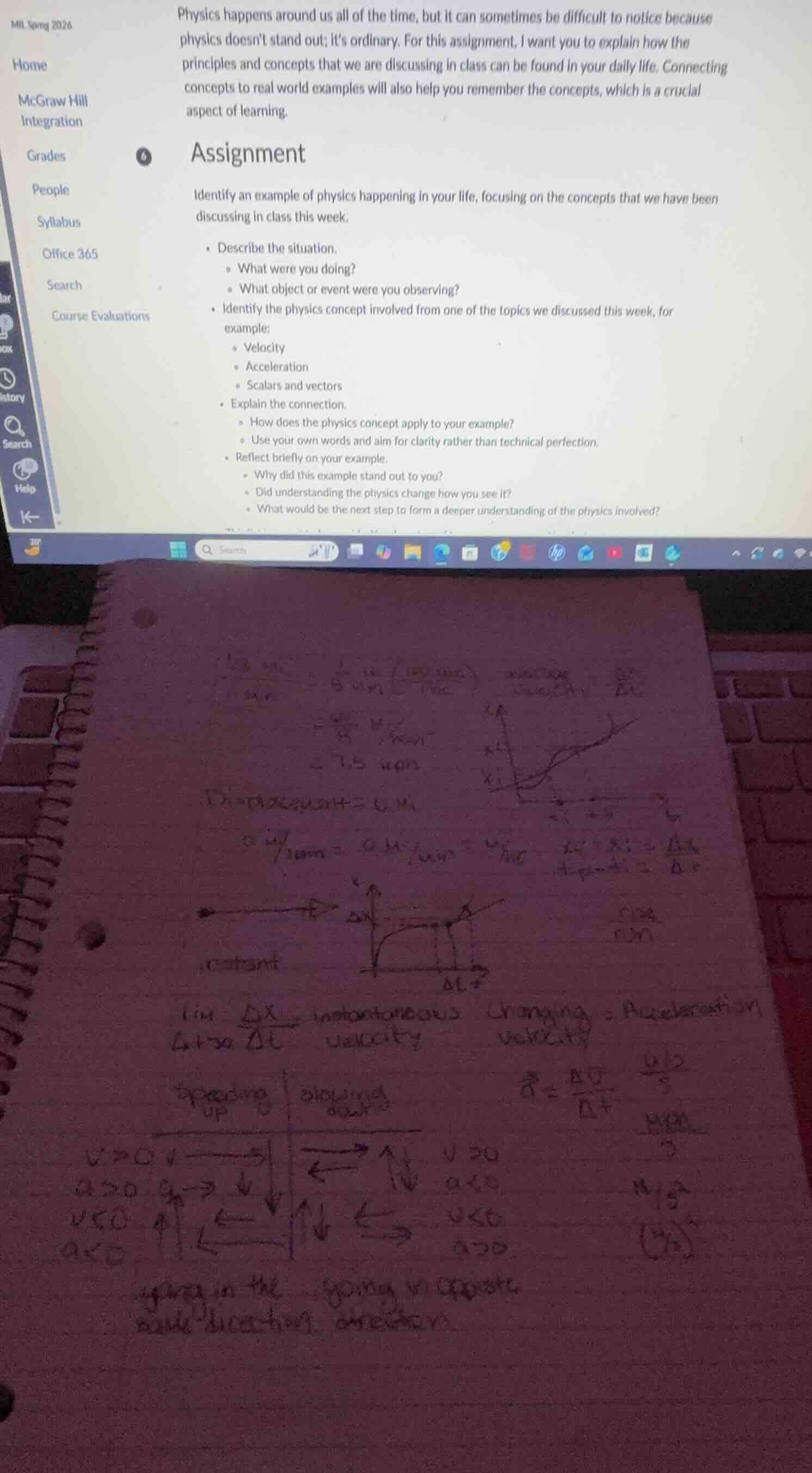
physics happens around us all of the time, but it can sometimes be difficult to notice because physics doesnt stand out; its ordinary. for this assignment, i want you to explain how the principles and concepts that we are discussing in class can be found in your daily life. connecting concepts to real world examples will also help you remember the concepts, which is a crucial aspect of learning.
assignment
identify an example of physics happening in your life, focusing on the concepts that we have been discussing in class this week.
- describe the situation.
- what were you doing?
- what object or event were you observing?
- identify the physics concept involved from one of the topics we discussed this week, for example:
- velocity
- acceleration
- scalars and vectors
- explain the connection.
- how does the physics concept apply to your example?
- use your own words and aim for clarity rather than technical perfection.
- reflect briefly on your example.
- why did this example stand out to you?
- did understanding the physics change how you see it?
- what would be the next step to form a deeper understanding of the physics involved?
- Describe the situation: I was riding my bicycle to campus. I started from my apartment, pedaled to speed up, then maintained a steady pace on a flat road, and finally slowed down to stop at a crosswalk. I observed my bicycle's motion and how its speed changed.
- Identify the physics concept: Acceleration (and related velocity changes)
- Explain the connection: When I first started pedaling, I increased my speed over time—this is positive acceleration ($a = \frac{\Delta v}{\Delta t}$, where my velocity $v$ increased in the forward direction). When I rode at a steady pace, my velocity was constant, so acceleration was 0. When I squeezed the brakes to stop, my speed decreased over time—this is negative acceleration (deceleration), as my velocity in the forward direction decreased.
- Reflect:
- This example stood out because it's a daily action I do without thinking, but it clearly shows the week's concepts.
- Understanding the physics makes me notice how I adjust my pedaling/braking to control acceleration, rather than just thinking about "speeding up" or "slowing down".
- To deepen my understanding, I could time my acceleration phases and calculate the numerical value of my acceleration, or test how different road slopes affect my acceleration.

Snap & solve any problem in the app
Get step-by-step solutions on Sovi AI
Photo-based solutions with guided steps
Explore more problems and detailed explanations
Situation Description:
I was riding my bicycle to campus: starting from rest, speeding up, maintaining a steady speed on a flat stretch, then slowing to a stop at a crosswalk. I observed my bicycle's changing motion.
Physics Concept:
Acceleration (and associated velocity changes)
Connection Explanation:
- Positive acceleration: When I began pedaling, my forward velocity increased over time, matching $a = \frac{\Delta v}{\Delta t}$ with a positive value.
- Zero acceleration: At steady speed, my velocity was constant, so $\Delta v = 0$ and acceleration was 0.
- Negative acceleration (deceleration): When braking, my forward velocity decreased over time, resulting in a negative acceleration value.
Reflection:
- This example stood out because it's a routine daily action that clearly demonstrates the week's motion concepts.
- Understanding the physics makes me consciously notice how I adjust pedaling/braking to control acceleration, rather than just thinking about "speeding up/slowing down".
- To deepen understanding, I could time my acceleration phases to calculate numerical acceleration values, or test how uphill/downhill slopes affect my acceleration.