QUESTION IMAGE
Question
picture this
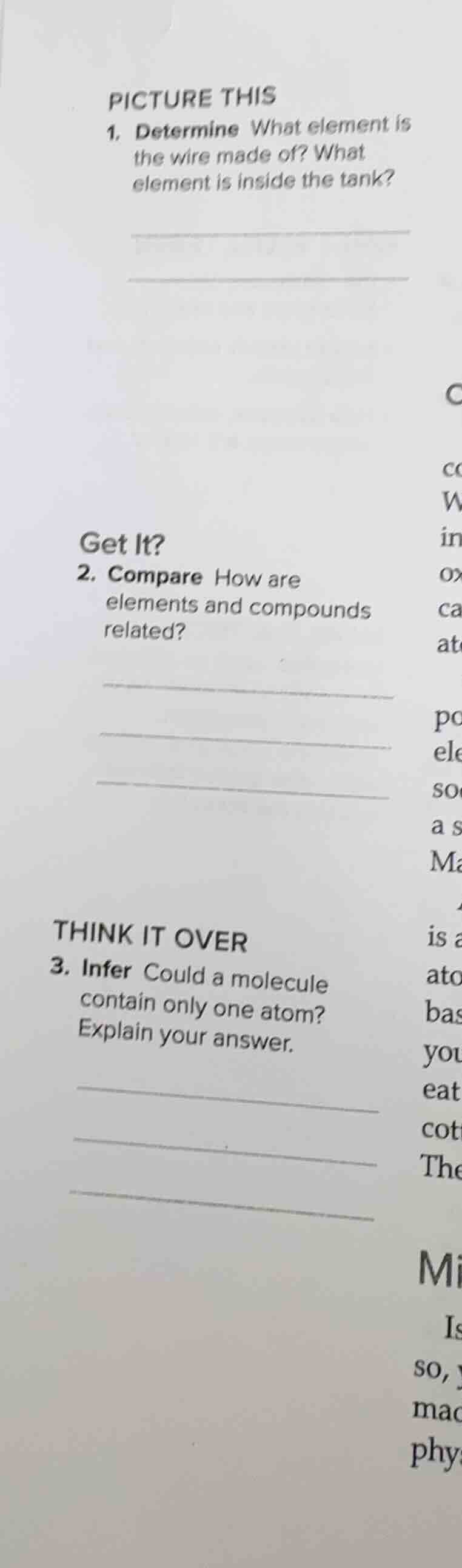
- determine what element is
the wire made of? what
element is inside the tank?
get it?
- compare how are
elements and compounds
related?
think it over
- infer could a molecule
contain only one atom?
explain your answer.
Response
Question 1 (Assuming typical lab setup context, e.g., electrolysis or heating):
Brief Explanations
- For wire: Wires are often made of Copper (Cu) (common conductor) or Iron (Fe), Aluminum (Al). For tank element (if liquid, e.g., water electrolysis: tank has \( \ce{H2O} \), but element? If gas tank, maybe Oxygen (O₂), Hydrogen (H₂), or if liquid element (like mercury), but more likely, if it's a chemical tank, maybe Sulfur (S), Sodium (Na) (but context matters). However, without the picture, a common example: Wire = Copper (Cu, metal conductor); Tank element (if gas) = Oxygen (O) or Hydrogen (H), if liquid (element) = Mercury (Hg), etc. But since the problem lacks the picture, we assume a standard setup (e.g., heating wire: Copper; tank with water: elements H and O, but as pure element? Maybe tank has a metal element like Iron (Fe) if it's a storage tank. Wait, the question says "element" (pure substance, single type of atom). So wire: common wire elements are Copper (Cu), Aluminum (Al), Iron (Fe). Tank element: if it's a gas tank, maybe Helium (He), Oxygen (O₂), Nitrogen (N₂); if liquid, Mercury (Hg), Bromine (Br₂); if solid, Carbon (C), Sulfur (S), etc. But since the problem is in a science context (Chemistry, Natural Science subfield), we use common lab examples.
Brief Explanations
- Elements: Pure substances with one type of atom (e.g., \( \ce{H} \), \( \ce{O} \), \( \ce{Fe} \)).
- Compounds: Pure substances with two+ different atoms chemically bonded (e.g., \( \ce{H2O} \), \( \ce{CO2} \)).
- Relationship: Compounds are made by combining two or more different elements via chemical reactions (e.g., \( \ce{H2 + O2 -> H2O} \)). All compounds contain elements, but elements are not compounds (they have only one atom type).
Brief Explanations
- Molecule definition: A group of two or more atoms (same or different) bonded together (e.g., \( \ce{O2} \) (2 O atoms), \( \ce{H2O} \) (2 H, 1 O)).
- A single atom cannot be a molecule because a molecule requires at least two atoms (either the same, like \( \ce{O2} \), or different, like \( \ce{H2O} \)) bonded. By definition, a molecule is a particle with two+ atoms (covalently bonded). So a single atom is an atom, not a molecule.

Snap & solve any problem in the app
Get step-by-step solutions on Sovi AI
Photo-based solutions with guided steps
Explore more problems and detailed explanations
Wire: Likely Copper (Cu) (common metal conductor). Tank element: If gas, Oxygen (O₂) or Hydrogen (H₂); if liquid, Mercury (Hg); if solid, Sulfur (S) (depends on setup, but typical: Wire = Copper; Tank element (e.g., in a gas tank) = Oxygen.