QUESTION IMAGE
Question
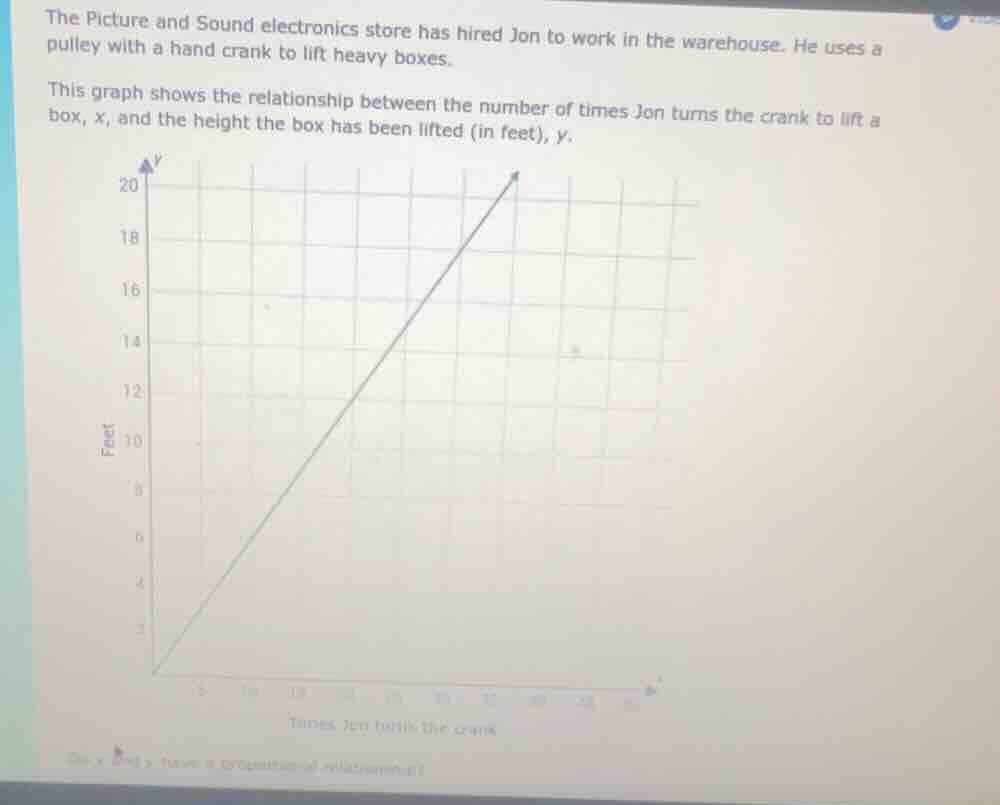
the picture and sound electronics store has hired jon to work in the warehouse. he uses a pulley with a hand crank to lift heavy boxes. this graph shows the relationship between the number of times jon turns the crank to lift a box, x, and the height the box has been lifted (in feet), y. (the graph is shown with y - axis labeled feet from 0 to 20 and x - axis labeled times jon turns the crank with a line passing through the origin and rising.) do x and y have a proportional relationship?
To determine if \( x \) (times Jon turns the crank) and \( y \) (height lifted) have a proportional relationship, we check two key aspects:
- Passes through the origin: The graph starts at \( (0,0) \), so when \( x = 0 \), \( y = 0 \).
- Constant rate (slope): For a proportional relationship, \( \frac{y}{x} \) should be constant. From the graph, when \( x = 10 \), \( y = 8 \) (so \( \frac{8}{10} = 0.8 \)); when \( x = 20 \), \( y = 16 \) (so \( \frac{16}{20} = 0.8 \)); when \( x = 30 \), \( y = 24 \)? Wait, no—wait, the top point is \( (30,24) \)? Wait, no, the y - axis at the top is 20? Wait, maybe I misread. Wait, the y - axis: the top is 20, and the x - axis at the top is 30? Wait, let's re - examine. If the graph is a straight line through \( (0,0) \) and has a constant slope, then \( y = kx \), where \( k \) is the constant of proportionality.
Looking at the grid: Let's take two points. Suppose when \( x = 10 \), \( y = 8 \) (since from the origin, moving 10 units right on x, 8 units up on y). Then when \( x = 20 \), \( y = 16 \) (10 more on x, 8 more on y), and when \( x = 30 \), \( y = 24 \)? But the y - axis at the top is 20? Wait, maybe the y - axis is labeled up to 20, but the line goes to \( (30,24) \)? No, maybe the y - axis is 20, and the x - axis is 30. Wait, regardless, the key is: a proportional relationship is a linear relationship that passes through the origin (\( (0,0) \)) and has a constant ratio \( \frac{y}{x} \).
Since the graph is a straight line passing through \( (0,0) \) and the ratio \( \frac{y}{x} \) is constant (for example, if we take two points, say \( (10,8) \) and \( (20,16) \), \( \frac{8}{10}=\frac{16}{20} = 0.8 \)), the relationship between \( x \) and \( y \) is proportional.
A proportional relationship exists between two quantities if their graph is a straight line passing through the origin \((0,0)\) and the ratio \(\frac{y}{x}\) (constant of proportionality) is constant for all pairs of \(x\) and \(y\) values. For Jon’s crank - turning (\(x\)) and height lifted (\(y\)):
- The graph passes through \((0,0)\) (when \(x = 0\), \(y = 0\), meaning no crank turns lift the box 0 feet).
- The ratio \(\frac{y}{x}\) is constant (e.g., if \(x = 10\) turns correspond to \(y = 8\) feet, \(\frac{8}{10}=0.8\); if \(x = 20\) turns correspond to \(y = 16\) feet, \(\frac{16}{20}=0.8\)), so the slope (rate) is constant.

Snap & solve any problem in the app
Get step-by-step solutions on Sovi AI
Photo-based solutions with guided steps
Explore more problems and detailed explanations
Yes, \( x \) and \( y \) have a proportional relationship because the graph is a straight line passing through the origin \((0,0)\) and the ratio \(\frac{y}{x}\) (height per crank turn) is constant.