QUESTION IMAGE
Question
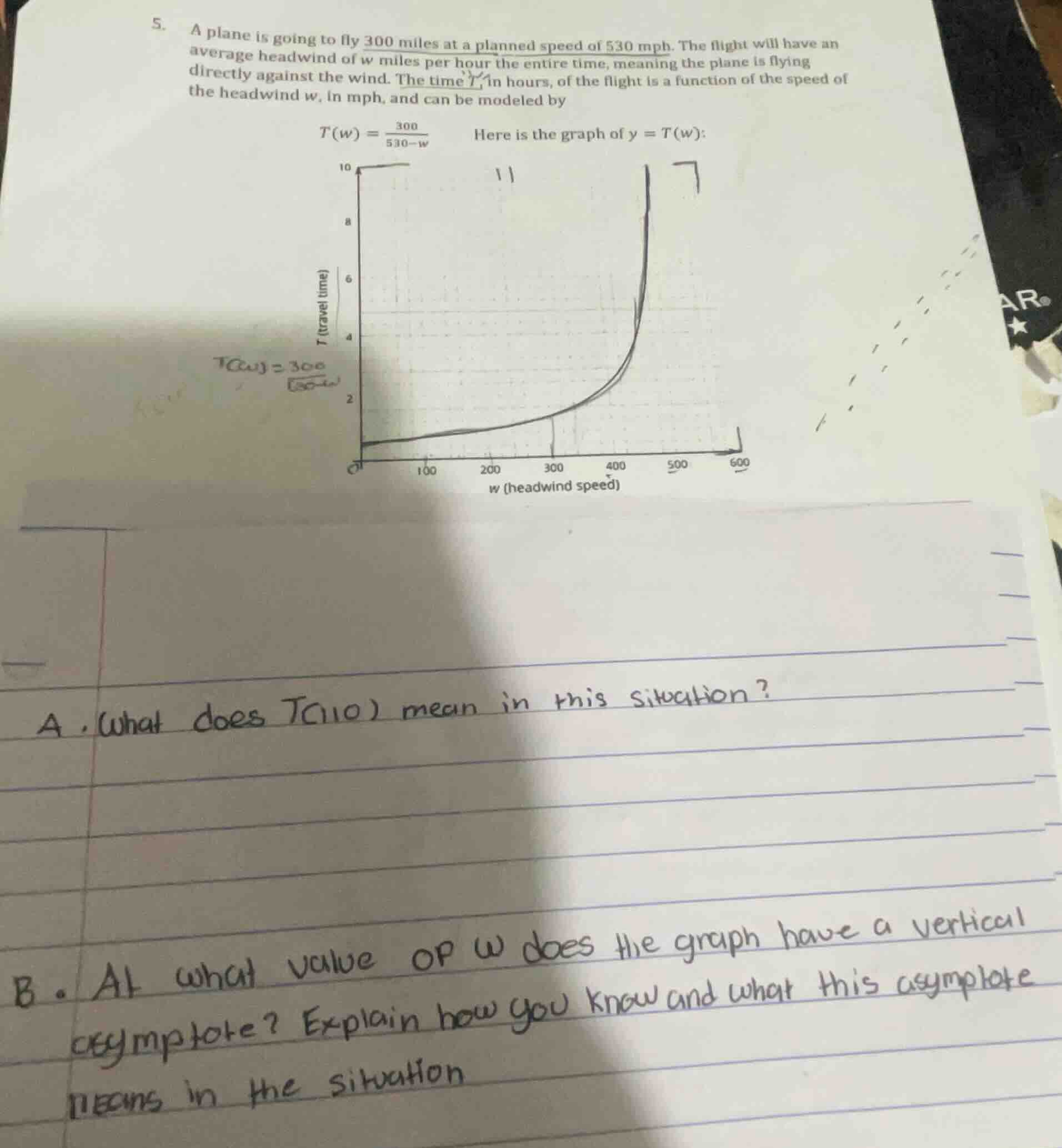
- a plane is going to fly 300 miles at a planned speed of 530 mph. the flight will have an average headwind of w miles per hour the entire time, meaning the plane is flying directly against the wind. the time t, in hours, of the flight is a function of the speed of the headwind w, in mph, and can be modeled by \\( t(w) = \frac{300}{530 - w} \\) here is the graph of \\( y = t(w) \\): graph of \\( y = t(w) \\) with t (travel time) on y - axis and w (headwind speed) on x - axis a. what does \\( t(110) \\) mean in this situation? b. at what value of w does the graph have a vertical asymptote? explain how you know and what this asymptote means in the situation
Part A:
$T(w)$ represents flight time in hours for a given headwind speed $w$ (in mph). $T(110)$ substitutes $w=110$, so it is the flight time when the headwind is 110 mph.
Part B:
A rational function has a vertical asymptote where its denominator equals 0 (and numerator is non-zero). For $T(w)=\frac{300}{530-w}$, set $530-w=0$. In context, this means when headwind equals the plane's planned speed, the plane's effective ground speed becomes 0, so it can't make forward progress, making flight time approach infinity.

Snap & solve any problem in the app
Get step-by-step solutions on Sovi AI
Photo-based solutions with guided steps
Explore more problems and detailed explanations
A. $T(110)$ is the total travel time (in hours) for the 300-mile flight when the average headwind speed is 110 mph.
B. The graph has a vertical asymptote at $w=530$. This is found by solving $530-w=0$ (the denominator of the function equals zero, while the numerator 300 is non-zero). In this situation, it means if the headwind speed matches the plane's planned speed of 530 mph, the plane's effective forward speed becomes 0, so it will never complete the 300-mile flight, causing travel time to approach infinity.