QUESTION IMAGE
Question
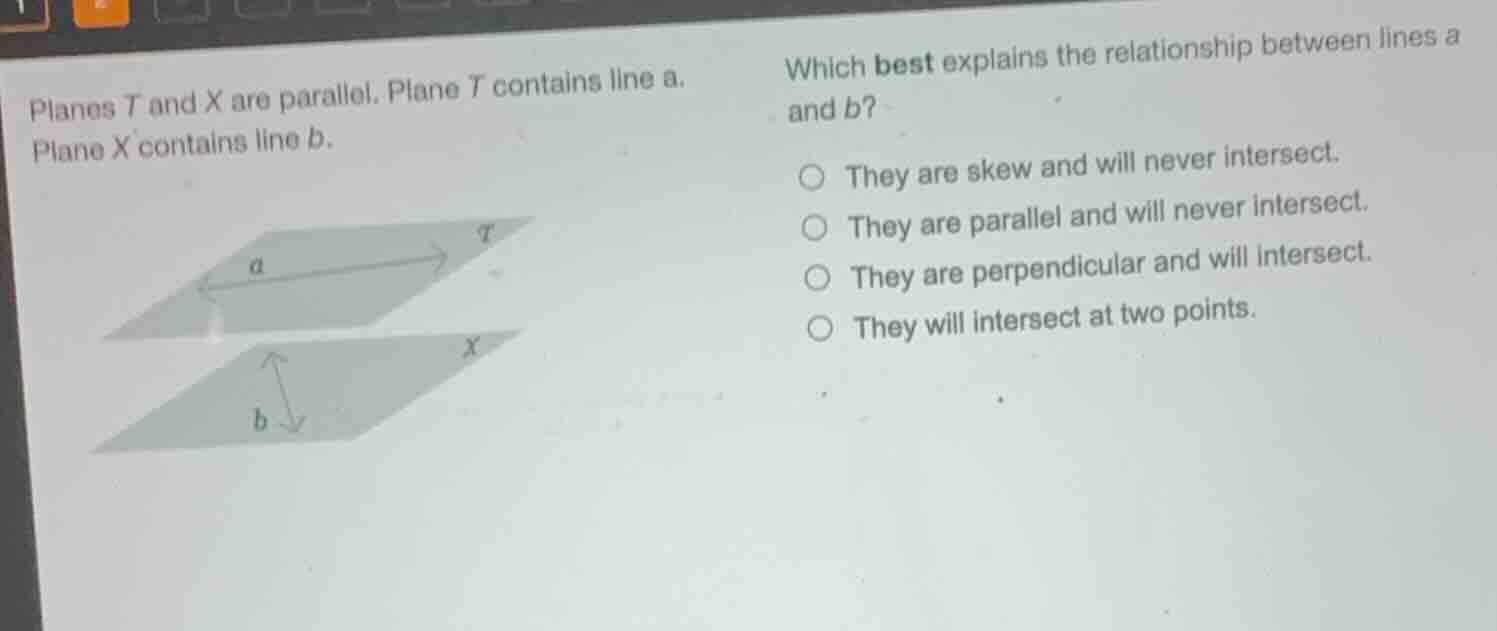
planes t and x are parallel. plane t contains line a. plane x contains line b. which best explains the relationship between lines a and b? \bigcirc they are skew and will never intersect. \bigcirc they are parallel and will never intersect. \bigcirc they are perpendicular and will intersect. \bigcirc they will intersect at two points.
Brief Explanations
- Recall the properties of parallel planes: If two planes are parallel, any lines in them that are not parallel (but also not intersecting) are skew, or if the lines have a relationship that keeps them non - intersecting. But first, let's analyze each option:
- Option 1: Skew lines are lines that are not parallel and do not intersect, and they lie in non - parallel planes? No, wait. Wait, planes T and X are parallel. Lines a is in plane T, line b is in plane X. Skew lines are in different planes and not parallel and not intersecting. But wait, let's check the other options.
- Option 2: If two planes are parallel, and we have lines in each plane. But for lines to be parallel, we need more conditions. Wait, no, actually, if two planes are parallel, and a line in one plane and a line in the other plane: if the lines are not parallel, they are skew. Wait, no, maybe I made a mistake. Wait, the key is: Parallel planes never intersect, so lines in parallel planes that are not parallel (but also not intersecting) are skew. Wait, but let's check the options again. Wait, the first option says "They are skew and will never intersect." Let's recall the definition of skew lines: Skew lines are two lines that do not intersect and are not parallel, and they lie in different planes. Since planes T and X are parallel, they never intersect, so lines a and b (in different parallel planes) can't intersect. Now, are they parallel? The diagram (even though we can see the direction of a is horizontal and b is vertical? Wait, no, the diagram shows line a with a right - pointing arrow and line b with an up - down arrow? Wait, no, maybe the diagram is of two parallel planes, T above X. Line a is in T, line b is in X. Since the planes are parallel, the lines can't intersect. Now, are they skew? Skew lines are non - parallel and non - intersecting. If the lines were parallel, they would be parallel. But from the diagram, the direction of a and b seem different (a is horizontal, b is vertical? Or maybe the arrows: a has a right arrow, b has an up - down arrow). So they are not parallel. So they are skew and will never intersect. Wait, but let's check the options again. The first option: "They are skew and will never intersect." The second option: "They are parallel and will never intersect." But for lines to be parallel, they need to be in the same plane or in parallel planes with the same direction. Since the planes are parallel, but the lines' directions (from the diagram) seem different, so they are not parallel. So the correct option is the first one? Wait, no, maybe I messed up. Wait, another approach: Parallel planes: two planes that never intersect. Lines in parallel planes: if a line is in plane T and a line is in plane X, since the planes never meet, the lines can't intersect. Now, skew lines are lines that are not parallel and do not intersect, and are in different planes. Since the planes are parallel, the lines are in different planes. If the lines are not parallel (which they seem not to be from the diagram), then they are skew. So the first option: "They are skew and will never intersect" is correct. Wait, but let's eliminate the other options:
- Option 3: "They are perpendicular and will intersect." But the planes are parallel, so they can't intersect, so this is wrong.
- Option 4: "They will intersect at two points." A line can intersect another line at at most one point, and since the planes are parallel, they can't intersect at all, so this is wrong.
- Now between option 1 and 2. If the lines were parallel, they would be p…

Snap & solve any problem in the app
Get step-by-step solutions on Sovi AI
Photo-based solutions with guided steps
Explore more problems and detailed explanations
A. They are skew and will never intersect.