QUESTION IMAGE
Question
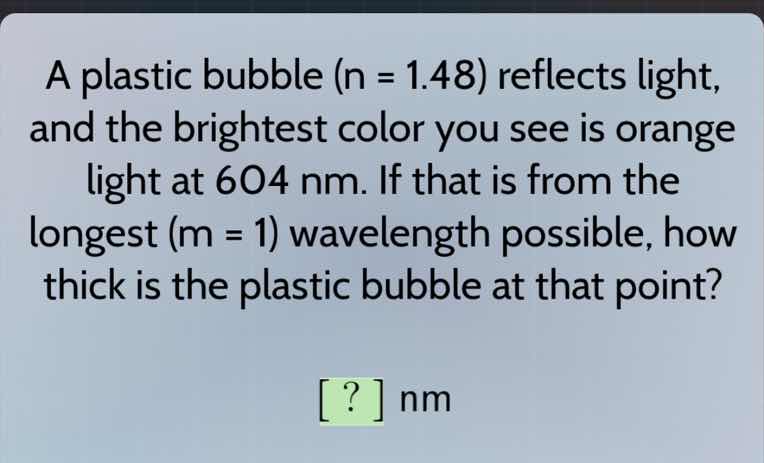
a plastic bubble (n = 1.48) reflects light, and the brightest color you see is orange light at 604 nm. if that is from the longest (m = 1) wavelength possible, how thick is the plastic bubble at that point? ? nm
Step1: Recall the formula for thin - film interference (constructive interference for reflected light)
For a thin film, when light is reflected from the top and bottom surfaces, for constructive interference in the case of a thin film (like a bubble) with normal incidence, the formula is \(2nt = m\lambda\), where \(n\) is the refractive index of the film, \(t\) is the thickness of the film, \(m\) is the order of interference, and \(\lambda\) is the wavelength of light in vacuum. We need to solve for \(t\), so we can re - arrange the formula to \(t=\frac{m\lambda}{2n}\).
Step2: Identify the given values
We are given that \(n = 1.48\), \(\lambda=604\space nm\), and \(m = 1\) (since it is the longest wavelength possible, so the order \(m = 1\)).
Step3: Substitute the values into the formula
Substitute \(m = 1\), \(\lambda = 604\space nm\) and \(n=1.48\) into the formula \(t=\frac{m\lambda}{2n}\).
\(t=\frac{1\times604}{2\times1.48}\)
First, calculate the denominator: \(2\times1.48 = 2.96\)
Then, calculate the numerator divided by the denominator: \(t=\frac{604}{2.96}\approx204.05\space nm\)

Snap & solve any problem in the app
Get step-by-step solutions on Sovi AI
Photo-based solutions with guided steps
Explore more problems and detailed explanations
\(204\) (rounded to a reasonable number of significant figures, if we consider more precise calculation \(\frac{604}{2\times1.48}=\frac{604}{2.96} = 204.054054\approx204\space nm\))