QUESTION IMAGE
Question
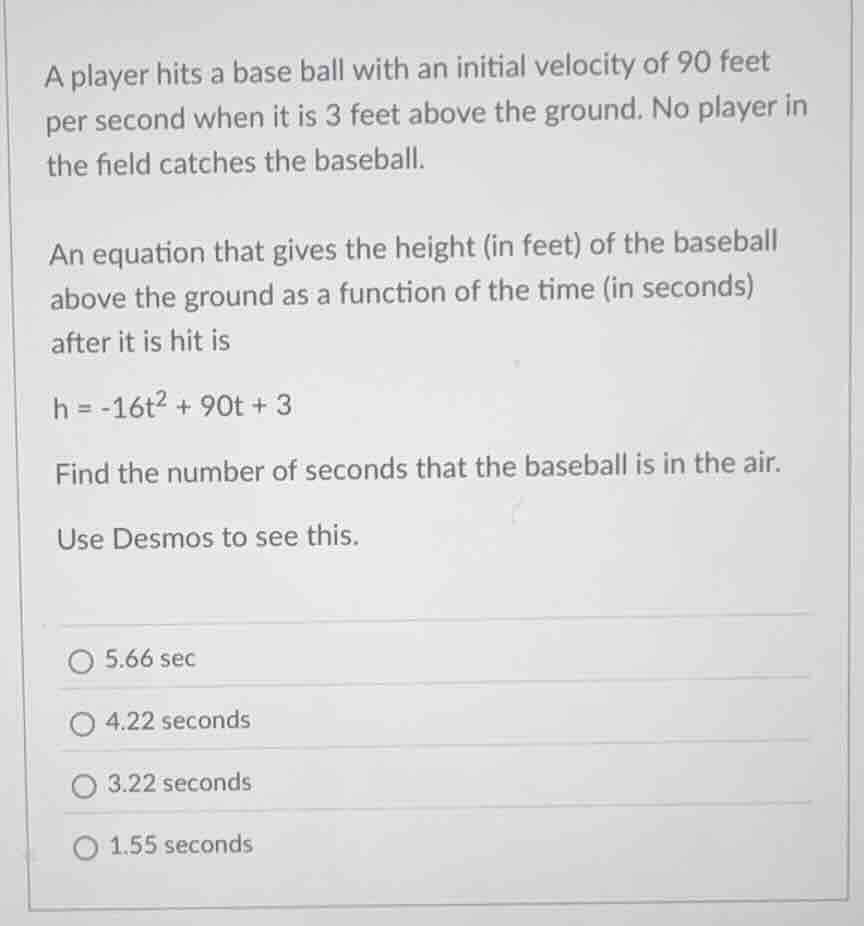
a player hits a base ball with an initial velocity of 90 feet per second when it is 3 feet above the ground. no player in the field catches the baseball.
an equation that gives the height (in feet) of the baseball above the ground as a function of the time (in seconds) after it is hit is
( h = -16t^2 + 90t + 3 )
find the number of seconds that the baseball is in the air.
use desmos to see this.
\\( \bigcirc \\) 5.66 sec
\\( \bigcirc \\) 4.22 seconds
\\( \bigcirc \\) 3.22 seconds
\\( \bigcirc \\) 1.55 seconds
Step1: Set height to 0
We need to find when the baseball hits the ground, so \( h = 0 \). The equation becomes \( 0=-16t^{2}+90t + 3 \). This is a quadratic equation in the form \( ax^{2}+bx + c = 0 \), where \( a=-16 \), \( b = 90 \), and \( c = 3 \).
Step2: Use quadratic formula
The quadratic formula is \( t=\frac{-b\pm\sqrt{b^{2}-4ac}}{2a} \). First, calculate the discriminant \( D=b^{2}-4ac \). Substitute the values: \( D=(90)^{2}-4\times(-16)\times3=8100 + 192=8292 \). Then, find the square root of the discriminant: \( \sqrt{8292}\approx91.06 \). Now, substitute into the quadratic formula: \( t=\frac{-90\pm91.06}{2\times(-16)} \). We have two solutions:
- For the plus sign: \( t=\frac{-90 + 91.06}{-32}=\frac{1.06}{-32}\approx - 0.033 \) (we discard this negative solution since time cannot be negative).
- For the minus sign: \( t=\frac{-90-91.06}{-32}=\frac{-181.06}{-32}\approx5.66 \)

Snap & solve any problem in the app
Get step-by-step solutions on Sovi AI
Photo-based solutions with guided steps
Explore more problems and detailed explanations
5.66 sec