QUESTION IMAGE
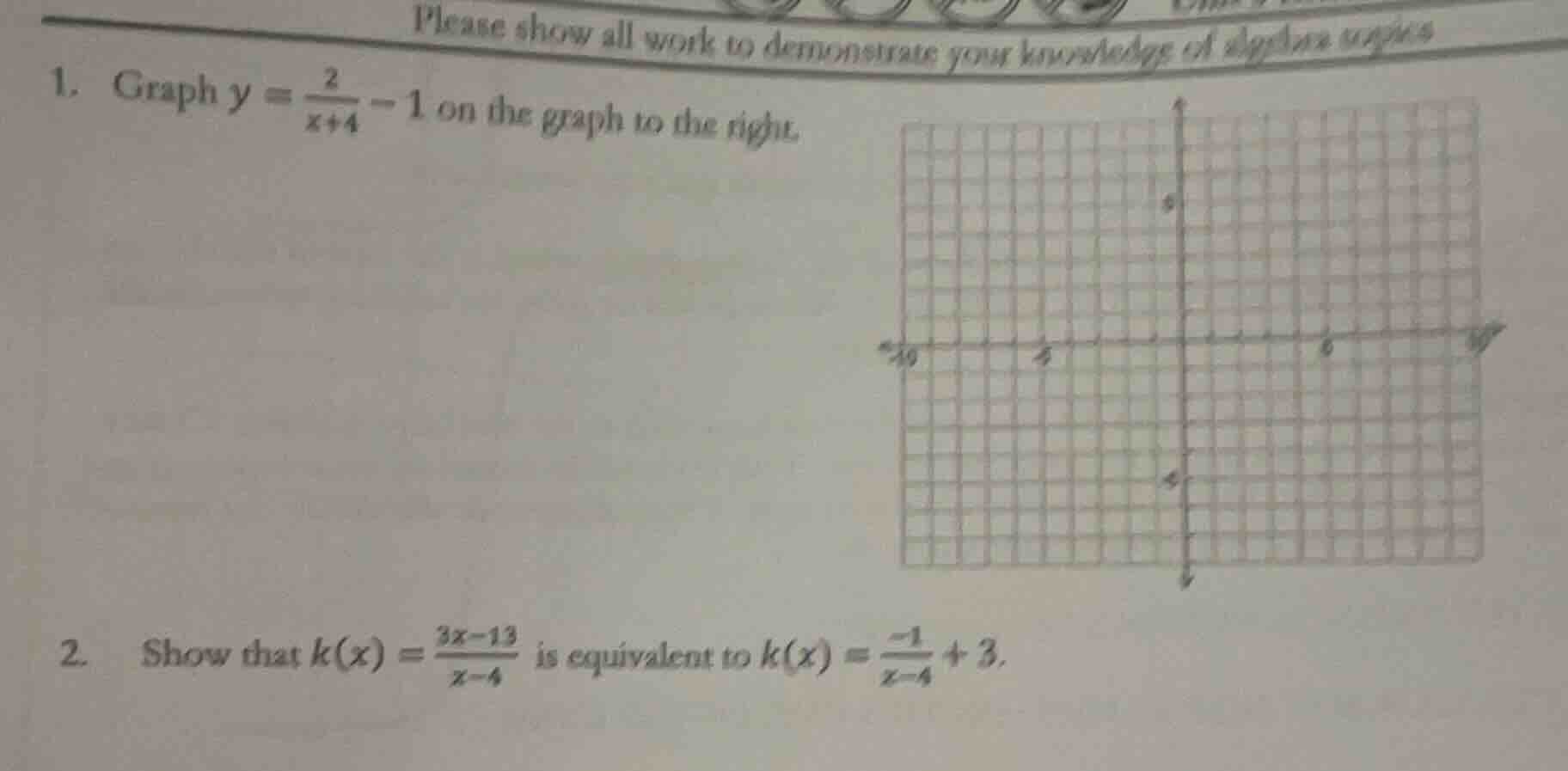
Question
please show all work to demonstrate your knowledge of algebra topics
- graph $y = \frac{2}{x + 4} - 1$ on the graph to the right.
- show that $k(x) = \frac{3x - 13}{x - 4}$ is equivalent to $k(x) = \frac{-1}{x - 4} + 3$.
Problem 1: Graph \( y = \frac{2}{x + 4} - 1 \)
Step 1: Identify the parent function and transformations
The parent function is \( y = \frac{1}{x} \). The given function \( y = \frac{2}{x + 4} - 1 \) is a transformation of the parent function.
- Vertical stretch by a factor of 2: \( y = \frac{2}{x} \)
- Horizontal shift left 4 units: \( y = \frac{2}{x + 4} \)
- Vertical shift down 1 unit: \( y = \frac{2}{x + 4} - 1 \)
Step 2: Find the vertical asymptote
The vertical asymptote occurs where the denominator is zero: \( x + 4 = 0 \implies x = -4 \).
Step 3: Find the horizontal asymptote
For rational functions of the form \( y = \frac{a}{x - h} + k \), the horizontal asymptote is \( y = k \). Here, \( k = -1 \), so the horizontal asymptote is \( y = -1 \).
Step 4: Find key points
- When \( x = -3 \): \( y = \frac{2}{-3 + 4} - 1 = \frac{2}{1} - 1 = 2 - 1 = 1 \). So the point is \( (-3, 1) \).
- When \( x = -2 \): \( y = \frac{2}{-2 + 4} - 1 = \frac{2}{2} - 1 = 1 - 1 = 0 \). So the point is \( (-2, 0) \).
- When \( x = -5 \): \( y = \frac{2}{-5 + 4} - 1 = \frac{2}{-1} - 1 = -2 - 1 = -3 \). So the point is \( (-5, -3) \).
- When \( x = 0 \): \( y = \frac{2}{0 + 4} - 1 = \frac{2}{4} - 1 = 0.5 - 1 = -0.5 \). So the point is \( (0, -0.5) \).
Step 5: Sketch the graph
Plot the vertical asymptote \( x = -4 \) and horizontal asymptote \( y = -1 \). Then plot the key points and draw the two branches of the hyperbola, one to the left of \( x = -4 \) and one to the right, approaching the asymptotes.
Problem 2: Show \( k(x) = \frac{3x - 13}{x - 4} \) is equivalent to \( k(x) = \frac{-1}{x - 4} + 3 \)
Step 1: Start with the right-hand side (RHS)
We start with \( \frac{-1}{x - 4} + 3 \).
Step 2: Combine the terms over a common denominator
To combine \( \frac{-1}{x - 4} \) and \( 3 \), we write \( 3 \) as \( \frac{3(x - 4)}{x - 4} \) (since \( x
eq 4 \), the denominator is non-zero).
\[
\frac{-1}{x - 4} + \frac{3(x - 4)}{x - 4}
\]
Step 3: Add the numerators
\[
\frac{-1 + 3(x - 4)}{x - 4}
\]
Step 4: Expand and simplify the numerator
\[
\frac{-1 + 3x - 12}{x - 4} = \frac{3x - 13}{x - 4}
\]
This is equal to the left-hand side (LHS) \( k(x) = \frac{3x - 13}{x - 4} \). So the two expressions are equivalent.
Final Answers
- The graph of \( y = \frac{2}{x + 4} - 1 \) has a vertical asymptote at \( x = -4 \), horizontal asymptote at \( y = -1 \), and passes through points like \( (-3, 1) \), \( (-2, 0) \), \( (-5, -3) \), \( (0, -0.5) \). (Graphing is done by plotting these features and points.)
- We have shown that \( \frac{3x - 13}{x - 4} = \frac{-1}{x - 4} + 3 \) by combining the terms on the RHS and simplifying to match the LHS.

Snap & solve any problem in the app
Get step-by-step solutions on Sovi AI
Photo-based solutions with guided steps
Explore more problems and detailed explanations
Problem 1: Graph \( y = \frac{2}{x + 4} - 1 \)
Step 1: Identify the parent function and transformations
The parent function is \( y = \frac{1}{x} \). The given function \( y = \frac{2}{x + 4} - 1 \) is a transformation of the parent function.
- Vertical stretch by a factor of 2: \( y = \frac{2}{x} \)
- Horizontal shift left 4 units: \( y = \frac{2}{x + 4} \)
- Vertical shift down 1 unit: \( y = \frac{2}{x + 4} - 1 \)
Step 2: Find the vertical asymptote
The vertical asymptote occurs where the denominator is zero: \( x + 4 = 0 \implies x = -4 \).
Step 3: Find the horizontal asymptote
For rational functions of the form \( y = \frac{a}{x - h} + k \), the horizontal asymptote is \( y = k \). Here, \( k = -1 \), so the horizontal asymptote is \( y = -1 \).
Step 4: Find key points
- When \( x = -3 \): \( y = \frac{2}{-3 + 4} - 1 = \frac{2}{1} - 1 = 2 - 1 = 1 \). So the point is \( (-3, 1) \).
- When \( x = -2 \): \( y = \frac{2}{-2 + 4} - 1 = \frac{2}{2} - 1 = 1 - 1 = 0 \). So the point is \( (-2, 0) \).
- When \( x = -5 \): \( y = \frac{2}{-5 + 4} - 1 = \frac{2}{-1} - 1 = -2 - 1 = -3 \). So the point is \( (-5, -3) \).
- When \( x = 0 \): \( y = \frac{2}{0 + 4} - 1 = \frac{2}{4} - 1 = 0.5 - 1 = -0.5 \). So the point is \( (0, -0.5) \).
Step 5: Sketch the graph
Plot the vertical asymptote \( x = -4 \) and horizontal asymptote \( y = -1 \). Then plot the key points and draw the two branches of the hyperbola, one to the left of \( x = -4 \) and one to the right, approaching the asymptotes.
Problem 2: Show \( k(x) = \frac{3x - 13}{x - 4} \) is equivalent to \( k(x) = \frac{-1}{x - 4} + 3 \)
Step 1: Start with the right-hand side (RHS)
We start with \( \frac{-1}{x - 4} + 3 \).
Step 2: Combine the terms over a common denominator
To combine \( \frac{-1}{x - 4} \) and \( 3 \), we write \( 3 \) as \( \frac{3(x - 4)}{x - 4} \) (since \( x
eq 4 \), the denominator is non-zero).
\[
\frac{-1}{x - 4} + \frac{3(x - 4)}{x - 4}
\]
Step 3: Add the numerators
\[
\frac{-1 + 3(x - 4)}{x - 4}
\]
Step 4: Expand and simplify the numerator
\[
\frac{-1 + 3x - 12}{x - 4} = \frac{3x - 13}{x - 4}
\]
This is equal to the left-hand side (LHS) \( k(x) = \frac{3x - 13}{x - 4} \). So the two expressions are equivalent.
Final Answers
- The graph of \( y = \frac{2}{x + 4} - 1 \) has a vertical asymptote at \( x = -4 \), horizontal asymptote at \( y = -1 \), and passes through points like \( (-3, 1) \), \( (-2, 0) \), \( (-5, -3) \), \( (0, -0.5) \). (Graphing is done by plotting these features and points.)
- We have shown that \( \frac{3x - 13}{x - 4} = \frac{-1}{x - 4} + 3 \) by combining the terms on the RHS and simplifying to match the LHS.