QUESTION IMAGE
Question
plot $1\dfrac{7}{10}$ and $2\dfrac{4}{5}$.
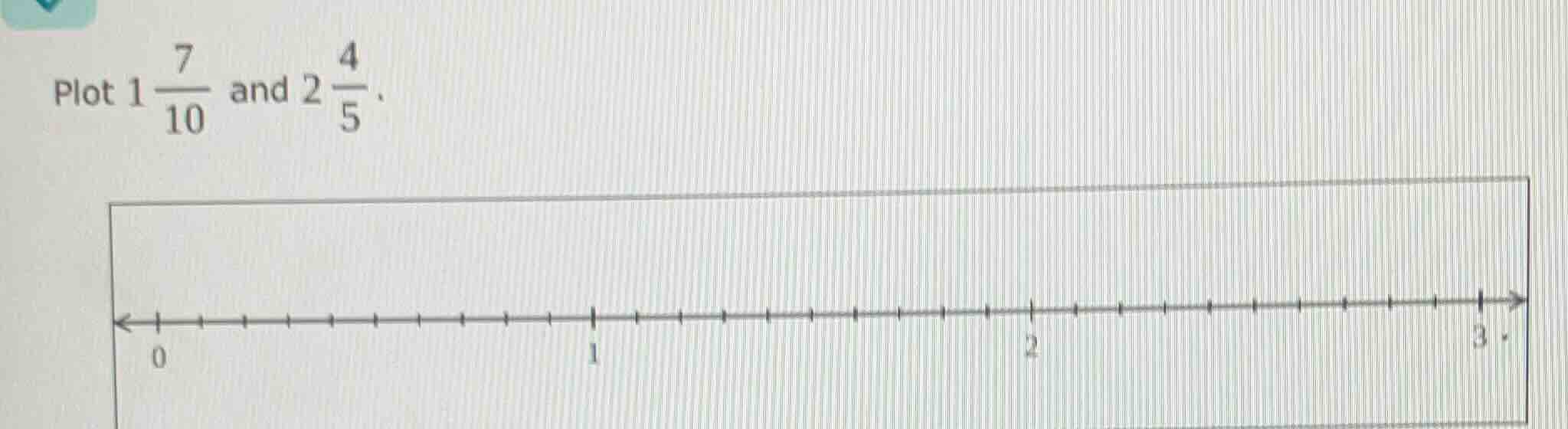
number line from 0 to 3 with marks
Step1: Analyze the number line
The number line has marks from 0 to 3. Between 0 and 1, 1 and 2, 2 and 3, we need to find the scale. Let's see the distance between 0 and 1: from the plot, we can assume the number of divisions. Let's first convert the mixed numbers to improper fractions or decimals for easier plotting.
Step2: Convert \(1\frac{7}{10}\) to decimal
\(1\frac{7}{10}=1 + \frac{7}{10}=1 + 0.7 = 1.7\)
Step3: Convert \(2\frac{4}{5}\) to decimal
\(2\frac{4}{5}=2+\frac{4}{5}=2 + 0.8=2.8\)
Step4: Determine the scale of the number line
Looking at the number line, between 0 and 1, let's count the number of small ticks. From 0 to 1, if we assume that the distance from 0 to 1 is divided into 10 equal parts (since we have tenths in the first number), each tick represents \(0.1\) (or \(\frac{1}{10}\)).
Step5: Plot \(1\frac{7}{10}\) (1.7)
Starting from 1, we move 7 tenths (since each tick is 0.1) to the right. So from 1, moving 7 ticks (each 0.1) gives us \(1 + 0.7=1.7\), which is \(1\frac{7}{10}\).
Step6: Plot \(2\frac{4}{5}\) (2.8)
First, \(2\frac{4}{5}=\frac{14}{5}=2.8\). Starting from 2, we know that \(\frac{4}{5}=0.8\), and since each tick is 0.1, we move 8 ticks to the right from 2. So \(2+0.8 = 2.8\), which is \(2\frac{4}{5}\).

Snap & solve any problem in the app
Get step-by-step solutions on Sovi AI
Photo-based solutions with guided steps
Explore more problems and detailed explanations
To plot \(1\frac{7}{10}\) (1.7) and \(2\frac{4}{5}\) (2.8) on the number line:
- For \(1\frac{7}{10}\): Locate 1 on the number line, then move 7 tenths (7 small ticks, each representing \(0.1\)) to the right.
- For \(2\frac{4}{5}\): Locate 2 on the number line, then move 8 tenths (8 small ticks, each representing \(0.1\)) to the right (since \(\frac{4}{5}=0.8 = 8\times0.1\)).