QUESTION IMAGE
Question
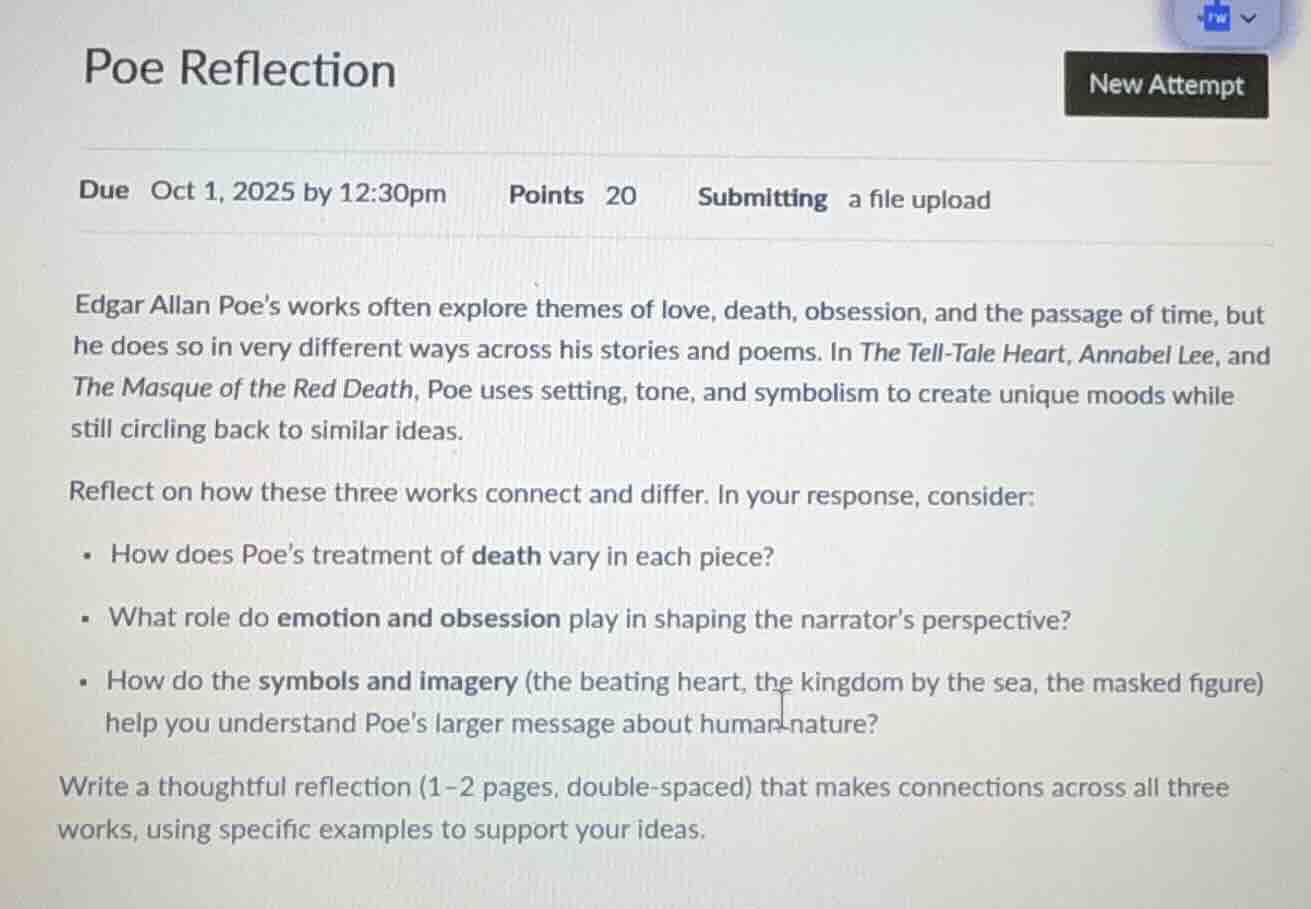
poe reflection
due oct 1, 2025 by 12:30pm points 20 submitting a file upload
edgar allan poe’s works often explore themes of love, death, obsession, and the passage of time, but he does so in very different ways across his stories and poems. in the tell - tale heart, annabel lee, and the masque of the red death, poe uses setting, tone, and symbolism to create unique moods while still circling back to similar ideas.
reflect on how these three works connect and differ. in your response, consider:
- how does poe’s treatment of death vary in each piece?
- what role do emotion and obsession play in shaping the narrator’s perspective?
- how do the symbols and imagery (the beating heart, the kingdom by the sea, the masked figure) help you understand poe’s larger message about human nature?
write a thoughtful reflection (1 - 2 pages, double - spaced) that makes connections across all three works, using specific examples to support your ideas.
- Treatment of Death:
- The Tell-Tale Heart: Death is a violent, intentional act (the narrator murders the old man) tied to guilt; it haunts the narrator as a psychological burden, not a abstract force.
- Annabel Lee: Death is a romanticized, cosmic separation—Annabel Lee's death is framed as a theft by jealous "seraphs of heaven," and the speaker's love transcends death, making it a bittersweet, unifying force.
- The Masque of the Red Death: Death is an unavoidable, egalitarian plague (the Red Death) that invades human attempts to escape it; it is a impersonal, universal force that hums human arrogance.
- Emotion and Obsession:
- The Tell-Tale Heart: The narrator's obsession with the old man's "vulture eye" drives his violent act, and his overwhelming guilt (a twisted emotional response) breaks his attempt to hide the crime, warping his perception of reality (he hears the dead man's heart beating).
- Annabel Lee: The speaker's obsessive, eternal love for Annabel Lee traps him in a static, grief-stricken perspective; he fixates on their childhood bond, refusing to move past her death and sleeping in her tomb.
- The Masque of the Red Death: Prince Prospero's obsessive desire to avoid death leads him to isolate himself and his court, creating a delusional, hedonistic bubble; his arrogance (a form of emotional obsession with control) blinds him to the inevitability of death.
- Symbols and Human Nature:
- Beating Heart (The Tell-Tale Heart): Symbolizes the inescapable weight of guilt and the fragility of human attempts to hide moral failure; it reveals that the human conscience cannot be silenced.
- Kingdom by the Sea (Annabel Lee): Symbolizes a lost, idealized innocence and the power of love to transcend physical death; it suggests that human connection can persist beyond mortal limits, even in grief.
- Masked Figure (The Masque of the Red Death): Symbolizes the universality and inevitability of death; it exposes the futility of human attempts to control or outrun fate, highlighting the arrogance of those who think they can avoid mortality.

Snap & solve any problem in the app
Get step-by-step solutions on Sovi AI
Photo-based solutions with guided steps
Explore more problems and detailed explanations
Reflection on Death, Obsession, and Symbolism in Poe’s Works
Edgar Allan Poe’s The Tell-Tale Heart, Annabel Lee, and The Masque of the Red Death all center on death, but their treatments of the theme, the role of obsession, and symbolic imagery reveal distinct facets of human nature.
In The Tell-Tale Heart, death is a deliberate, intimate act rooted in psychological unraveling. The narrator murders the old man not out of hatred, but a irrational obsession with the man’s "pale blue eye, with a film over it." This act of violence is followed by crippling guilt: the narrator’s perception warps as he hears the dead man’s heart beating beneath the floorboards, a physical manifestation of his unescapable conscience. Here, death is a personal, guilt-laden burden that exposes the fragility of human self-control and the impossibility of hiding moral failure.
By contrast, Annabel Lee frames death as a romantic, cosmic separation. The speaker’s young bride is taken by "the angels, not half so happy in Heaven" who envy their perfect love. Death does not end their bond; the speaker fixates on their childhood home "in a kingdom by the sea" and sleeps in Annabel Lee’s tomb every night. His obsessive grief traps him in a static, idealized past, revealing how love and loss can warp human perspective to prioritize emotional permanence over moving forward. Death here is a bittersweet force that underscores the transcendent power of human connection.
The Masque of the Red Death presents death as an impersonal, universal inevitability. Prince Prospero, obsessed with escaping a deadly plague, locks himself and his court in a fortified abbey, hosting a lavish masquerade to ignore the suffering outside. But the Red Death itself, disguised as a masked guest, infiltrates the party and kills everyone, regardless of wealth or status. The masked figure symbolizes the futility of human attempts to control fate; death does not discriminate, and arrogance in the face of mortality leads to ruin.
Across all three works, Poe uses symbolism to comment on core truths of human nature. The beating heart in The Tell-Tale Heart exposes the inescapable weight of guilt, proving that the human conscience cannot be silenced. The kingdom by the sea in Annabel Lee represents the idealized innocence of lost love, showing how grief can trap people in a nostalgic, unchanging perspective. The masked figure in The Masque of the Red Death is a stark reminder that death is a great equalizer, humbling human arrogance and exposing the futility of trying to outrun fate.
Together, these works reveal that death is not a single, monolithic force: it can be a source of guilt, a catalyst for eternal love, or an unyielding universal truth. Obsession, whether with a single detail, a lost love, or survival, shapes human perception in destructive or redemptive ways, and Poe’s symbols lay bare the raw, often contradictory, realities of what it means to be human.