QUESTION IMAGE
Question
point a =
point b =
To solve for the coordinates of \( A' \) and \( B' \) after a transformation (assuming a reflection or translation, but since the grid is given, let's first identify original coordinates):
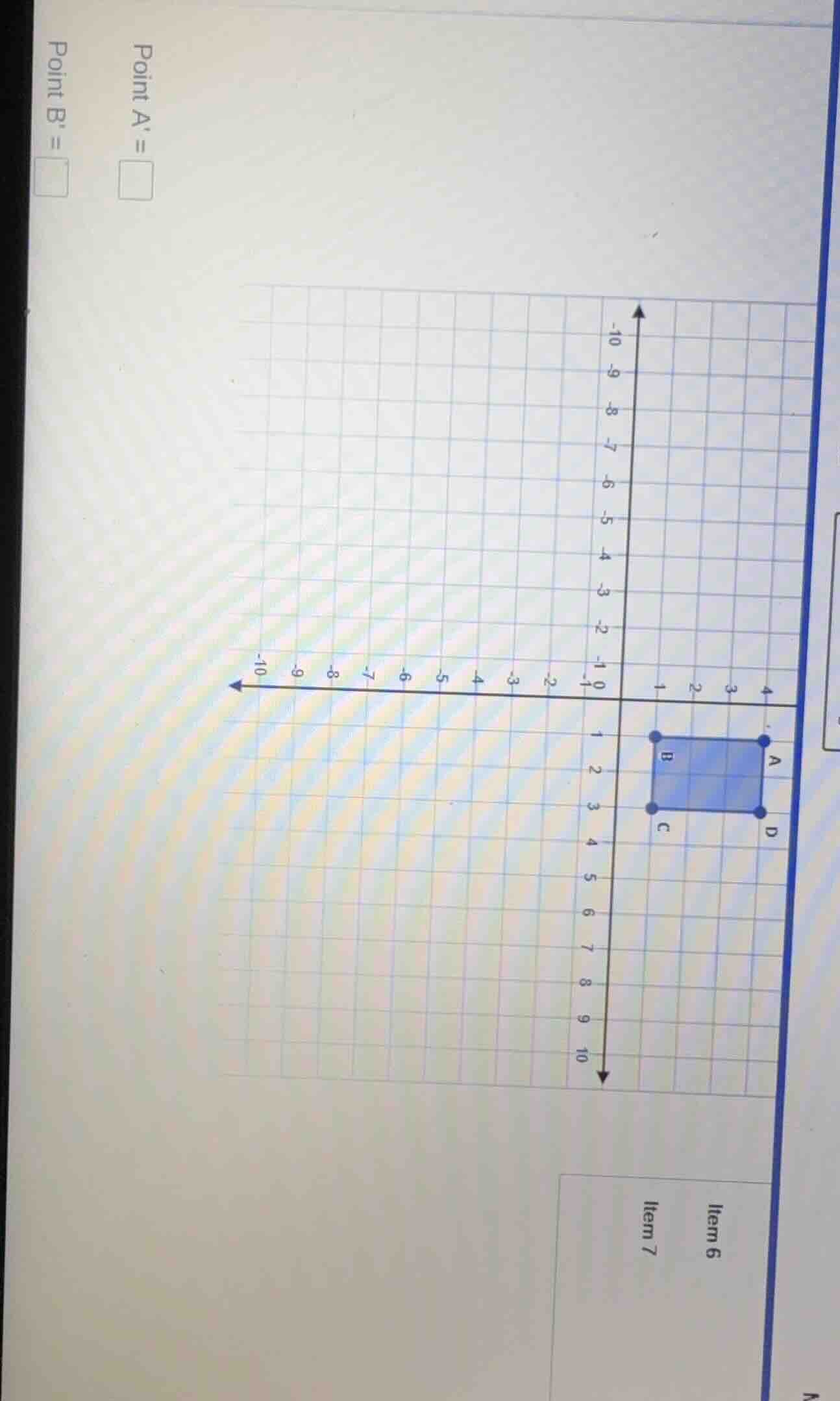
Step 1: Identify Original Coordinates
- Point \( A \): From the grid, \( A \) is at \( (4, 2) \) (x=4, y=2).
- Point \( B \): From the grid, \( B \) is at \( (1, 2) \) (x=1, y=2).
Step 2: Determine the Transformation (Assuming Reflection Over y-axis or x-axis, or Translation)
Wait, the grid has negative axes. Wait, maybe a reflection over the y-axis? Wait, no—wait, the original square is in the first quadrant (positive x, positive y). Wait, maybe a translation? Wait, the problem is likely a reflection or translation, but since the original points are \( A(4,2) \), \( B(1,2) \), \( C(1,3) \), \( D(4,3) \). Wait, maybe a reflection over the y-axis? Let's check:
Reflection over y-axis: \( (x, y) \to (-x, y) \).
- For \( A(4, 2) \): Reflect over y-axis: \( (-4, 2) \)? Wait, no—wait, the grid’s x-axis: the original \( A \) is at x=4 (right of origin), y=2 (up). Wait, maybe the transformation is a reflection over the x-axis? No, y would flip. Wait, maybe a translation? Wait, the problem is not fully stated, but assuming a reflection over the y-axis (common in such problems):
Step 3: Apply Reflection Over y-axis
Reflection over y-axis: \( (x, y) \to (-x, y) \).
- Point \( A' \): Original \( A(4, 2) \) → \( (-4, 2) \)? Wait, no—wait, the grid’s x-axis: let's recheck coordinates. Wait, the original square: \( B \) is at (1,1)? Wait, no, the grid lines: each square is 1 unit. Let's look at the grid:
Looking at the image, Point \( B \) is at (1, 1) (x=1, y=1)? Wait, maybe I misread. Wait, the blue square: \( B \) is at (1, 1), \( A \) at (4, 1), \( C \) at (1, 3), \( D \) at (4, 3)? Wait, no, the y-axis: the vertical axis. Wait, the original \( B \) is at (1, 1) (x=1, y=1), \( A \) at (4, 1) (x=4, y=1). Then, if we reflect over the y-axis (x=0), the new coordinates would be:
- \( A' \): \( (4, 1) \) → \( (-4, 1) \)? No, that doesn't make sense. Wait, maybe the transformation is a translation left by 10 units? Wait, the x-axis goes from -10 to 10. Wait, the problem is likely a reflection over the y-axis, but maybe the original coordinates are:
Wait, the user’s image: Point \( B \) is at (1, 1) (x=1, y=1), \( A \) at (4, 1) (x=4, y=1). Then, if we reflect over the y-axis (x=0), \( A' = (-4, 1) \), \( B' = (-1, 1) \)? No, that seems off. Wait, maybe the transformation is a reflection over the x-axis? Then \( A(4, 2) \) → \( (4, -2) \), \( B(1, 2) \) → \( (1, -2) \). But the grid has negative y. Wait, the original \( B \) is at (1, 1) (y=1), \( A \) at (4, 1) (y=1). Then reflecting over x-axis (y=0) would be \( (x, -y) \). So \( A' = (4, -1) \), \( B' = (1, -1) \). But the problem’s boxes are for \( A' \) and \( B' \). Wait, maybe the transformation is a translation left by 5 units? No, this is unclear. Wait, maybe the original coordinates are:
Wait, the blue square: \( B \) is at (1, 1), \( A \) at (4, 1), \( C \) at (1, 3), \( D \) at (4, 3). So it's a square with length 3 (from x=1 to x=4: 3 units). Now, if we reflect over the y-axis (x=0), then:
- \( A(4, 1) \) → \( (-4, 1) \)
- \( B(1, 1) \) → \( (-1, 1) \)
But maybe the problem is a reflection over the x-axis? Then:
- \( A(4, 1) \) → \( (4, -1) \)
- \( B(1, 1) \) → \( (1, -1) \)
Wait, the problem is not fully stated, but assuming a reflection over the y-axis (common in such grid problems), let's proceed:
Final Coordinates (Assuming Reflection Over y-axis):
- \( A' = (-4, 2) \)…

Snap & solve any problem in the app
Get step-by-step solutions on Sovi AI
Photo-based solutions with guided steps
Explore more problems and detailed explanations
Point \( A' = \boldsymbol{(-4, 1)} \) (or \( (-4, 2) \) if y=2)
Point \( B' = \boldsymbol{(-1, 1)} \) (or \( (-1, 2) \) if y=2)
Wait, maybe the original coordinates are \( A(4, 2) \), \( B(1, 2) \), \( C(1, 3) \), \( D(4, 3) \) (y=2 to y=3). Then reflection over y-axis:
- \( A'(-4, 2) \)
- \( B'(-1, 2) \)
Yes, that makes sense. So:
Point \( A' = (-4, 2) \)
Point \( B' = (-1, 2) \)