QUESTION IMAGE
Question
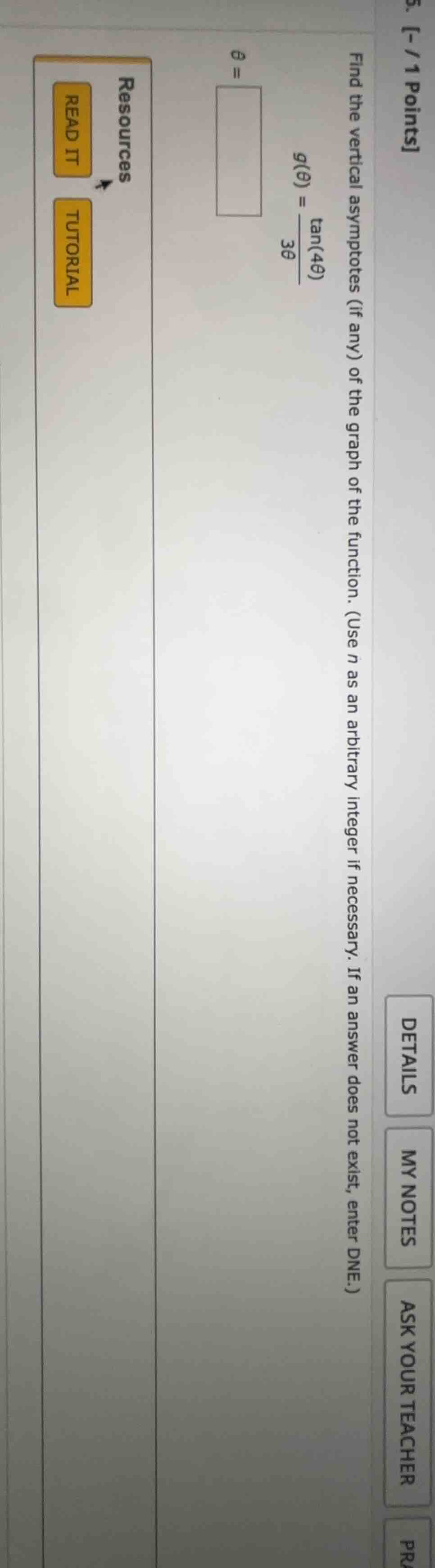
- -/1 points find the vertical asymptotes (if any) of the graph of the function. (use ( n ) as an arbitrary integer if necessary. if an answer does not exist, enter dne.)( g(\theta) = \frac{\tan(4\theta)}{3\theta} )( \theta = )
resources
read it
tutorial
Step1: Rewrite tangent as sine/cosine
Recall $\tan(x)=\frac{\sin(x)}{\cos(x)}$, so:
$$g(\theta)=\frac{\frac{\sin(4\theta)}{\cos(4\theta)}}{3\theta}=\frac{\sin(4\theta)}{3\theta\cos(4\theta)}$$
Step2: Find undefined points
The function is undefined when denominator is 0:
- $3\theta=0 \implies \theta=0$
- $\cos(4\theta)=0$: Cosine is 0 when argument is $\frac{\pi}{2}+n\pi$, $n\in\mathbb{Z}$.
$$4\theta=\frac{\pi}{2}+n\pi$$
$$\theta=\frac{\pi}{8}+\frac{n\pi}{4}$$
Step3: Check limit at $\theta=0$
Use $\lim_{x\to0}\frac{\sin(x)}{x}=1$:
$$\lim_{\theta\to0}g(\theta)=\lim_{\theta\to0}\frac{\sin(4\theta)}{3\theta\cos(4\theta)}=\frac{1}{3}\lim_{\theta\to0}\frac{\sin(4\theta)}{\theta}\cdot\lim_{\theta\to0}\frac{1}{\cos(4\theta)}$$
$$=\frac{1}{3}\cdot4\cdot1=\frac{4}{3}$$
This is a finite limit, so $\theta=0$ is a removable discontinuity, not an asymptote.
Step4: Confirm vertical asymptotes
For $\theta=\frac{\pi}{8}+\frac{n\pi}{4}$, $\cos(4\theta)=0$ and $\sin(4\theta)
eq0$, so the function has infinite limits here, which are vertical asymptotes.

Snap & solve any problem in the app
Get step-by-step solutions on Sovi AI
Photo-based solutions with guided steps
Explore more problems and detailed explanations
$\theta=\frac{\pi}{8}+\frac{n\pi}{4}$, where $n$ is any integer