QUESTION IMAGE
Question
6 points
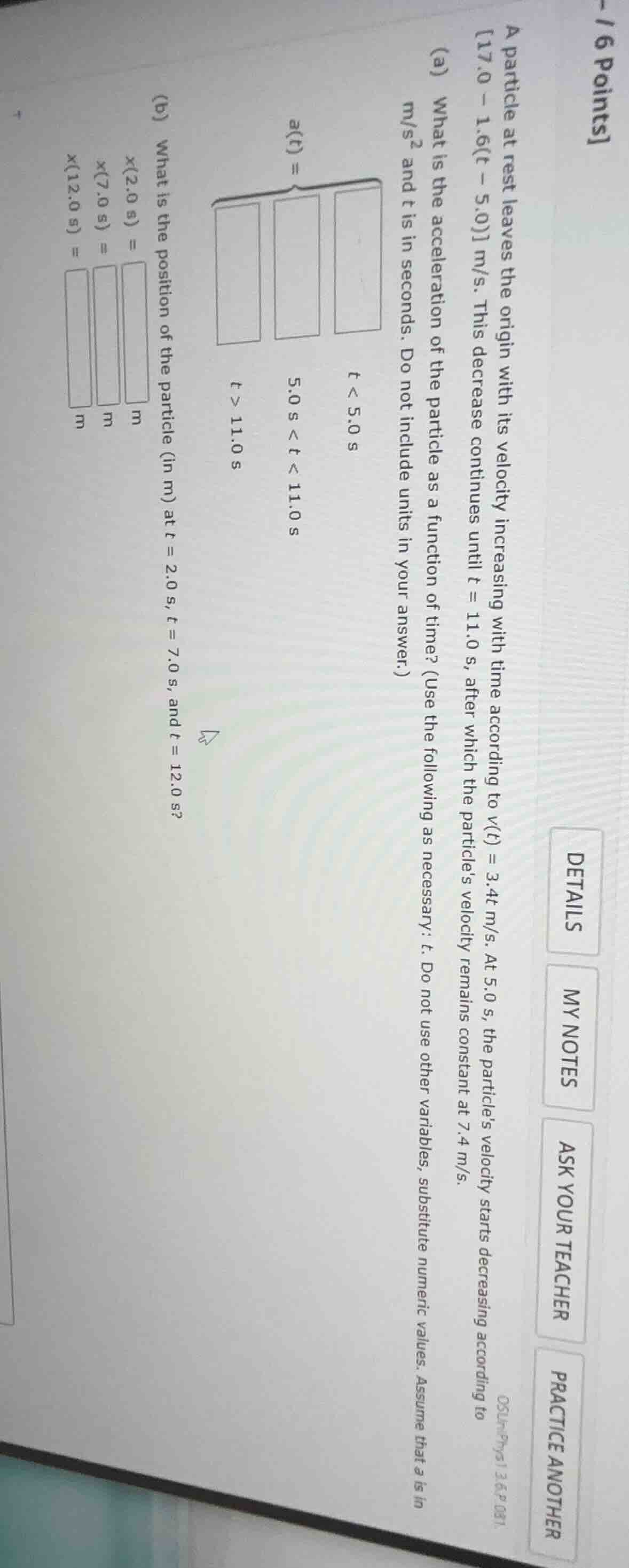
a particle at rest leaves the origin with its velocity increasing with time according to $v(t) = 3.4t$ m/s. at 5.0 s, the particles velocity starts decreasing according to $17.0 - 1.6(t - 5.0)$ m/s. this decrease continues until $t = 11.0$ s, after which the particles velocity remains constant at 7.4 m/s.
(a) what is the acceleration of the particle as a function of time? (use the following as necessary: $t$. do not use other variables, substitute numeric values. assume that $a$ is in m/s² and $t$ is in seconds. do not include units in your answer.)
$a(t) = \
$
(b) what is the position of the particle (in m) at $t = 2.0$ s, $t = 7.0$ s, and $t = 12.0$ s?
$x(2.0\text{ s}) = \square$ m
$x(7.0\text{ s}) = \square$ m
$x(12.0\text{ s}) = \square$ m
Step1: Find acceleration for \(t < 5.0\ s\)
Acceleration is derivative of velocity: \(a(t)=\frac{dv}{dt}=\frac{d}{dt}(3.4t)=3.4\)
Step2: Find acceleration for \(5.0\ s < t < 11.0\ s\)
Differentiate the velocity function: \(a(t)=\frac{dv}{dt}=\frac{d}{dt}[17.0 - 1.6(t-5.0)]=-1.6\)
Step3: Find acceleration for \(t > 11.0\ s\)
Velocity is constant (\(7.4\ m/s\)), so derivative is 0: \(a(t)=\frac{d}{dt}(7.4)=0\)
Step4: Find position at \(t=2.0\ s\)
Integrate velocity \(v(t)=3.4t\): \(x(t)=\int 3.4t\ dt=1.7t^2\). Substitute \(t=2.0\):
\(x(2.0)=1.7(2.0)^2=6.8\)
Step5: Find position at \(t=7.0\ s\)
First find position at \(t=5.0\ s\): \(x(5.0)=1.7(5.0)^2=42.5\ m\).
Integrate velocity for \(t\geq5.0\): \(x(t)=42.5+\int_{5.0}^{t}[17.0-1.6(\tau-5.0)]d\tau=42.5+17.0(t-5.0)-0.8(t-5.0)^2\).
Substitute \(t=7.0\):
\(x(7.0)=42.5+17.0(2.0)-0.8(2.0)^2=42.5+34-3.2=73.3\)
Step6: Find position at \(t=12.0\ s\)
First find position at \(t=11.0\ s\):
\(x(11.0)=42.5+17.0(6.0)-0.8(6.0)^2=42.5+102-28.8=115.7\ m\).
For \(t\geq11.0\ s\), velocity is \(7.4\ m/s\): \(x(t)=115.7+7.4(t-11.0)\).
Substitute \(t=12.0\):
\(x(12.0)=115.7+7.4(1.0)=123.1\)

Snap & solve any problem in the app
Get step-by-step solutions on Sovi AI
Photo-based solutions with guided steps
Explore more problems and detailed explanations
Part (a)
\(a(t)=
\)
Part (b)
\(x(2.0\ s)=6.8\ m\)
\(x(7.0\ s)=73.3\ m\)
\(x(12.0\ s)=123.1\ m\)