QUESTION IMAGE
Question
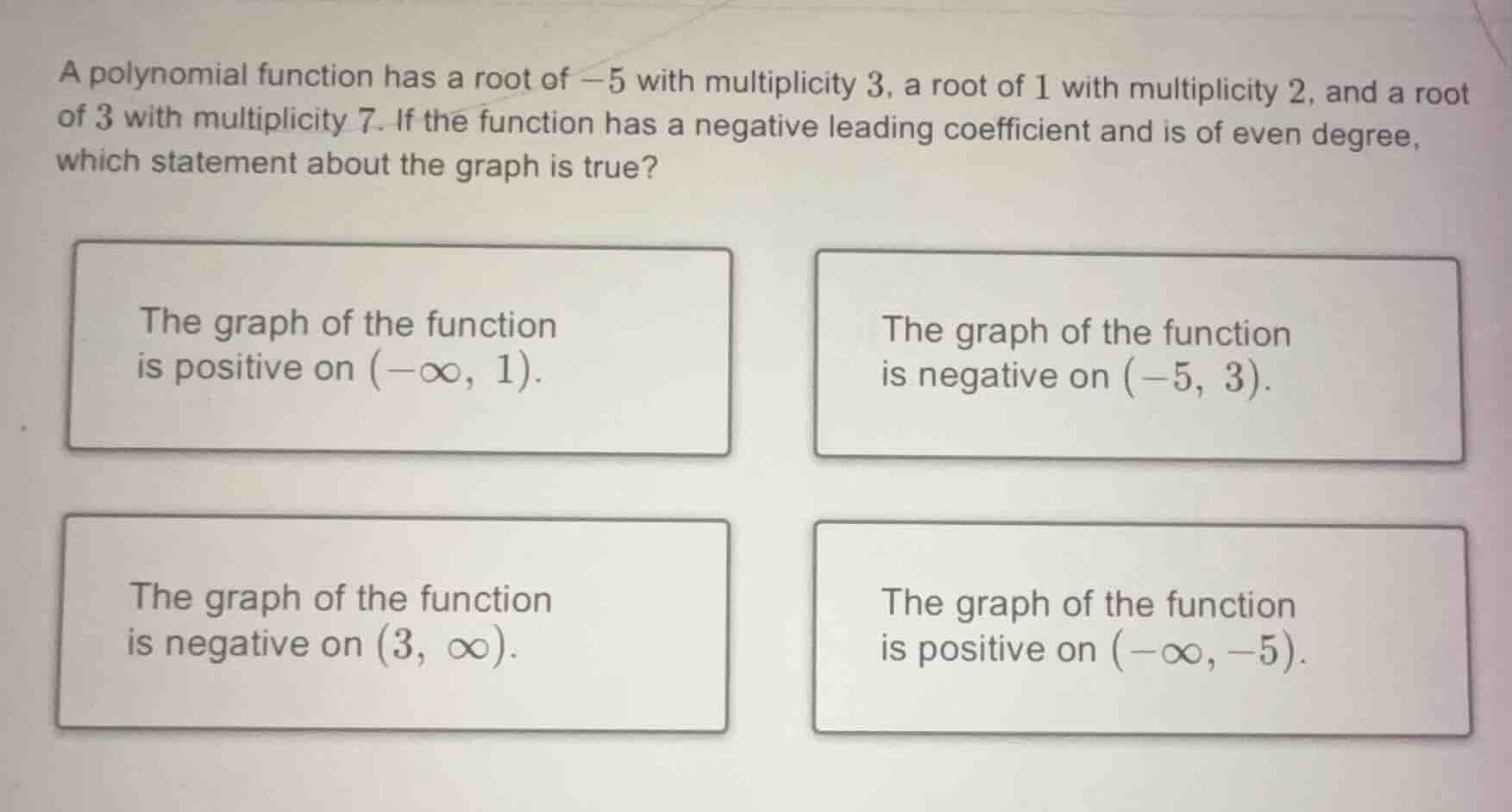
a polynomial function has a root of -5 with multiplicity 3, a root of 1 with multiplicity 2, and a root of 3 with multiplicity 7. if the function has a negative leading coefficient and is of even degree, which statement about the graph is true? the graph of the function is positive on (-∞, 1). the graph of the function is negative on (-5, 3). the graph of the function is negative on (3, ∞). the graph of the function is positive on (-∞, -5).
Step 1: Determine the degree and leading coefficient
The multiplicities of the roots are 3, 2, and 7. The degree of the polynomial is the sum of the multiplicities: \(3 + 2 + 7 = 12\), which is even. The leading coefficient is negative.
Step 2: Analyze the end behavior
For a polynomial with an even degree and a negative leading coefficient, as \(x \to \infty\) and \(x \to -\infty\), \(f(x) \to -\infty\).
Step 3: Analyze the sign of the function in intervals
- The roots divide the number line into intervals: \((-\infty, -5)\), \((-5, 1)\), \((1, 3)\), and \((3, \infty)\).
- For a root with odd multiplicity, the sign of the function changes at that root; for even multiplicity, the sign does not change.
- Let's consider a test point in each interval:
- For \((-\infty, -5)\), let's take \(x = -6\). The factors would be \((-6 + 5)^3(-6 - 1)^2(-6 - 3)^7\). Simplifying, \((-1)^3(-7)^2(-9)^7\). The product of an odd number of negative terms (from \((-1)^3\) and \((-9)^7\)) and an even number of negative terms (from \((-7)^2\)): \((-1) \times (positive) \times (-1) = positive\)? Wait, no. Wait, the leading coefficient is negative. Wait, the polynomial can be written as \(f(x) = -a(x + 5)^3(x - 1)^2(x - 3)^7\) where \(a > 0\).
- For \(x < -5\) (e.g., \(x = -6\)): \((x + 5) = -1\) (odd power, so sign changes), \((x - 1) = -7\) (even power, sign doesn't change), \((x - 3) = -9\) (odd power, sign changes). So the product inside the polynomial (without the leading coefficient) is \((-1)^3(-7)^2(-9)^7\). The exponent 3 is odd, 2 is even, 7 is odd. So \((-1) \times (positive) \times (-1) = positive\). Then multiply by the negative leading coefficient: \(f(-6) = -a \times (positive) = negative\)? Wait, maybe I made a mistake. Let's re-express:
\(f(x) = -a(x + 5)^3(x - 1)^2(x - 3)^7\), \(a > 0\).
- For \(x < -5\) (e.g., \(x = -6\)):
- \((x + 5) = -1\), so \((x + 5)^3 = (-1)^3 = -1\)
- \((x - 1) = -7\), so \((x - 1)^2 = (-7)^2 = 49\) (positive)
- \((x - 3) = -9\), so \((x - 3)^7 = (-9)^7 = -9^7\) (negative)
- Multiply these together: \((-1) \times 49 \times (-9^7) = 49 \times 9^7\) (positive)
- Then multiply by \(-a\) (where \(a > 0\)): \(f(-6) = -a \times (positive) = negative\). Wait, that's different from before. So my initial thought was wrong.
- For \((-5, 1)\), let's take \(x = 0\):
- \((0 + 5)^3 = 125\) (positive)
- \((0 - 1)^2 = 1\) (positive)
- \((0 - 3)^7 = -3^7\) (negative)
- Product inside: \(125 \times 1 \times (-3^7) = -125 \times 3^7\) (negative)
- Multiply by \(-a\): \(f(0) = -a \times (-125 \times 3^7) = a \times 125 \times 3^7\) (positive)
- For \((1, 3)\), let's take \(x = 2\):
- \((2 + 5)^3 = 343\) (positive)
- \((2 - 1)^2 = 1\) (positive)
- \((2 - 3)^7 = -1\) (negative)
- Product inside: \(343 \times 1 \times (-1) = -343\) (negative)
- Multiply by \(-a\): \(f(2) = -a \times (-343) = a \times 343\) (positive)
- For \((3, \infty)\), let's take \(x = 4\):
- \((4 + 5)^3 = 729\) (positive)
- \((4 - 1)^2 = 9\) (positive)
- \((4 - 3)^7 = 1\) (positive)
- Product inside: \(729 \times 9 \times 1 = 6561\) (positive)
- Multiply by \(-a\): \(f(4) = -a \times 6561\) (negative)
Step 4: Evaluate each option
- Option 1: "The graph of the function is positive on \((-\infty, 1)\)". From our analysis, on \((-\infty, -5)\) the function is negative, and on \((-5, 1)\) it's positive. So this is false.
- Option 2: "The graph of the function is negative on \((-5, 3)\)". On \((-5, 1)\) and \((1, 3)\), the function is positive. So this is false.
- Op…

Snap & solve any problem in the app
Get step-by-step solutions on Sovi AI
Photo-based solutions with guided steps
Explore more problems and detailed explanations
The graph of the function is negative on \((3, \infty)\) (the third option, assuming the options are labeled as: 1. The graph... on \((-\infty, 1)\); 2. The graph... on \((-5, 3)\); 3. The graph... on \((3, \infty)\); 4. The graph... on \((-\infty, -5)\))