QUESTION IMAGE
Question
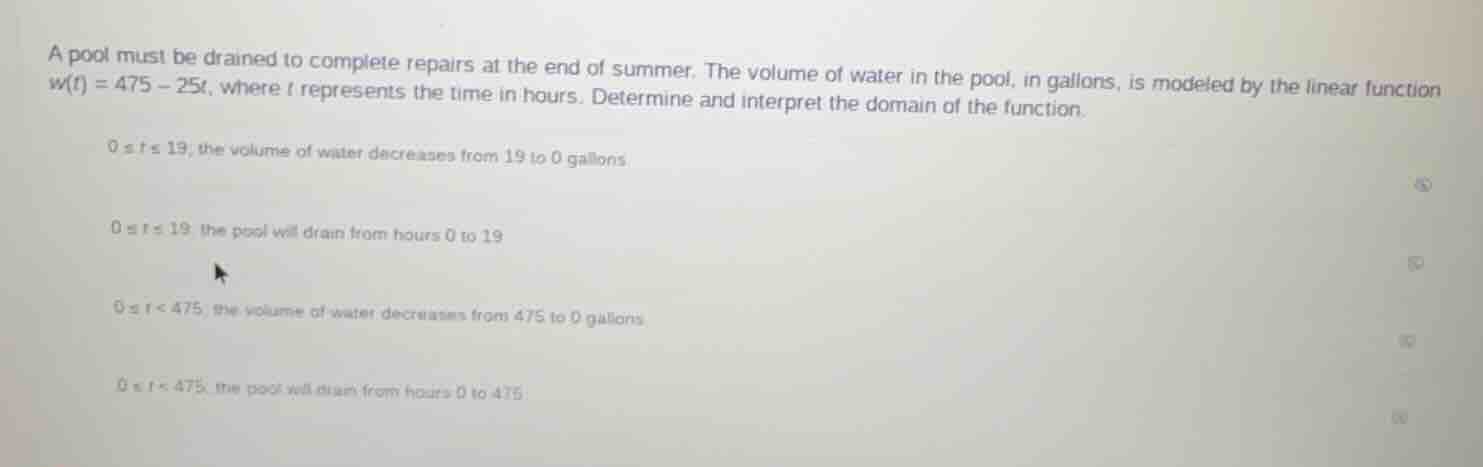
a pool must be drained to complete repairs at the end of summer. the volume of water in the pool, in gallons, is modeled by the linear function ( w(t) = 475 - 25t ), where ( t ) represents the time in hours. determine and interpret the domain of the function.
- ( 0 leq t leq 19 ), the volume of water decreases from 19 to 0 gallons
- ( 0 leq t leq 19 ), the pool will drain from hours 0 to 19
- ( 0 leq t < 475 ), the volume of water decreases from 475 to 0 gallons
- ( 0 leq t < 475 ), the pool will drain from hours 0 to 475
Step1: Analyze the volume function
The volume function is \( w(t) = 475 - 25t \). The volume of water \( w(t) \) can't be negative, so we set \( w(t)\geq0 \).
\[
475 - 25t\geq0
\]
Step2: Solve for t
Subtract 475 from both sides:
\[
- 25t\geq - 475
\]
Divide both sides by - 25 (and reverse the inequality sign):
\[
t\leq19
\]
Also, time \( t \) can't be negative, so \( t\geq0 \). So the domain of \( t \) is \( 0\leq t\leq19 \).
Now, interpret the domain: When \( t = 0 \), \( w(0)=475-25\times0 = 475 \) gallons (initial volume). When \( t = 19 \), \( w(19)=475 - 25\times19=475 - 475 = 0 \) gallons (pool is drained). So the volume of water decreases from 475 to 0 gallons as \( t \) goes from 0 to 19 hours. Wait, but looking at the options, the first option says "0 ≤ t ≤ 19, the volume of water decreases from 19 to 0 gallons" - no, that's wrong. Wait, no, let's re - check. Wait, the first option's interpretation is wrong, the second option: "0 ≤ t ≤ 19, the pool will drain from hours 0 to 19" - but the correct interpretation should relate to volume. Wait, no, let's re - solve. Wait, when \( t = 0 \), volume is 475, when \( t = 19 \), volume is 0. So the domain is \( 0\leq t\leq19 \), and the interpretation is that the volume of water decreases from 475 to 0 gallons as time goes from 0 to 19 hours. But among the options, the first option has the correct domain \( 0\leq t\leq19 \) but wrong interpretation, the second option has correct domain and a simple interpretation about time. Wait, maybe I made a mistake. Wait, the function is \( w(t)=475 - 25t \). To find when the pool is drained, set \( w(t) = 0 \):
\[
475-25t = 0\\
25t=475\\
t = 19
\]
So time starts at \( t = 0 \) (when we start draining) and ends at \( t = 19 \) (when the pool is empty). So the domain of \( t \) (time) is \( 0\leq t\leq19 \). Now, looking at the options:
- Option 1: Domain \( 0\leq t\leq19 \), interpretation "the volume of water decreases from 19 to 0 gallons" - wrong, volume starts at 475.
- Option 2: Domain \( 0\leq t\leq19 \), interpretation "the pool will drain from hours 0 to 19" - correct domain and a valid (simple) interpretation about time.
- Option 3: Domain \( 0\leq t\lt475 \) - wrong, because \( t \) is time, not related to 475 in that way.
- Option 4: Domain \( 0\leq t\lt475 \) - wrong.
Wait, maybe the first option's interpretation is a typo? No, maybe I misread. Wait, no, let's check again. The first option says "the volume of water decreases from 19 to 0 gallons" - that's wrong. The second option: "0 ≤ t ≤ 19, the pool will drain from hours 0 to 19" - that's correct in terms of domain and a basic interpretation of time.

Snap & solve any problem in the app
Get step-by-step solutions on Sovi AI
Photo-based solutions with guided steps
Explore more problems and detailed explanations
The correct option is: \( 0\leq t\leq19 \), the pool will drain from hours 0 to 19 (the second option among the given options, assuming the options are presented as:
- \( 0\leq t\leq19 \), the volume of water decreases from 19 to 0 gallons
- \( 0\leq t\leq19 \), the pool will drain from hours 0 to 19
- \( 0\leq t\lt475 \), the volume of water decreases from 475 to 0 gallons
- \( 0\leq t\lt475 \), the pool will drain from hours 0 to 475
So the answer is: 0 ≤ t ≤ 19, the pool will drain from hours 0 to 19 (the second option in the list of options provided)