QUESTION IMAGE
Question
possible points: 12.5
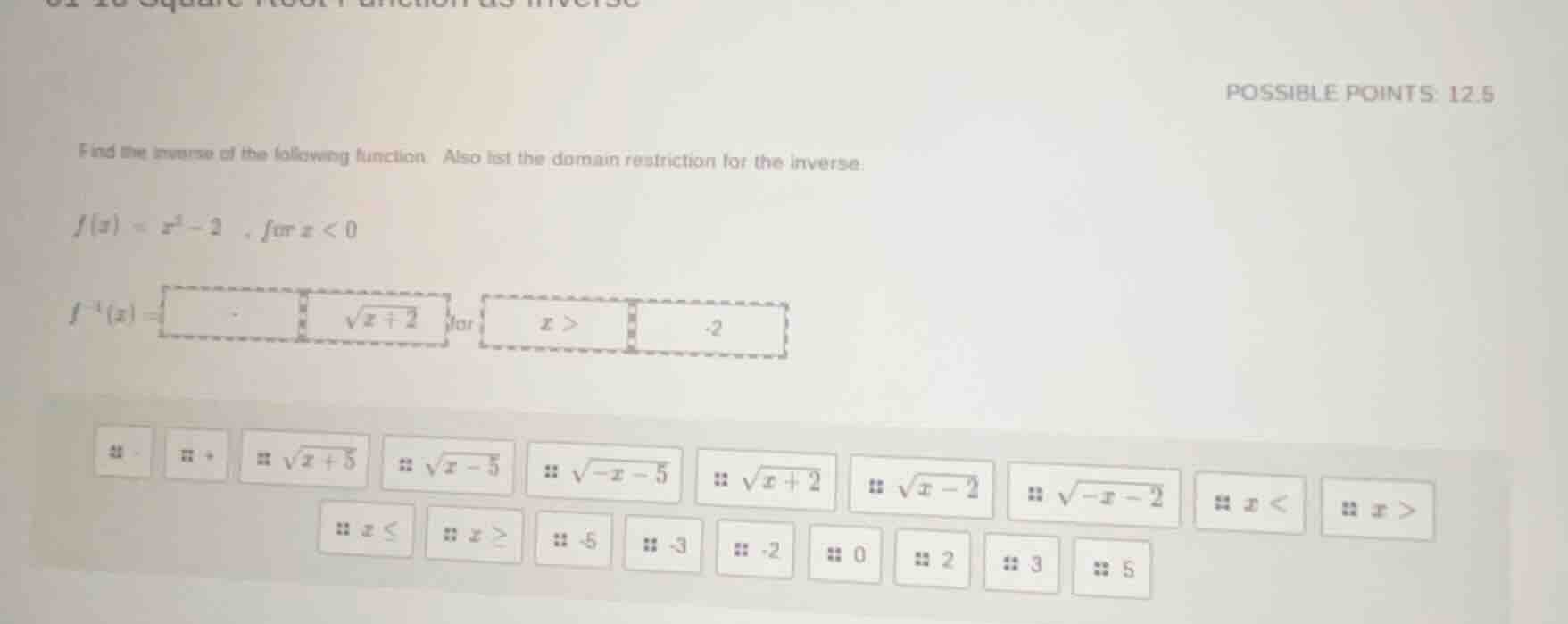
find the inverse of the following function. also list the domain restriction for the inverse.
$f(x) = x^2 - 2$, for $x < 0$
$f^{-1}(x) = \square \sqrt{x + 2}$ for $x > -2$
options: $x -$, $x +$, $\sqrt{x + 5}$, $\sqrt{x - 5}$, $\sqrt{-x - 5}$, $\sqrt{x + 2}$, $\sqrt{x - 2}$, $\sqrt{-x - 2}$, $x <$, $x >$, $x \leq$, $x \geq$, $-5$, $-3$, $-2$, $0$, $2$, $3$, $5$
Step1: Swap \(x\) and \(y\)
Given \(y = x^2 - 2\) for \(x < 0\), swap \(x\) and \(y\) to get \(x = y^2 - 2\).
Step2: Solve for \(y\)
Add 2 to both sides: \(x + 2 = y^2\). Take square roots: \(y=\pm\sqrt{x + 2}\). But original \(x<0\), so inverse should have \(y<0\) (since domain of \(f\) is range of \(f^{-1}\), and range of \(f\) for \(x < 0\) is \(y>-2\)). So \(y = -\sqrt{x + 2}\)? Wait, no, wait. Wait, original function: \(f(x)=x^2 - 2\), \(x < 0\). Let's find inverse. Let \(y = x^2 - 2\), \(x < 0\). Then \(x^2 = y + 2\), so \(x = -\sqrt{y + 2}\) (since \(x < 0\), we take negative root). Then swap \(x\) and \(y\): \(f^{-1}(x)=-\sqrt{x + 2}\)? Wait, but the options have a negative sign? Wait, the first box is for the sign. Wait, the first dashed box is before \(\sqrt{x + 2}\). So we need to put a negative sign there. Then the domain of \(f^{-1}\): the range of \(f\) is \(y > -2\) (since \(x^2 \geq 0\), so \(x^2 - 2 \geq -2\), but \(x < 0\), so \(x^2\) is still \(\geq 0\), so \(y > -2\)). So domain of \(f^{-1}\) is \(x > -2\). Wait, but the first part: \(f^{-1}(x)=\boldsymbol{-}\sqrt{x + 2}\) for \(x > -2\). Wait, let's check again.
Original function: \(f(x) = x^2 - 2\), \(x < 0\). Let's find inverse.
- Let \(y = x^2 - 2\), \(x < 0\).
- Solve for \(x\): \(x^2 = y + 2\), so \(x = -\sqrt{y + 2}\) (because \(x < 0\), we take the negative square root).
- Swap \(x\) and \(y\): \(f^{-1}(x) = -\sqrt{x + 2}\) (wait, no, wait: when we swap, \(y = -\sqrt{x + 2}\)). Wait, but the first box is a sign (like - or +). So the first box should be "-", then the square root is \(\sqrt{x + 2}\), and the domain is \(x > -2\) (since the range of \(f\) is \(y > -2\), because \(x^2 \geq 0\), so \(x^2 - 2 \geq -2\), and since \(x\) can be any negative number, \(x^2\) can be any non-negative number, so \(y\) can be any number greater than or equal to -2? Wait, no: \(x < 0\), so \(x^2\) is positive, so \(x^2 - 2\) is greater than -2 (since \(x^2 > 0\) when \(x
eq 0\), so \(x^2 - 2 > -2\)). So range of \(f\) is \(y > -2\), so domain of \(f^{-1}\) is \(x > -2\).
So putting it together: \(f^{-1}(x) = \boldsymbol{-}\sqrt{x + 2}\) for \(x > -2\). Wait, but the options have a "-" button. So the first box is "-", then \(\sqrt{x + 2}\), and the domain is \(x > -2\) (which is already partially filled with -2, so we need to confirm the inequality. The options have \(x >\), and the number is -2. Wait, the domain restriction is \(x > -2\). So:
\(f^{-1}(x) = \boldsymbol{-}\sqrt{x + 2}\) for \(x > -2\). Wait, but the first dashed box is before \(\sqrt{x + 2}\), so we put "-" there. Then the domain is \(x > -2\), which matches the given "-2" and "x >".
Wait, let's check with an example. Let \(x = -1\) (which is < 0) in \(f(x)\): \(f(-1) = (-1)^2 - 2 = 1 - 2 = -1\). Then \(f^{-1}(-1)\) should be -1. Let's plug into \(f^{-1}(x) = -\sqrt{x + 2}\): \(f^{-1}(-1) = -\sqrt{-1 + 2} = -\sqrt{1} = -1\), which matches. Good. Another example: \(x = -2\) (but \(x < 0\), so \(x = -2\) is allowed? Wait, \(x < 0\), so \(x = -2\) is okay. \(f(-2) = (-2)^2 - 2 = 4 - 2 = 2\). Then \(f^{-1}(2) = -\sqrt{2 + 2} = -\sqrt{4} = -2\), which is correct (since \(f(-2) = 2\), so \(f^{-1}(2) = -2\)). And the domain of \(f^{-1}\) is \(x > -2\) (since the range of \(f\) is \(y > -2\), as \(x^2 - 2\) when \(x < 0\) can be any number greater than -2: when \(x\) approaches 0 from the left, \(f(x)\) approaches -2, and as \(x\) becomes more negative, \(f(x)\) becomes larger (since \(x^2\) increases). So range of \(f\) is \((-2, \infty)\), so domain of \(f^{-1}\) is \((-2, \infty)\), i.e., \(x >…

Snap & solve any problem in the app
Get step-by-step solutions on Sovi AI
Photo-based solutions with guided steps
Explore more problems and detailed explanations
First box: \(-\) (the negative sign option), then \(\sqrt{x + 2}\), and for the domain: \(x > -2\) (so the first domain box is \(x >\), the second is \(-2\)). So putting it as per the boxes:
\(f^{-1}(x) = \boldsymbol{-}\sqrt{x + 2}\) for \(x > -2\)