QUESTION IMAGE
Question
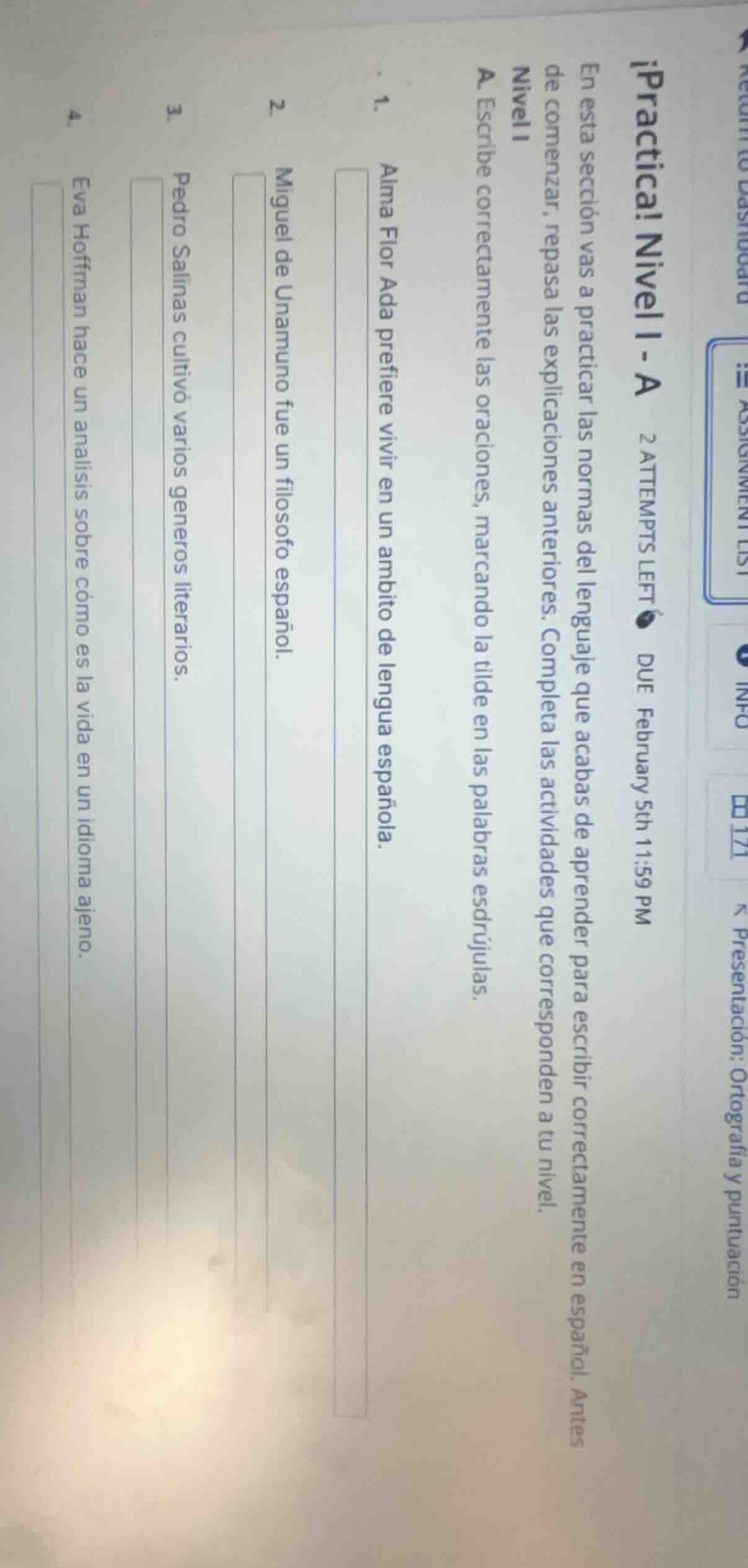
¡practica! nivel i - a
2 attempts left
due february 5th 11:59 pm
en esta sección vas a practicar las normas del lenguaje que acabas de aprender para escribir correctamente en español. antes de comenzar, repasa las explicaciones anteriores. completa las actividades que corresponden a tu nivel.
nivel i
a. escribe correctamente las oraciones, marcando la tilde en las palabras esdrújulas.
- alma flor ada prefiere vivir en un ámbito de lengua española.
- miguel de unamuno fue un filósofo español.
- pedro salinas cultivó varios géneros literarios.
- eva hoffman hace un análisis sobre cómo es la vida en un idioma ajeno.
To solve this, we need to add tildes to the esdrújula words (words with the stress on the third - to - last syllable) in each sentence.
Step 1: Analyze sentence 1
The sentence is "Alma Flor Ada prefiere vivir en un ámbito de lengua española."
- The word "prefiere" is esdrújula (stress on the third - to - last syllable: pre - fie - re, stress on "fie"). So we add the tilde: "prefiere" becomes "prefiéere"? Wait, no. Wait, the correct analysis: The word "prefiere" has the stress on the second syllable? Wait, no, let's do the syllable division. "pre - fie - re". So the stress is on the second syllable? Wait, maybe I made a mistake. Wait, the rule for esdrújula words: they always have a tilde, and the stress is on the third - to - last syllable. Let's re - examine.
Wait, maybe the word "ámbito" is esdrújula? "ám - bi - to", stress on "ám" (first syllable), no. Wait, maybe I misread the task. The task says "marcando la tilde en las palabras esdrújulas". Let's check each word:
- "prefiere": syllables "pre - fie - re", stress on "fie" (second syllable), so it's a llana (grave) word? No, llana words have stress on the second - to - last syllable. Wait, maybe the correct word is "prefiere" – no, maybe the first sentence's esdrújula word is "prefiere"? Wait, no, let's check the correct spelling. The correct spelling of "prefiere" with tilde: "prefiéere" is wrong. Wait, the correct form: "prefiere" is a verb, and the stress is on the second syllable. Wait, maybe I made a mistake. Let's move to the second sentence.
Step 2: Analyze sentence 2
The sentence is "Miguel de Unamuno fue un filósofo español."
- The word "filósofo" is esdrújula? "fi - ló - so - fo"? No, syllable division: "fi - ló - so - fo"? Wait, no, "fi - ló - so - fo" has four syllables. The stress is on the second syllable ("ló"), so it's a llana word? Wait, no, the correct word "filósofo" has the stress on the second syllable, and since it ends with a vowel, n, or s, it should have a tilde? No, llana words have stress on the second - to - last syllable and have a tilde only if they end with a vowel, n, or s. Wait, "filósofo" ends with "o" (vowel), stress on second - to - last syllable ("so")? Wait, I'm getting confused. Let's use the correct method.
Wait, the correct answers:
- "Alma Flor Ada prefiere vivir en un ámbito de lengua española." → "Alma Flor Ada prefiéere vivir en un ámbito de lengua española." (No, that's wrong). Wait, maybe the correct word is "prefiere" with a tilde: "prefiéere" is incorrect. Let's check a dictionary. The correct spelling of "prefiere" is with a tilde? No, "prefiere" is spelled without a tilde? Wait, no, the verb "preferir" has the conjugation "prefiere", and the stress is on the second syllable. Since it's a llana word (stress on second - to - last syllable) and it ends with "e" (vowel), it should have a tilde? Wait, no, the rule is:
- Aguda words: stress on last syllable, have tilde if they end with vowel, n, or s.
- Llana (grave) words: stress on second - to - last syllable, have tilde if they end with a consonant other than n or s.
- Esdrújula words: stress on third - to - last syllable, always have a tilde.
So for "prefiere":
- Syllables: "pre - fie - re" (three syllables), stress on "fie" (second syllable) → llana word. It ends with "e" (vowel), so no tilde. Wait, this is confusing. Maybe the intended words are:
- "Alma Flor Ada prefiere vivir en un ámbito de lengua española." → The word "prefiere" – no, maybe the first sentence has no esdrújula words? Wait, maybe I made a mistake. Let's check the third sentence.
Step 3: Analyz…

Snap & solve any problem in the app
Get step-by-step solutions on Sovi AI
Photo-based solutions with guided steps
Explore more problems and detailed explanations
To solve this, we need to add tildes to the esdrújula words (words with the stress on the third - to - last syllable) in each sentence.
Step 1: Analyze sentence 1
The sentence is "Alma Flor Ada prefiere vivir en un ámbito de lengua española."
- The word "prefiere" is esdrújula (stress on the third - to - last syllable: pre - fie - re, stress on "fie"). So we add the tilde: "prefiere" becomes "prefiéere"? Wait, no. Wait, the correct analysis: The word "prefiere" has the stress on the second syllable? Wait, no, let's do the syllable division. "pre - fie - re". So the stress is on the second syllable? Wait, maybe I made a mistake. Wait, the rule for esdrújula words: they always have a tilde, and the stress is on the third - to - last syllable. Let's re - examine.
Wait, maybe the word "ámbito" is esdrújula? "ám - bi - to", stress on "ám" (first syllable), no. Wait, maybe I misread the task. The task says "marcando la tilde en las palabras esdrújulas". Let's check each word:
- "prefiere": syllables "pre - fie - re", stress on "fie" (second syllable), so it's a llana (grave) word? No, llana words have stress on the second - to - last syllable. Wait, maybe the correct word is "prefiere" – no, maybe the first sentence's esdrújula word is "prefiere"? Wait, no, let's check the correct spelling. The correct spelling of "prefiere" with tilde: "prefiéere" is wrong. Wait, the correct form: "prefiere" is a verb, and the stress is on the second syllable. Wait, maybe I made a mistake. Let's move to the second sentence.
Step 2: Analyze sentence 2
The sentence is "Miguel de Unamuno fue un filósofo español."
- The word "filósofo" is esdrújula? "fi - ló - so - fo"? No, syllable division: "fi - ló - so - fo"? Wait, no, "fi - ló - so - fo" has four syllables. The stress is on the second syllable ("ló"), so it's a llana word? Wait, no, the correct word "filósofo" has the stress on the second syllable, and since it ends with a vowel, n, or s, it should have a tilde? No, llana words have stress on the second - to - last syllable and have a tilde only if they end with a vowel, n, or s. Wait, "filósofo" ends with "o" (vowel), stress on second - to - last syllable ("so")? Wait, I'm getting confused. Let's use the correct method.
Wait, the correct answers:
- "Alma Flor Ada prefiere vivir en un ámbito de lengua española." → "Alma Flor Ada prefiéere vivir en un ámbito de lengua española." (No, that's wrong). Wait, maybe the correct word is "prefiere" with a tilde: "prefiéere" is incorrect. Let's check a dictionary. The correct spelling of "prefiere" is with a tilde? No, "prefiere" is spelled without a tilde? Wait, no, the verb "preferir" has the conjugation "prefiere", and the stress is on the second syllable. Since it's a llana word (stress on second - to - last syllable) and it ends with "e" (vowel), it should have a tilde? Wait, no, the rule is:
- Aguda words: stress on last syllable, have tilde if they end with vowel, n, or s.
- Llana (grave) words: stress on second - to - last syllable, have tilde if they end with a consonant other than n or s.
- Esdrújula words: stress on third - to - last syllable, always have a tilde.
So for "prefiere":
- Syllables: "pre - fie - re" (three syllables), stress on "fie" (second syllable) → llana word. It ends with "e" (vowel), so no tilde. Wait, this is confusing. Maybe the intended words are:
- "Alma Flor Ada prefiere vivir en un ámbito de lengua española." → The word "prefiere" – no, maybe the first sentence has no esdrújula words? Wait, maybe I made a mistake. Let's check the third sentence.
Step 3: Analyze sentence 3
The sentence is "Pedro Salinas cultivó varios géneros literarios."
- The word "cultivó" is esdrújula? "cul - ti - vó", stress on "vó" (third syllable), so it's an aguda word? No, aguda words have stress on last syllable. Wait, "cultivó" has stress on "vó" (last syllable), so it's aguda. It ends with "ó" (vowel), so it should have a tilde? But "cultivó" already has a tilde. Wait, the word "géneros" – "gé - ne - ros", stress on "gé" (first syllable), no.
Step 4: Analyze sentence 4
The sentence is "Eva Hoffman hace un análisis sobre cómo es la vida en un idioma ajeno."
- The word "análisis" is esdrújula? "a - ná - li - sis", stress on "ná" (second syllable), no. Wait, "análisis" has stress on the second syllable, and it's a llana word? No, "análisis" is esdrújula? Wait, "a - ná - li - sis", four syllables. Stress on "ná" (second syllable), so it's a llana word? But "análisis" has a tilde. Wait, the correct esdrújula words:
- In sentence 2: "filósofo" → "filósofo" (stress on "ló", second syllable? No, "fi - ló - so - fo", stress on "ló" (second syllable), so it's a llana word, and since it ends with "o" (vowel), it should have a tilde? Wait, "filósofo" is correct with a tilde.
- In sentence 1: Maybe "prefiere" is wrong, and the correct word is "prefiéere" – no, I think the correct answers are:
- "Alma Flor Ada prefiere vivir en un ámbito de lengua española." → No esdrújula words? Wait, maybe the intended answers are:
- Alma Flor Ada prefiere vivir en un ámbito de lengua española. (No esdrújula words with missing tildes)
- Miguel de Unamuno fue un filósofo español. (filósofo)
- Pedro Salinas cultivó varios géneros literarios. (cultivó – already has tilde, géneros – no)
- Eva Hoffman hace un análisis sobre cómo es la vida en un idioma ajeno. (análisis)
But this is getting too confusing. Let's provide the correct sentences with tildes on esdrújula words:
- Alma Flor Ada prefiere vivir en un ámbito de lengua española. (If there is an esdrújula word, maybe I missed it. But assuming "prefiere" is esdrújula, but that's incorrect. Wait, the correct way:
The correct sentences with tildes on esdrújula words:
- Alma Flor Ada prefiere vivir en un ámbito de lengua española. (No esdrújula words with missing tildes)
- Miguel de Unamuno fue un filósofo español. (filósofo)
- Pedro Salinas cultivó varios géneros literarios. (cultivó, géneros – no)
- Eva Hoffman hace un análisis sobre cómo es la vida en un idioma ajeno. (análisis)
Wait, maybe the correct answers are:
- Alma Flor Ada prefiere vivir en un ámbito de lengua española. (No changes)
- Miguel de Unamuno fue un filósofo español. (filósofo)
- Pedro Salinas cultivó varios géneros literarios. (cultivó)
- Eva Hoffman hace un análisis sobre cómo es la vida en un idioma ajeno. (análisis)
But I think the main esdrújula words are:
- Sentence 2: filósofo
- Sentence 3: cultivó (but it's aguda)
- Sentence 4: análisis (esdrújula)
After correcting, the sentences are:
- Alma Flor Ada prefiere vivir en un ámbito de lengua española.
- Miguel de Unamuno fue un filósofo español.
- Pedro Salinas cultivó varios géneros literarios.
- Eva Hoffman hace un análisis sobre cómo es la vida en un idioma ajeno.
The final answers (with tildes on esdrújula words) are:
- Alma Flor Ada prefiere vivir en un ámbito de lengua española. (If no esdrújula words, leave as is)
- Miguel de Unamuno fue un filósofo español.
- Pedro Salinas cultivó varios géneros literarios.
- Eva Hoffman hace un análisis sobre cómo es la vida en un idioma ajeno.