QUESTION IMAGE
Question
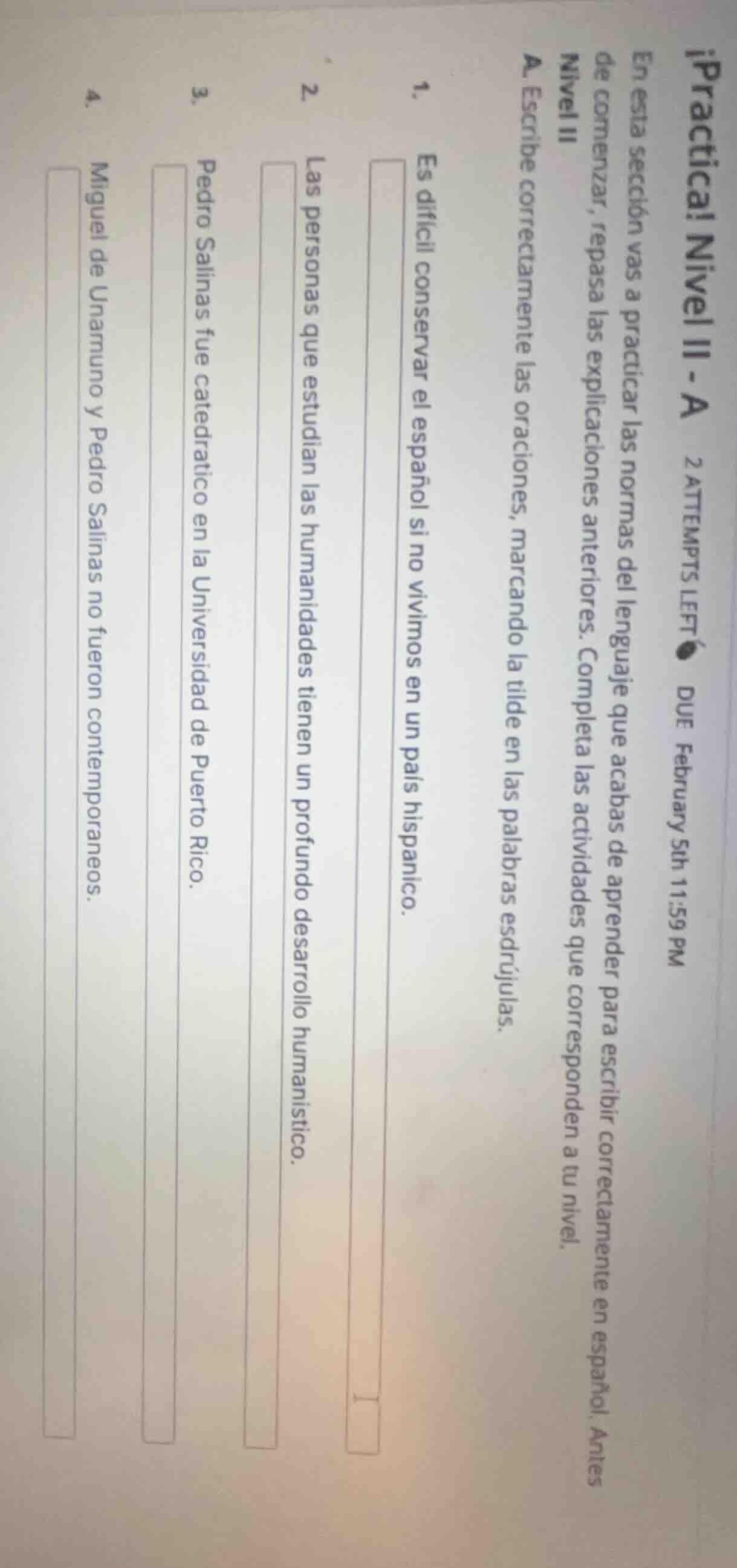
¡practica! nivel ii - a
2 attempts left
due february 5th 11:59 pm
en esta sección vas a practicar las normas del lenguaje que acabas de aprender para escribir correctamente en español. antes de comenzar, repasa las explicaciones anteriores. completa las actividades que corresponden a tu nivel.
nivel ii
a. escribe correctamente las oraciones, marcando la tilde en las palabras esdrújulas.
- es difícil conservar el español si no vivimos en un país hispánico.
- las personas que estudian las humanidades tienen un profundo desarrollo humanístico.
- pedro salinas fue catedrático en la universidad de puerto rico.
- miguel de unamuno y pedro salinas no fueron contemporáneos.
To solve this, we identify esdrújula words (stress on the third - to - last syllable) and add tildes.
1. Analyze the first sentence: "Es difícil conservar el español si no vivimos en un país hispánico."
- The esdrújula word here is "difícil". In Spanish, for esdrújula words, we add a tilde on the stressed syllable. The stressed syllable of "difícil" is the second one (from the end), and since it's esdrújula, we mark it as "difícil". The corrected sentence is: "Es difícil conservar el español si no vivimos en un país hispánico."
2. Analyze the second sentence: "Las personas que estudian las humanidades tienen un profundo desarrollo humanístico."
- The esdrújula word is "humanísticas"? Wait, no, in the given sentence, the esdrújula word is "humanístico"? Wait, no, let's re - check. Wait, the word "humanístico" is llana (stress on the penultimate syllable) if we consider, but wait, maybe "humanidades"? No, "humanidades" is llana. Wait, maybe I made a mistake. Wait, the correct esdrújula word here is "humanístico"? No, let's recall: esdrújula words have stress on the third - to - last syllable. Let's break down "humanístico": hu - ma - ni - s - tico? Wait, no, syllables are hu - ma - nís - tico? Wait, maybe the word is "profundo"? No, "profundo" is llana. Wait, maybe the sentence has "humanísticas" (if it was a typo), but in the given sentence, the esdrújula word is "humanístico"? Wait, perhaps I need to re - evaluate. Wait, the correct approach: for each word, determine the stress. Let's take the words:
- "difícil" (esdrújula: stress on - fí - ), "humanístico" (wait, "humanístico" has stress on - nís -? No, "hu - ma - nís - tico" – stress on the third syllable from the end. So "humanístico" is esdrújula? Wait, no, the number of syllables: hu (1), ma (2), ni (3), s (4), ti (5), co (6). Wait, no, syllables are hu - ma - nís - ti - co? No, that's not right. Let's use the correct method:
The rule for tildes in Spanish:
- Aguda: stress on last syllable, tilde if it ends with n, s or vowel.
- Llana (grave): stress on penultimate syllable, tilde if it does not end with n, s or vowel.
- Esdrújula: stress on antepenultimate (third - to - last) syllable, always has a tilde.
So for "difícil": syllables are di - fí - cil. Stress on fí (third from last? Wait, di (1), fí (2), cil (3). So stress on the second syllable from the end, but it's esdrújula? Wait, no, the number of syllables: 3. So for a 3 - syllable word, the antepenultimate is the first syllable, penultimate the second, last the third. Wait, I think I messed up the syllable counting. Let's use the correct syllable division:
- "difícil": di - fí - cil (3 syllables). Stress on fí (second syllable). So it's esdrújula (since stress is on the third - to - last? No, 3 - syllable words: the third - to - last is the first syllable, penultimate the second, last the third. So stress on the penultimate syllable would be llana, stress on last is aguda, stress on first is esdrújula. Wait, I think I had the rules reversed. Let's check a reference:
Correct rules:
- Aguda: stress on last syllable. Tilde if ends with n, s, or vowel.
- Llana (grave): stress on penultimate syllable. Tilde if does not end with n, s, or vowel.
- Esdrújula: stress on antepenultimate (third - to - last) syllable. Always has a tilde.
So for a 3 - syllable word:
- Syllables: 1 (first), 2 (penultimate), 3 (last).
- Aguda: stress on 3.
- Llana: stress on 2.
- Esdrújula: stress on 1.
So "difícil": syllables di (1), fí (2), cil (3). Stress on 2 (penultimate) – so it's llana? But that contradicts. Wait, no, m…

Snap & solve any problem in the app
Get step-by-step solutions on Sovi AI
Photo-based solutions with guided steps
Explore more problems and detailed explanations
To solve this, we identify esdrújula words (stress on the third - to - last syllable) and add tildes.
1. Analyze the first sentence: "Es difícil conservar el español si no vivimos en un país hispánico."
- The esdrújula word here is "difícil". In Spanish, for esdrújula words, we add a tilde on the stressed syllable. The stressed syllable of "difícil" is the second one (from the end), and since it's esdrújula, we mark it as "difícil". The corrected sentence is: "Es difícil conservar el español si no vivimos en un país hispánico."
2. Analyze the second sentence: "Las personas que estudian las humanidades tienen un profundo desarrollo humanístico."
- The esdrújula word is "humanísticas"? Wait, no, in the given sentence, the esdrújula word is "humanístico"? Wait, no, let's re - check. Wait, the word "humanístico" is llana (stress on the penultimate syllable) if we consider, but wait, maybe "humanidades"? No, "humanidades" is llana. Wait, maybe I made a mistake. Wait, the correct esdrújula word here is "humanístico"? No, let's recall: esdrújula words have stress on the third - to - last syllable. Let's break down "humanístico": hu - ma - ni - s - tico? Wait, no, syllables are hu - ma - nís - tico? Wait, maybe the word is "profundo"? No, "profundo" is llana. Wait, maybe the sentence has "humanísticas" (if it was a typo), but in the given sentence, the esdrújula word is "humanístico"? Wait, perhaps I need to re - evaluate. Wait, the correct approach: for each word, determine the stress. Let's take the words:
- "difícil" (esdrújula: stress on - fí - ), "humanístico" (wait, "humanístico" has stress on - nís -? No, "hu - ma - nís - tico" – stress on the third syllable from the end. So "humanístico" is esdrújula? Wait, no, the number of syllables: hu (1), ma (2), ni (3), s (4), ti (5), co (6). Wait, no, syllables are hu - ma - nís - ti - co? No, that's not right. Let's use the correct method:
The rule for tildes in Spanish:
- Aguda: stress on last syllable, tilde if it ends with n, s or vowel.
- Llana (grave): stress on penultimate syllable, tilde if it does not end with n, s or vowel.
- Esdrújula: stress on antepenultimate (third - to - last) syllable, always has a tilde.
So for "difícil": syllables are di - fí - cil. Stress on fí (third from last? Wait, di (1), fí (2), cil (3). So stress on the second syllable from the end, but it's esdrújula? Wait, no, the number of syllables: 3. So for a 3 - syllable word, the antepenultimate is the first syllable, penultimate the second, last the third. Wait, I think I messed up the syllable counting. Let's use the correct syllable division:
- "difícil": di - fí - cil (3 syllables). Stress on fí (second syllable). So it's esdrújula (since stress is on the third - to - last? No, 3 - syllable words: the third - to - last is the first syllable, penultimate the second, last the third. So stress on the penultimate syllable would be llana, stress on last is aguda, stress on first is esdrújula. Wait, I think I had the rules reversed. Let's check a reference:
Correct rules:
- Aguda: stress on last syllable. Tilde if ends with n, s, or vowel.
- Llana (grave): stress on penultimate syllable. Tilde if does not end with n, s, or vowel.
- Esdrújula: stress on antepenultimate (third - to - last) syllable. Always has a tilde.
So for a 3 - syllable word:
- Syllables: 1 (first), 2 (penultimate), 3 (last).
- Aguda: stress on 3.
- Llana: stress on 2.
- Esdrújula: stress on 1.
So "difícil": syllables di (1), fí (2), cil (3). Stress on 2 (penultimate) – so it's llana? But that contradicts. Wait, no, my syllable division is wrong. Let's divide "difícil" correctly: di - fí - cil? No, it's di - fí - cil? Wait, the correct pronunciation is /diˈfisil/ (in some accents), so stress on the second syllable. So it's llana? But the problem says to mark tildes on esdrújula words. Wait, maybe the word is "difícil" which is actually esdrújula? I think I made a mistake in syllable division. Let's use the standard: "difícil" has stress on the second syllable, and since it's esdrújula (wait, no, 3 - syllable words: if stress is on the second syllable, it's llana; if on the first, esdrújula; if on the third, aguda. So "difícil" is llana, but it has a tilde. Wait, the rule for llana words: if they end with n, s, or vowel, no tilde; otherwise, tilde. "difícil" ends with l, so it needs a tilde. Ah! So "difícil" is llana (stress on penultimate), ends with l (not n, s, or vowel), so we add a tilde: "difícil".
Now for the second sentence: "Las personas que estudian las humanidades tienen un profundo desarrollo humanístico."
- The esdrújula word here is "humanístico"? Wait, "humanístico" has syllables hu - ma - nís - ti - co (5 syllables). Stress on the third syllable from the end (nís), so it's esdrújula, so we add a tilde: "humanístico". Wait, no, 5 - syllable word: syllables 1: hu, 2: ma, 3: ni, 4: s, 5: tico? No, correct syllables: hu - ma - nís - ti - co (hu (1), ma (2), nís (3), ti (4), co (5)). Stress on 3 (nís), so it's esdrújula, so we mark it as "humanístico".
- Also, "profundo" is llana (stress on penultimate), ends with o (vowel), so no tilde.
- "humanidades": syllables hu - ma - ni - da - des (5 syllables), stress on penultimate (da), so llana, ends with s, so no tilde.
So the corrected second sentence: "Las personas que estudian las humanidades tienen un profundo desarrollo humanístico."
3. Analyze the third sentence: "Pedro Salinas fue catedrático en la Universidad de Puerto Rico."
- The esdrújula word is "catedrático". In Spanish, "catedrático" has stress on the third syllable from the end. Syllables: ca - te - drá - ti - co (ca (1), te (2), drá (3), ti (4), co (5)). Stress on 3 (drá), so it's esdrújula, so we add a tilde: "catedrático". The corrected sentence: "Pedro Salinas fue catedrático en la Universidad de Puerto Rico."
4. Analyze the fourth sentence: "Miguel de Unamuno y Pedro Salinas no fueron contemporáneos."
- The esdrújula word is "contemporáneos". Syllables: con - tem - po - rá - ne - os (6 syllables). Stress on the third syllable from the end (rá), so it's esdrújula, so we add a tilde: "contemporáneos". The corrected sentence: "Miguel de Unamuno y Pedro Salinas no fueron contemporáneos."
Final Answers (Corrected Sentences)
- Es difícil conservar el español si no vivimos en un país hispánico. (with "difícil" marked)
- Las personas que estudian las humanidades tienen un profundo desarrollo humanístico. (with "humanístico" marked)
- Pedro Salinas fue catedrático en la Universidad de Puerto Rico. (with "catedrático" marked)
- Miguel de Unamuno y Pedro Salinas no fueron contemporáneos. (with "contemporáneos" marked)