QUESTION IMAGE
Question
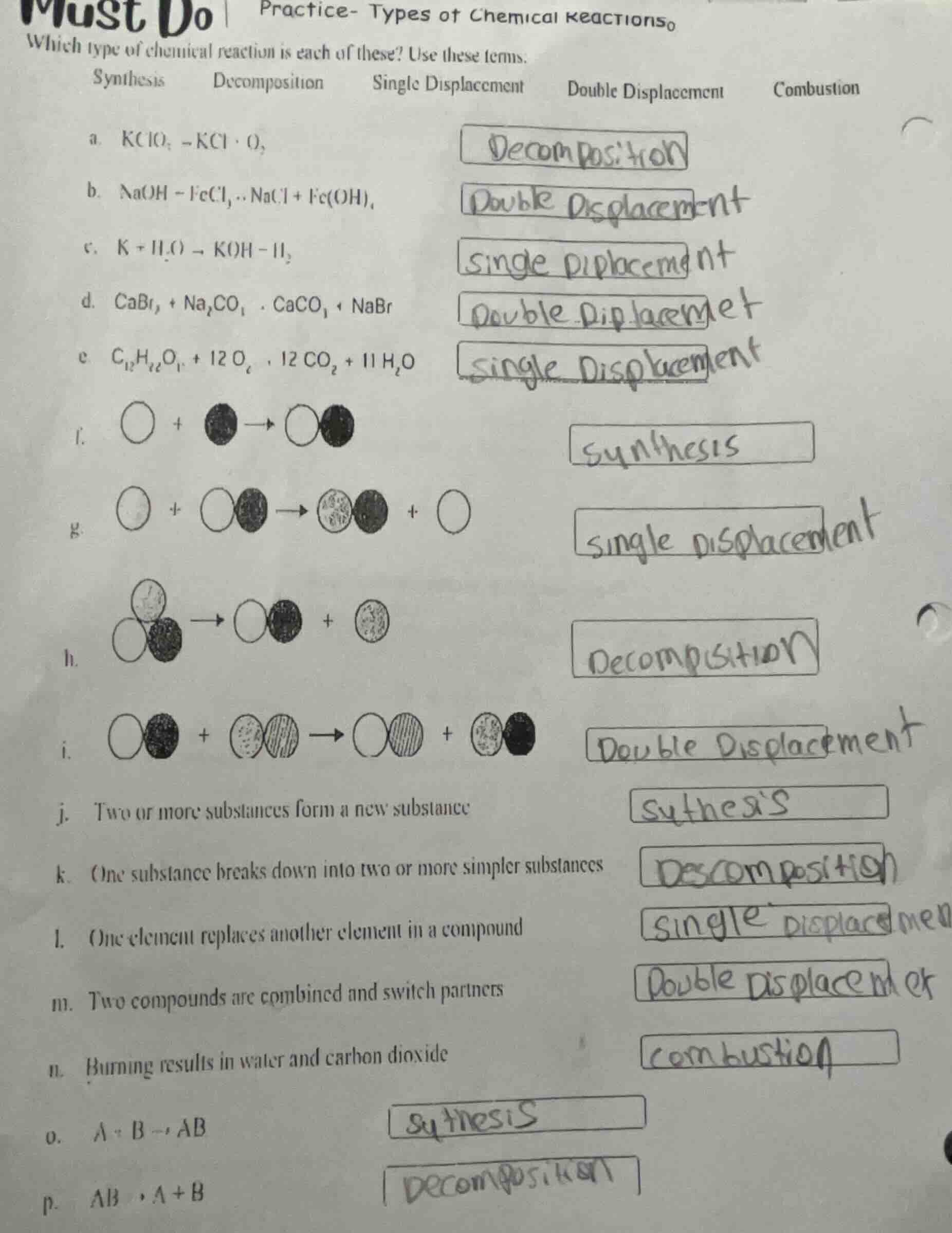
must do | practice- types of chemical reactions
which type of chemical reaction is each of these? use these terms.
synthesis decomposition single displacement double displacement combustion
a. $kclo_3 \
ightarrow kcl + o_2$
b. $naoh + fecl_3 \
ightarrow nacl + fe(oh)_3$
c. $k + h_2o \
ightarrow koh + h_2$
d. $cabr_2 + na_2co_3 \
ightarrow caco_3 + nabr$
e. $c_{12}h_{22}o_{11} + 12 o_2 \
ightarrow 12 co_2 + 11 h_2o$
f. image of two atoms combining
g. image of a single displacement reaction
h. image of a decomposition reaction
i. image of a double displacement reaction
j. two or more substances form a new substance
k. one substance breaks down into two or more simpler substances
l. one element replaces another element in a compound
m. two compounds are combined and switch partners
n. burning results in water and carbon dioxide
o. $a + b \
ightarrow ab$
p. $ab \
ightarrow a + b$
To solve this, we analyze each reaction based on the definitions of chemical reaction types:
Part (a)
- Reaction: $\ce{KClO3 -> KCl + O2}$
- Analysis: A single compound breaks down into simpler substances (KCl and O₂). This fits Decomposition (one substance → two or more simpler substances).
Part (b)
- Reaction: $\ce{NaOH + FeCl3 -> NaCl + Fe(OH)3}$ (balanced: $\ce{3NaOH + FeCl3 -> 3NaCl + Fe(OH)3}$)
- Analysis: Two compounds exchange ions (Na⁺/Fe³⁺ swap with OH⁻/Cl⁻). This fits Double Displacement (two compounds switch partners).
Part (c)
- Reaction: $\ce{K + H2O -> KOH + H2}$
- Analysis: An element (K) replaces another element (H) in a compound (H₂O). This fits Single Displacement (one element replaces another in a compound).
Part (d)
- Reaction: $\ce{CaBr2 + Na2CO3 -> CaCO3 + NaBr}$ (balanced: $\ce{CaBr2 + Na2CO3 -> CaCO3 + 2NaBr}$)
- Analysis: Two compounds exchange ions (Ca²⁺/Na⁺ swap with Br⁻/CO₃²⁻). This fits Double Displacement.
Part (e)
- Reaction: $\ce{C12H22O11 + 12O2 -> 12CO2 + 11H2O}$
- Analysis: A hydrocarbon (sugar) reacts with O₂, producing CO₂ and H₂O. This fits Combustion (burning with O₂ to form CO₂ + H₂O).
Part (f)
- Diagram: Two atoms (○ + ●) form a single molecule (○●).
- Analysis: Two substances combine into one. This fits Synthesis (two or more → one new substance).
Part (g)
- Diagram: An atom (○) replaces another atom (○) in a compound (○●), forming a new compound (○●) and releasing the original atom (○).
- Analysis: One element replaces another in a compound. This fits Single Displacement.
Part (h)
- Diagram: A single molecule (○●○) breaks into two molecules (○● + ○).
- Analysis: One substance breaks into simpler substances. This fits Decomposition.
Part (i)
- Diagram: Two compounds (○● + ○○) exchange ions (○ swaps with ○).
- Analysis: Two compounds switch partners. This fits Double Displacement.
Part (j)
- Definition: “Two or more substances form a new substance.”
- Analysis: Matches the definition of Synthesis (A + B → AB).
Part (k)
- Definition: “One substance breaks down into two or more simpler substances.”
- Analysis: Matches the definition of Decomposition (AB → A + B).
Part (l)
- Definition: “One element replaces another element in a compound.”
- Analysis: Matches the definition of Single Displacement (A + BC → AC + B).
Part (m)
- Definition: “Two compounds are combined and switch partners.”
- Analysis: Matches the definition of Double Displacement (AB + CD → AD + CB).
Part (n)
- Definition: “Burning results in water and carbon dioxide.”
- Analysis: Burning (combustion) of organic compounds produces CO₂ + H₂O. This fits Combustion.
Part (o)
- Formula: $\ce{A + B -> AB}$
- Analysis: Two substances combine into one. This fits Synthesis.
Part (p)
- Formula: $\ce{AB -> A + B}$
- Analysis: One substance breaks into simpler substances. This fits Decomposition.
Final Answers (Correcting e and d’s initial errors):
a. Decomposition
b. Double Displacement
c. Single Displacement
d. Double Displacement
e. Combustion
f. Synthesis
g. Single Displacement
h. Decomposition
i. Double Displacement
j. Synthesis
k. Decomposition
l. Single Displacement
m. Double Displacement
n. Combustion
o. Synthesis
p. Decomposition

Snap & solve any problem in the app
Get step-by-step solutions on Sovi AI
Photo-based solutions with guided steps
Explore more problems and detailed explanations
To solve this, we analyze each reaction based on the definitions of chemical reaction types:
Part (a)
- Reaction: $\ce{KClO3 -> KCl + O2}$
- Analysis: A single compound breaks down into simpler substances (KCl and O₂). This fits Decomposition (one substance → two or more simpler substances).
Part (b)
- Reaction: $\ce{NaOH + FeCl3 -> NaCl + Fe(OH)3}$ (balanced: $\ce{3NaOH + FeCl3 -> 3NaCl + Fe(OH)3}$)
- Analysis: Two compounds exchange ions (Na⁺/Fe³⁺ swap with OH⁻/Cl⁻). This fits Double Displacement (two compounds switch partners).
Part (c)
- Reaction: $\ce{K + H2O -> KOH + H2}$
- Analysis: An element (K) replaces another element (H) in a compound (H₂O). This fits Single Displacement (one element replaces another in a compound).
Part (d)
- Reaction: $\ce{CaBr2 + Na2CO3 -> CaCO3 + NaBr}$ (balanced: $\ce{CaBr2 + Na2CO3 -> CaCO3 + 2NaBr}$)
- Analysis: Two compounds exchange ions (Ca²⁺/Na⁺ swap with Br⁻/CO₃²⁻). This fits Double Displacement.
Part (e)
- Reaction: $\ce{C12H22O11 + 12O2 -> 12CO2 + 11H2O}$
- Analysis: A hydrocarbon (sugar) reacts with O₂, producing CO₂ and H₂O. This fits Combustion (burning with O₂ to form CO₂ + H₂O).
Part (f)
- Diagram: Two atoms (○ + ●) form a single molecule (○●).
- Analysis: Two substances combine into one. This fits Synthesis (two or more → one new substance).
Part (g)
- Diagram: An atom (○) replaces another atom (○) in a compound (○●), forming a new compound (○●) and releasing the original atom (○).
- Analysis: One element replaces another in a compound. This fits Single Displacement.
Part (h)
- Diagram: A single molecule (○●○) breaks into two molecules (○● + ○).
- Analysis: One substance breaks into simpler substances. This fits Decomposition.
Part (i)
- Diagram: Two compounds (○● + ○○) exchange ions (○ swaps with ○).
- Analysis: Two compounds switch partners. This fits Double Displacement.
Part (j)
- Definition: “Two or more substances form a new substance.”
- Analysis: Matches the definition of Synthesis (A + B → AB).
Part (k)
- Definition: “One substance breaks down into two or more simpler substances.”
- Analysis: Matches the definition of Decomposition (AB → A + B).
Part (l)
- Definition: “One element replaces another element in a compound.”
- Analysis: Matches the definition of Single Displacement (A + BC → AC + B).
Part (m)
- Definition: “Two compounds are combined and switch partners.”
- Analysis: Matches the definition of Double Displacement (AB + CD → AD + CB).
Part (n)
- Definition: “Burning results in water and carbon dioxide.”
- Analysis: Burning (combustion) of organic compounds produces CO₂ + H₂O. This fits Combustion.
Part (o)
- Formula: $\ce{A + B -> AB}$
- Analysis: Two substances combine into one. This fits Synthesis.
Part (p)
- Formula: $\ce{AB -> A + B}$
- Analysis: One substance breaks into simpler substances. This fits Decomposition.
Final Answers (Correcting e and d’s initial errors):
a. Decomposition
b. Double Displacement
c. Single Displacement
d. Double Displacement
e. Combustion
f. Synthesis
g. Single Displacement
h. Decomposition
i. Double Displacement
j. Synthesis
k. Decomposition
l. Single Displacement
m. Double Displacement
n. Combustion
o. Synthesis
p. Decomposition