QUESTION IMAGE
Question
practice
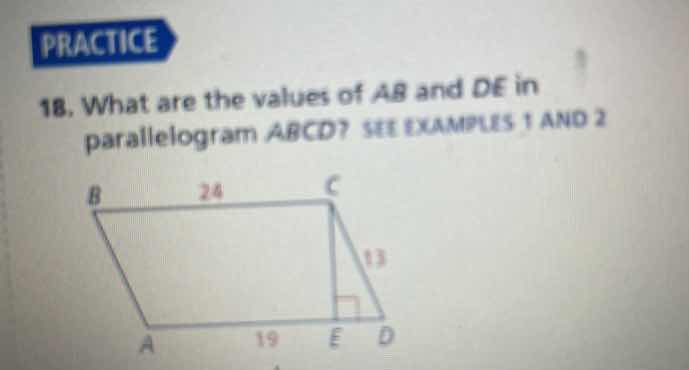
- what are the values of ab and de in parallelogram abcd? see examples 1 and 2
(image of parallelogram abcd with bc=24, cd=13, ae=19, and ce perpendicular to ad at e)
Step1: Recall properties of parallelogram
In a parallelogram, opposite sides are equal. So, \( AB = CD \) and \( AD = BC \). Also, from the right triangle \( CED \), we can use the Pythagorean theorem or properties of the parallelogram to find \( DE \). First, find \( AB \). Since \( BC = 24 \) and \( AD = BC \), but also \( AB \) is equal to \( CD \)? Wait, no, in parallelogram \( ABCD \), \( AB \parallel CD \) and \( AB = CD \), \( AD \parallel BC \) and \( AD = BC \). Wait, the length of \( BC \) is 24, so \( AD = BC = 24 \)? But \( AE = 19 \), so \( DE = AD - AE = 24 - 19 = 5 \)? Wait, no, wait the diagram: \( AE \) is 19, \( AD \) is... Wait, maybe I misread. Wait, in parallelogram \( ABCD \), \( AB \) is equal to \( CD \), and \( AD \) is equal to \( BC \). \( BC = 24 \), so \( AD = 24 \). \( AE = 19 \), so \( DE = AD - AE = 24 - 19 = 5 \). And \( AB \): since \( CD \) is the hypotenuse? Wait, no, \( CE \) is perpendicular to \( AD \), so triangle \( CED \) is right-angled. \( CD \) is equal to \( AB \). Wait, \( CD \) is given? Wait, no, the length of \( BC \) is 24, so \( AD = 24 \), \( AE = 19 \), so \( DE = 24 - 19 = 5 \). And \( AB \): since \( AB \) is equal to \( CD \), and \( CD \) can be found using Pythagoras? Wait, \( CE \) is... Wait, no, maybe \( AB = CD \), and \( CD \) is equal to \( AB \), but \( BC = 24 \), so \( AB = CD \), but wait, maybe \( AB \) is equal to \( BC \)? No, no, opposite sides. Wait, maybe I made a mistake. Wait, in parallelogram \( ABCD \), \( AB \) is parallel to \( CD \), \( AD \) parallel to \( BC \). So \( AB = CD \), \( AD = BC \). \( BC = 24 \), so \( AD = 24 \). \( AE = 19 \), so \( DE = AD - AE = 24 - 19 = 5 \). And \( AB \): since \( AB \) is equal to \( CD \), but \( CD \) is the side, but wait, the length of \( AB \): wait, maybe \( AB = CD \), and \( CD \) is equal to \( \sqrt{CE^2 + DE^2} \)? Wait, no, \( CE \) is not given. Wait, no, maybe \( AB \) is equal to \( BC \)? No, that's only if it's a rhombus. Wait, no, the problem is probably that in the parallelogram, \( AB = CD \), and \( CD \) is equal to \( AB \), and \( AD = BC = 24 \), so \( AB \): wait, maybe \( AB \) is equal to \( CD \), and \( CD \) is 13? No, 13 is the length of \( CD \)? Wait, no, the diagram has \( CD \) as 13? Wait, no, the number 13 is next to \( CD \)? Wait, the user's diagram: \( BC = 24 \), \( AE = 19 \), \( CD = 13 \)? Wait, no, maybe I misread. Wait, the problem: "What are the values of \( AB \) and \( DE \) in parallelogram \( ABCD \)". So, in parallelogram, opposite sides are equal. So \( AB = CD \), \( AD = BC \). \( BC = 24 \), so \( AD = 24 \). \( AE = 19 \), so \( DE = AD - AE = 24 - 19 = 5 \). And \( AB = CD \), and \( CD \) is 13? Wait, no, 13 is the length of \( CD \)? Wait, the diagram shows \( CD = 13 \)? Wait, maybe \( AB = 13 \)? Wait, no, that doesn't make sense. Wait, maybe I got the sides wrong. Let's re-express:
In parallelogram \( ABCD \):
- \( AB \parallel CD \), \( AB = CD \)
- \( AD \parallel BC \), \( AD = BC \)
From the diagram:
- \( BC = 24 \), so \( AD = BC = 24 \)
- \( AE = 19 \), so \( DE = AD - AE = 24 - 19 = 5 \)
- \( AB \): since \( AB = CD \), and \( CD \) is equal to \( AB \), and \( CD \) can be found? Wait, no, maybe \( AB \) is equal to \( CD \), and \( CD \) is 13? Wait, the length of \( CD \) is 13? Wait, the number 13 is next to \( CD \), so \( CD = 13 \), so \( AB = 13 \). Wait, that makes sense. So \( AB = 13 \) (since \( AB = CD \)) and \( DE = 5 \) (since \( AD = 24 \), \( AE = 19 \), so \( DE = 24 - 19 = 5 \)).
Step2: Verify
- \( AB \): In paral…

Snap & solve any problem in the app
Get step-by-step solutions on Sovi AI
Photo-based solutions with guided steps
Explore more problems and detailed explanations
\( AB = 13 \), \( DE = 5 \)