QUESTION IMAGE
Question
practice with the angle formed by a tangent and chord theorem
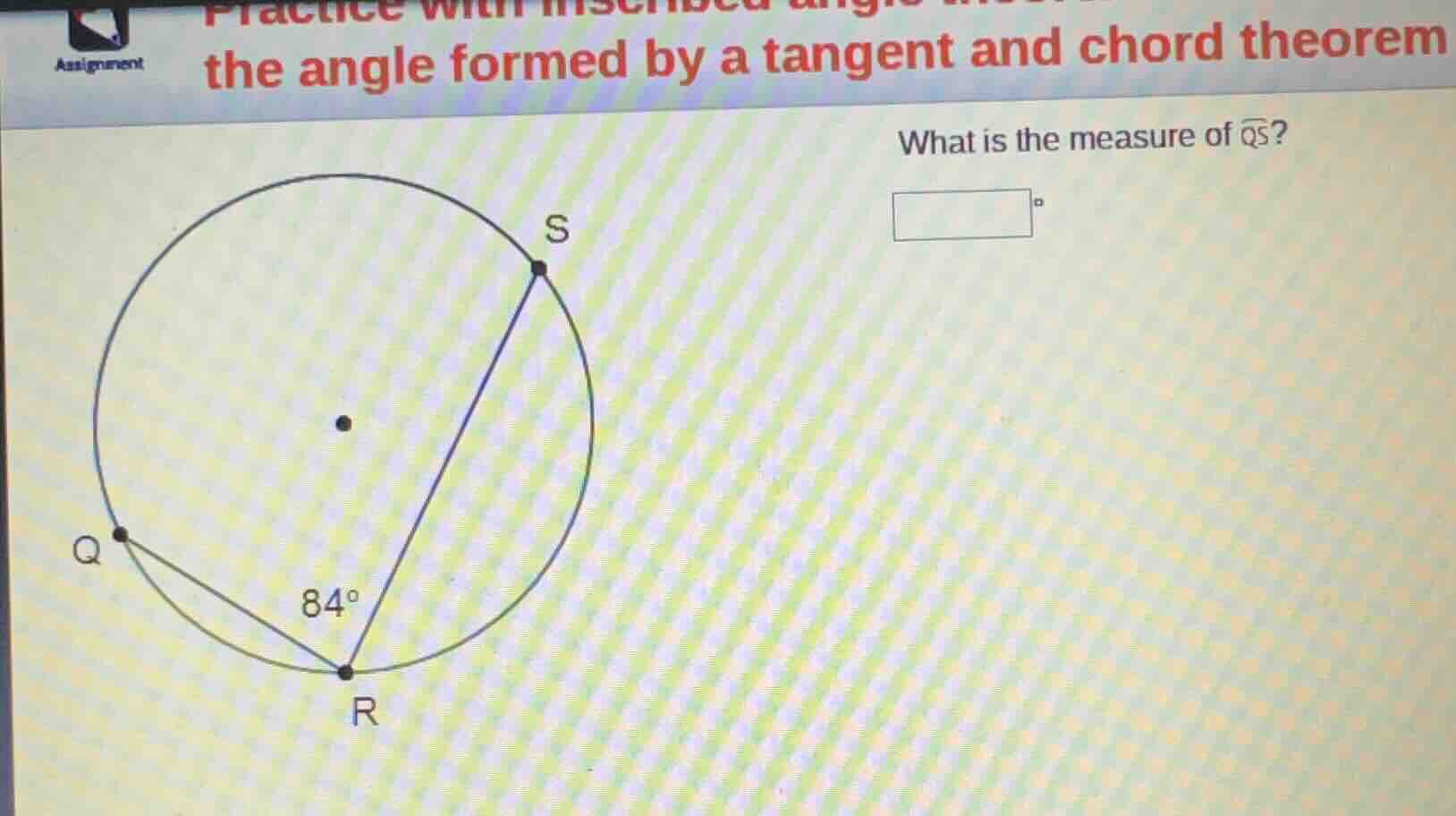
what is the measure of \\(\overarc{qs}\\)?
\\(\square^\circ\\)
(there is a circle with center (not labeled but a dot), points q, r, s on the circle. at point r, the angle \\(\angle qrs\\) is 84°.)
Step1: Recall the inscribed angle theorem
The measure of an inscribed angle is half the measure of its intercepted arc. But here, if we assume that \( \angle QRS \) is an inscribed angle? Wait, no, actually, if \( R \) is a point on the circle, and \( QR \) and \( SR \) are chords, but wait, maybe the angle at \( R \) is an inscribed angle? Wait, no, the problem is about the arc \( QS \). Wait, maybe the angle given is a central angle? Wait, no, the center is marked, but the angle at \( R \) is 84 degrees. Wait, maybe \( \angle QRS \) is an inscribed angle, but no, if \( R \) is on the circle, then the arc \( QS \) intercepted by angle \( \angle QRS \) would have measure twice the angle. Wait, no, the inscribed angle theorem states that the measure of an inscribed angle is half the measure of its intercepted arc. So if \( \angle QRS \) is an inscribed angle intercepting arc \( QS \), then the measure of arc \( QS \) is \( 2 \times \angle QRS \). Wait, but the angle given is 84 degrees. Wait, no, maybe I got it wrong. Wait, the angle at \( R \) is 84 degrees, and \( R \) is on the circle, so \( \angle QRS \) is an inscribed angle, so the arc \( QS \) that it intercepts should be twice that angle? Wait, no, the inscribed angle is half the arc. So if the angle is 84 degrees, then the arc \( QS \) is \( 2 \times 84 = 168 \)? Wait, no, that can't be, because a circle is 360 degrees, but maybe the angle is a central angle? Wait, the center is marked, but the angle at \( R \) is not at the center. Wait, maybe the problem is that \( \angle QRS \) is an inscribed angle, so arc \( QS \) is \( 2 \times 84 = 168 \)? Wait, no, that would be if it's an inscribed angle. Wait, let's recheck. The inscribed angle theorem: the measure of an inscribed angle is equal to half the measure of its intercepted arc. So if \( \angle QRS \) is an inscribed angle (with \( R \) on the circle), then arc \( QS \) (the arc opposite the angle, not containing \( R \)) would be \( 2 \times \angle QRS \). Wait, but the angle given is 84 degrees, so arc \( QS \) would be \( 2 \times 84 = 168 \)? Wait, no, that seems too big. Wait, maybe the angle is a central angle? But the center is a different point. Wait, maybe the diagram is such that \( R \) is on the circle, and \( \angle QRS \) is an inscribed angle, so the arc \( QS \) is twice the angle. Wait, let's confirm. The inscribed angle theorem: \( m\angle QRS = \frac{1}{2} m\overset{\frown}{QS} \). So solving for \( m\overset{\frown}{QS} \), we get \( m\overset{\frown}{QS} = 2 \times m\angle QRS \). Given \( m\angle QRS = 84^\circ \), then \( m\overset{\frown}{QS} = 2 \times 84 = 168^\circ \)? Wait, but that would mean the arc \( QS \) is 168 degrees. But maybe I made a mistake. Wait, no, the inscribed angle is half the arc. So if the angle is 84, the arc is 168. Alternatively, maybe the angle is a central angle, but the center is not at \( R \). Wait, the center is marked as a dot, not at \( R \), so \( R \) is on the circle, so \( \angle QRS \) is an inscribed angle. Therefore, arc \( QS \) is twice 84.
Step2: Calculate the measure of arc \( QS \)
Using the inscribed angle theorem: \( m\overset{\frown}{QS} = 2 \times m\angle QRS \)
Given \( m\angle QRS = 84^\circ \), so \( m\overset{\frown}{QS} = 2 \times 84^\circ = 168^\circ \)

Snap & solve any problem in the app
Get step-by-step solutions on Sovi AI
Photo-based solutions with guided steps
Explore more problems and detailed explanations
\( 168 \)